
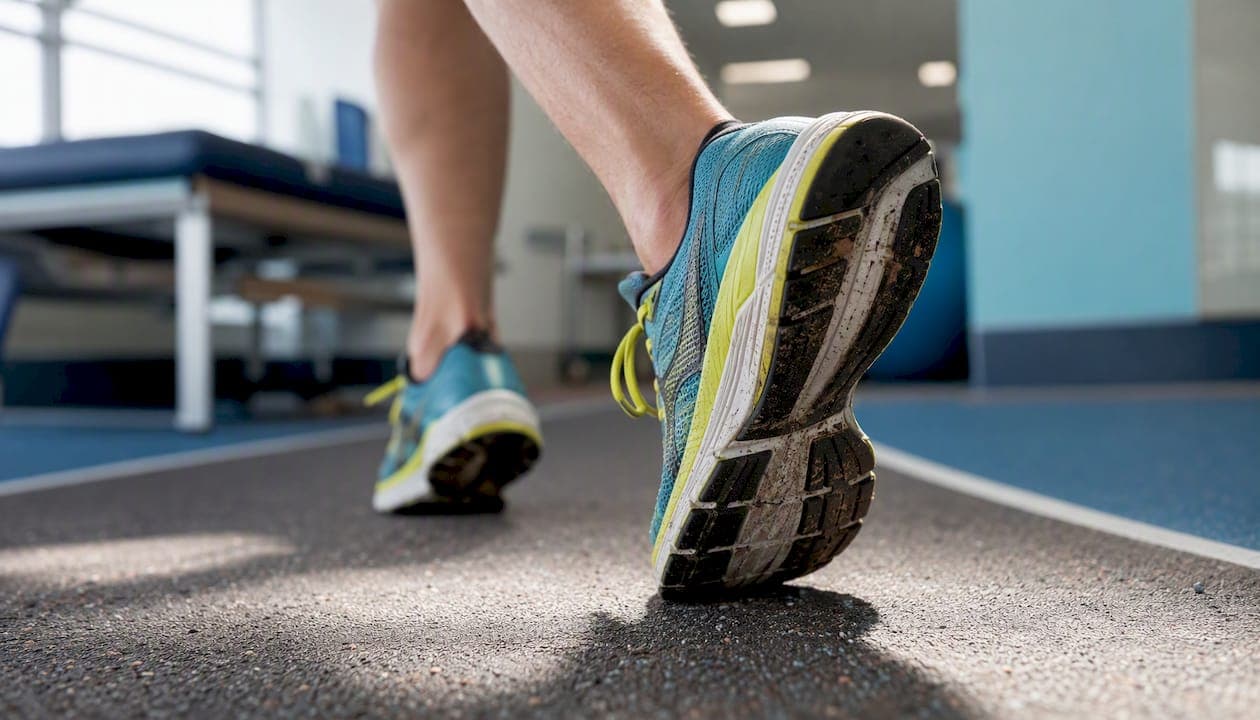
Here's the verdict, straight up: your shoes are neither the villain nor the hero of your injury story. They can nudge your mechanics around, sometimes helpfully, sometimes not, but no shoe reliably prevents injury and no shoe is single-handedly wrecking your knees either. The evidence on this is honestly more interesting (and more useful) than the marketing copy on any shoebox.
So while we unpack the research, here's what to actually do about it right now:
- Chase comfort and fit over marketing claims. If a shoe feels right straight out of the box, that's a genuinely good sign, not a coincidence.
- Never jump shoe types overnight. Minimalist to maximalist, high drop to zero drop, whatever the switch, your tissues need weeks to catch up.
- Get a proper gait assessment if pain sticks around. Persistent pain isn't a shoe problem to solve alone, it's a "go see someone" problem.
The research behind this verdict includes systematic reviews of footwear technology, randomised trials of gait retraining, and clinical practice guidance built on motor learning principles. We'll walk through all of it, minus the jargon overload.
Key Takeaways
Footwear can change your running mechanics, but comfort-driven selection, gradual transitions, and clinical gait retraining have far stronger injury-reduction evidence than any specific shoe feature.
| Point | Details |
|---|---|
| Comfort beats marketing | Choose shoes that feel right immediately rather than ones matched to your foot type or a marketed technology. |
| Gait retraining has the strongest evidence | A randomised trial found a 62% lower injury rate in novice runners after a structured retraining programme. |
| Transition shoes gradually | Spread a switch between meaningfully different shoe types across four to eight weeks, starting with short exposures. |
| Watch for load transfer | Lowering drop or adding minimalism can shift strain onto the calf and Achilles, so progress slowly. |
| Persistent pain needs assessment | Pain lasting beyond two to four weeks, or any red flag symptom, warrants a clinical gait and loading assessment. |
Table of Contents
- How footwear affects running injuries: the shoe anatomy that matters
- What does the research say about footwear and injury risk?
- How does footwear change your running mechanics?
- When is changing your running shoes actually the right call?
- How do you choose and safely switch running shoes?
- What clinical treatments actually reduce running injury risk?
- Are pronation control and minimalist shoes actually evidence-based?
- When should you see a clinician about running-related pain?
- Get a proper running assessment, not another guess
- What this all comes down to
- Frequently asked questions
- Sources
How footwear affects running injuries: the shoe anatomy that matters
Before we get into what the studies say (and don't say), you need to know what you're actually looking at when you pick up a shoe. Every running shoe is a stack of design decisions, and each one gets marketed as if it's the secret to injury-free running. Spoiler: none of them are magic, but they do change how your foot interacts with the ground.
Picture the shoe in three layers. The upper wraps your foot and handles fit. The midsole sits between your foot and the ground, doing most of the cushioning and stability work. The outsole is the rubber that actually touches the tarmac, trail, or treadmill belt.
Here's what each key feature does, and what it's supposed to do for your mechanics:
- Cushioning — foam thickness and density in the midsole, intended to lower the impact peak when your foot strikes the ground.
- Stack height — the total height of material between your foot and the ground; taller stacks generally mean more cushioning but less ground feel.
- Heel-toe drop — the height difference between heel and forefoot; a lower drop is thought to encourage a more forefoot or midfoot strike, a higher drop tends to suit rearfoot strikers.
- Midsole hardness — how firm or soft the foam feels underfoot; softer foams are marketed as shock absorbers, firmer ones as more "responsive."
- Stability or motion-control tech — posts, wider bases, or firmer medial foam designed to limit inward rolling of the foot (pronation).
- Outsole — the tread pattern and rubber compound, which affects grip and durability depending on surface.
- Flexibility — how easily the shoe bends at the forefoot, which is meant to influence how naturally your foot can flex through toe-off.
That's the theory. The mechanism each feature is supposed to trigger sounds plausible on paper. Softer foam should mean less shock. A lower drop should mean a more "natural" strike. Motion control should stop excess pronation. The trouble, as you'll see in the next section, is that plausible mechanisms and proven injury prevention are two very different things.
One persistent myth deserves a callout here: the idea that your foot type (flat, high-arched, neutral) should dictate your shoe category. It's been standard advice in run shops for decades. The evidence for it just isn't there.
Pro Tip: Ignore the "your foot type needs this shoe" pitch at the counter. Walk around the shop, jog on the in-store treadmill if there is one, and trust how the shoe feels after five minutes more than any diagram of your arch.
What does the research say about footwear and injury risk?
This is where things get genuinely surprising if you've spent years believing that the right shoe prevents injury and the wrong one causes it. It doesn't hold up nearly as cleanly as the industry would like.
A large systematic review synthesising data from over 11,000 participants found no reliable injury-prevention effect from the shoe features runners obsess over most: cushioning, midsole hardness, stability technology, or selecting shoes based on static foot posture. That last one is the big one. The entire "get fitted based on how your arch looks standing still" model that dominated run-shop culture for a generation has essentially no strong evidence behind it.
A separate review of footwear construction and biomechanics, covering 63 biomechanical studies, backs this up from a different angle. Yes, shoe construction changes biomechanics measurably: stiffer forefeet, softer midsoles, and taller stacks all shift loading patterns in controlled lab settings. But the jump from "changes mechanics" to "prevents injury" doesn't survive contact with longitudinal data. The link is inconsistent, and much of it depends on which outcome you're measuring and who's wearing the shoe.
Then there's the counterpoint that tends to surprise runners the most: gait retraining, not shoe choice, has some of the strongest injury-reduction evidence in the entire running literature.
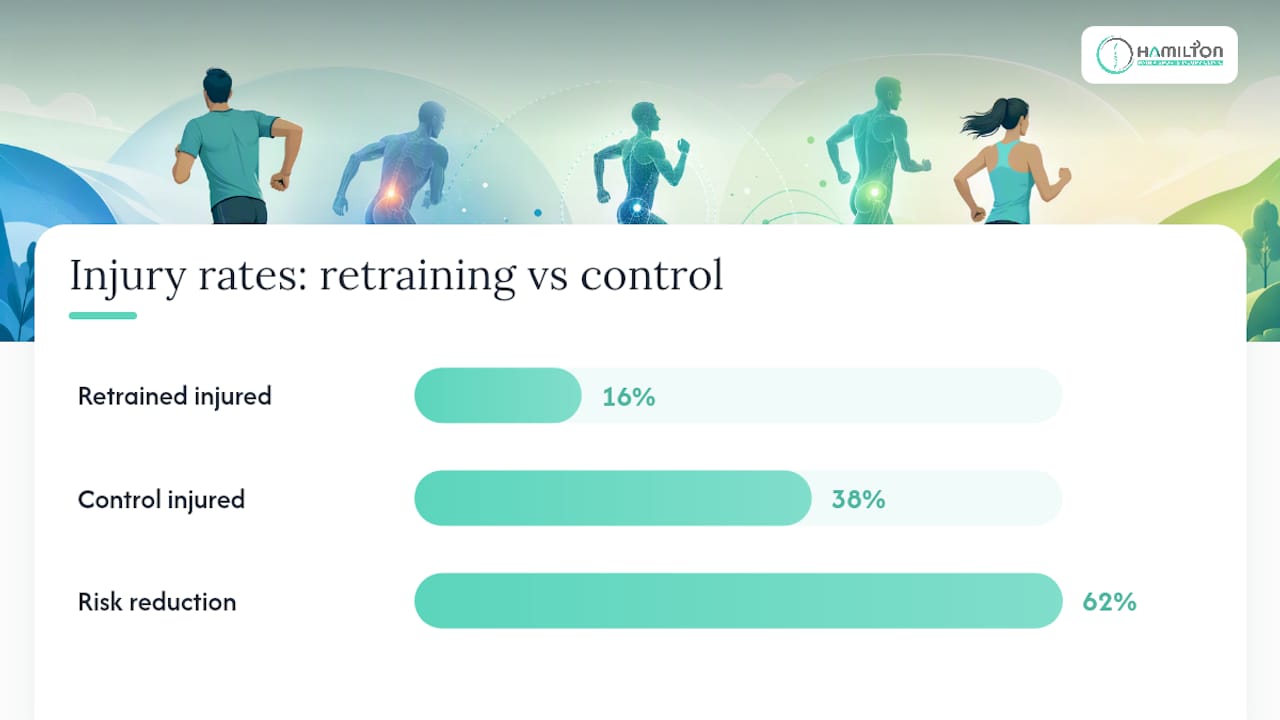
Statistic callout: A randomised trial in novice runners found that a laboratory-based gait retraining programme cut running-related injury occurrence by 62% over 12 months, 16% in the retrained group versus 38% in controls (hazard ratio 0.38, 95% CI 0.25 to 0.59). No shoe study comes close to that effect size.
That's a genuinely striking contrast. Runners will spend hours agonising over 2mm of stack height or whether a shoe has "enough" stability, while the intervention with the clearest evidence base, retraining how you actually move, gets a fraction of the attention.
It's worth being honest about the messier findings too, because pretending the evidence is tidier than it is would be its own kind of myth-making:
- Some observational coverage has reported associations between thick-heeled shoes and higher injury rates in real-world runner samples, which sounds alarming until you remember that observational data can't separate cause from coincidence the way an RCT can.
- Long-term injury rates haven't meaningfully dropped despite decades of shoe innovation, which is exactly what you'd expect if footwear design were a minor player rather than a primary driver, as the mythbusting paper on running injuries points out.
- Comfort, oddly, may matter more than any specific technology. The same paper proposes a "comfort filter" idea: shoes that feel comfortable may let you keep your own preferred movement pattern, and that alone might explain why comfort correlates with fewer injuries better than any marketed feature does.
None of this research is perfect, and it's worth knowing where the cracks are. Injury definitions vary wildly between studies (some count any niggle, others only injuries that stop training entirely). Follow-up periods are often short, sometimes just one training block, when overuse injuries can take months to show up. Sample sizes in footwear-specific trials tend to be small. Blinding a runner to which shoe they're wearing is basically impossible, which opens the door to expectation bias. And lab-based gait analysis, however precise, doesn't always reflect how someone actually runs on a hilly trail in the rain. Keep all of that in mind before treating any single study as gospel, including the ones cited here.
How does footwear change your running mechanics?
This is the part that actually explains why shoes feel like they matter even when the injury data is murky. They absolutely do change how you move. What's less certain is whether that change is good, bad, or simply different for you.
Think of it as a chain: shoe feature → mechanical change → tissue load → potential injury. Each link is plausible. The chain as a whole doesn't always hold.
Here's how the major mechanical variables map to the injuries clinicians actually see:
- Cadence (steps per minute) — lower cadence tends to mean longer strides and higher impact per step; shoes with more cushioning can subtly encourage overstriding without you noticing.
- Foot strike pattern — low-drop or minimalist shoes tend to push runners toward a forefoot or midfoot strike, which shifts load away from the knee and onto the calf and Achilles.
- Vertical loading rate — how quickly force builds up at impact; higher rates have been associated in some studies with patellofemoral pain and tibial stress, though the picture isn't universal.
- Tibial acceleration — a proxy for shock transmitted up the leg; softer midsoles can reduce this in lab tests, though the construction review notes thicker midsoles also reduce plantar sensation, which may change how you land in ways that offset the cushioning benefit.
- Peak hip adduction — how far your hip drops or your knee caves inward mid-stance; linked in some research to iliotibial band and patellofemoral issues, and influenced more by strength and control than by shoe choice.
Here's a scenario that plays out constantly in clinic, and it's a genuinely useful illustration of the whole chain in action. A runner switches from a standard 10mm-drop trainer to a 0 to 4mm "natural" shoe because a friend swears by it. Within two weeks, they've got calf soreness that wasn't there before. That's not random. Reducing drop shifts more load onto the calf and Achilles as the foot lands flatter and pushes off differently. Mild soreness is the tissue adapting. Push straight into high mileage on the new shoe, though, and that soreness can tip into Achilles tendinopathy, because tendon adapts more slowly than muscle does.
The fix isn't "avoid low-drop shoes forever." It's respecting the adaptation window, something correct movement pattern retraining research backs up repeatedly: gradual exposure lets tissue capacity catch up with the new demand, rather than asking tendons to cope with an overnight change in loading strategy.
When is changing your running shoes actually the right call?
Given everything above, you might reasonably ask whether footwear changes are ever worth bothering with. They are, just not as a blanket fix. A few specific situations make a shoe swap a sensible move rather than a shot in the dark.
Clear terrain mismatch. Road shoes on technical trail, or trail shoes with aggressive lugs on tarmac for months on end, create genuine mechanical friction between what the shoe is built for and what you're actually doing.
Visible wear or poor fit. Compressed midsole foam, worn-through outsole patches, or a toe box that's squeezing your feet into hot spots and blisters, these are physical signals, not vibes.
Comfort that's actually declined. If a shoe you used to love now feels wrong underfoot after several hundred kilometres, that's your body telling you something the mileage counter can't.
A guided retraining plan. If you're working through a structured gait retraining programme, a footwear change might be a deliberate part of that plan, introduced alongside coaching, not instead of it.
A few concrete examples worth flagging:
- Repeated forefoot pain after trying a minimalist shoe, a sign the transition happened too fast for the tissue involved.
- Sole separation, or a rounded-off outsole that no longer grips wet surfaces.
- A toe box that pinches, causing blisters or black toenails on longer runs.
- Persistent numbness or hot spots that show up at the same mileage point every run.
Pro Tip: Never change your shoes in isolation. Pair any footwear switch with sensible load management, dropping volume slightly for the first two weeks, and if pain is involved, loop in strength work or gait coaching rather than hoping the new shoe does all the work alone.
How do you choose and safely switch running shoes?
Here's the process we'd actually recommend, built around the evidence rather than the sales pitch.
- Assess your own situation first. What terrain do you run on most? What's your weekly volume? Do you have any current symptoms? This matters more than any spec sheet.
- Prioritise comfort and fit over features. Try shoes on, jog in them if you can, and trust how they feel in the first few minutes. The comfort filter research suggests this beats picking by "foot type" or marketed technology.
- Trial new shoes with short exposures first. A few kilometres, not a long run, is the right opening move for any new pair, especially if the drop or stack height differs meaningfully from what you're used to.
- Follow a progressive transition schedule. For a genuinely different shoe type (say, high drop to low drop, or traditional to maximalist), spread the changeover across four to eight weeks: start with one short run a week in the new shoe, add a second run in week two or three, and only make it your primary trainer once it's felt comfortable for several sessions in a row.
- Monitor pain and function throughout. Mild muscle soreness in a new area is normal adaptation. Sharp, localised, or worsening pain is your cue to slow down or stop the transition.
When you're actually stood in a shop or scrolling a shoe retailer's site, run through this checklist:
- Does it feel comfortable within the first minute of wearing it, not just standing in it?
- Does the fit match your foot shape, particularly width and toe box room?
- Is the stack height and drop appropriate for what you're transitioning from, not a huge jump?
- Is it actually suited to your primary running surface?
- Do you know the signs it needs replacing (compressed midsole, worn outsole, roughly 500 to 800km depending on your weight and stride)?
- Are you rotating two pairs, which some runners find reduces repetitive strain by varying loading slightly between sessions?
That last point about rotation is underused advice. Alternating between two pairs, even two similar ones, changes the loading pattern just enough from run to run that some clinicians believe it reduces cumulative strain on any single tissue. The evidence here is more theoretical than proven by trial data, but it costs you nothing and plenty of experienced runners swear by it.
If you're increasing cadence alongside a shoe change, which often happens naturally with lower-drop shoes, it's worth understanding how cadence affects injury risk on its own terms, since the two variables interact.
What clinical treatments actually reduce running injury risk?
If footwear isn't the star player the marketing suggests, what is? The evidence points fairly clearly at structured clinical interventions, gait retraining chief among them, alongside sensible load management and targeted strength work.
Gait retraining isn't just "run differently and hope." Effective protocols follow a fairly consistent structure: a clinical review of gait retraining describes programmes of 8 to 10 sessions over 4 to 8 weeks, using feedback (visual, verbal, or metronome-based) that gets progressively faded out as the new pattern becomes automatic. That faded-feedback piece matters enormously. Gait retraining is fundamentally a motor learning process, and if you don't wean off the external cues, you tend to revert to your old pattern the moment nobody's watching.
A typical clinic-based programme runs something like this:
- Initial assessment, measuring cadence, strike pattern, and loading through video or wearable sensors.
- Targeted cueing, often a metronome to nudge cadence up, or visual feedback to shift strike pattern.
- Progressive feedback fading across the 8 to 10 sessions, so the change becomes yours rather than something you need a screen to maintain.
- Concurrent strength and load progression, because a new movement pattern still needs the tissue capacity to support it.
Newer approaches using real-time wearable feedback show genuine promise, with a systematic review of feedback-based gait retraining reporting reduced pain and improved mechanics in several trials. The certainty of that evidence is still rated low, though, and protocols vary a lot between studies, so treat this as an encouraging early signal rather than a settled answer.
Here's the honest clinical boundary worth drawing: footwear is usually an adjunct, a supporting tool you adjust alongside the main intervention. When structural loading issues or movement pattern faults are actually driving your injury, targeted rehabilitation, not a new pair of trainers, is the primary lever. The same principle applies to staged rehab generally, and it's echoed in how staged treatment maximises recovery outcomes for joint issues more broadly, where combining interventions in sequence beats relying on any single fix.
Pro Tip: If you've changed shoes three times this year chasing an injury that won't quit, that's the signal to stop shopping and start a proper gait assessment instead. The shoe was never going to fix a movement pattern problem.
Are pronation control and minimalist shoes actually evidence-based?
A few claims get repeated so often in running circles that they've become accepted wisdom. Most of them don't survive scrutiny.
- Myth: pronation control prevents injury. The systematic review on footwear mythbusting found no reliable injury-prevention effect from stability shoes selected by foot posture. Pronation isn't the villain it was made out to be.
- Myth: more cushioning always protects you. Cushioning changes impact metrics in the lab, but that hasn't translated into consistently lower injury rates in real-world data.
- Myth: minimalist is universally superior. Minimalist shoes can improve running economy for some runners, but they also increase forefoot loading, which is exactly why abrupt switches cause calf and Achilles trouble.
- Nuanced truth: comfort beats marketing. Across the research, how a shoe feels to you predicts good outcomes better than any advertised technology does.
Pro Tip: When a shoe's marketing leans hard on one buzzword, "stability," "energy return," "natural motion," treat it as a hypothesis, not a fact. Test the shoe on your own feet before you believe the label.
When should you see a clinician about running-related pain?
Most niggles don't need a clinic visit on day one. But there's a clear point where self-management should hand off to professional assessment, and knowing that line matters as much as any shoe decision you'll make.
Start simple: check your shoes for obvious wear, ease off volume slightly, and give it a week or two. If a footwear change seems relevant based on the scenarios covered earlier, trial it gradually rather than switching your whole rotation overnight. If pain persists beyond two to four weeks despite these adjustments, or if any of the following show up, it's time to book an assessment rather than keep guessing:
- Pain that's getting worse at night or waking you up.
- Visible swelling around a joint or along a tendon.
- One specific spot that's sharply tender to touch.
- Difficulty walking normally, not just running.
- Pain that starts earlier in each run than it did the week before.
A proper clinical assessment goes well beyond "try these shoes instead." Expect a clinician to take a detailed injury and training history, look at your loading patterns and recent volume changes, assess your gait (sometimes on video), test for strength deficits in the hip, calf, or foot, and only refer for imaging if the clinical picture actually warrants it. That's a different process entirely to swapping trainers and hoping. If you've been stuck in a cycle of the same injury returning, it's worth reading why injuries keep coming back, because the pattern usually points to something a shoe alone can't fix.
Get a proper running assessment, not another guess
If you've read this far, you already know the honest answer isn't hiding in a shoebox. It's in understanding your own mechanics, loading, and history well enough to know what actually needs to change. That's exactly what a structured assessment does that a shop fitting can't.
Sportsinjurydublin's sports rehabilitation service is built around that individual approach: proper assessment of your gait, loading, and injury history rather than a generic protocol applied to everyone who walks through the door. If you're managing a nagging issue and wondering whether it's your shoes, your training, or something else entirely, that's precisely the question a tailored plan answers.
For runners easing back after injury, the return to sport rehabilitation programme builds a staged progression so you're not guessing at volume or pace as you rebuild. And because strength underpins nearly everything covered here, from tissue capacity to gait retraining outcomes, strength training for runners rounds out a plan that treats footwear as one part of the picture rather than the whole solution.
What this all comes down to
The judgement the research actually supports is a bit less exciting than most running shops would like: shoes are a variable, not a verdict. The best available evidence puts gait retraining, load management, and comfort-first selection well ahead of chasing cushioning specs or stability ratings, and that gap between what's marketed and what's proven is wider than most runners realise.
Where conventional advice really falls down is treating footwear as a diagnosis. "Get fitted for your foot type" sounds authoritative and has sold millions of shoes, but it's not backed by strong evidence, and it distracts from interventions that actually move the needle. If I had to prioritise one thing for a runner dealing with recurring pain, it wouldn't be a shoe search. It would be a proper gait assessment paired with a strength plan.
That's not a popular message for an industry built on selling the next model as the fix. It's just the one the data supports.
Frequently asked questions
Does changing running shoes actually prevent injuries? Not reliably on its own. Systematic reviews show conventional shoe features like cushioning and stability don't produce a consistent injury-prevention effect, though comfort-driven choices and gradual transitions can support lower risk.
What running shoe features matter most for injury prevention? None of the marketed features (cushioning, drop, midsole hardness) show strong standalone evidence. Comfort and fit correlate more consistently with better outcomes than any specific technology.
How long does it take to adapt to new running shoes? Plan on four to eight weeks for a meaningfully different shoe type, starting with short runs and building up gradually while monitoring for unusual soreness.
Can minimalist shoes cause injuries? They can increase forefoot and Achilles loading if introduced too quickly. Gradual transition and strength work reduce that risk considerably.
When should I see a clinician about running pain instead of changing shoes? If pain persists beyond two to four weeks, worsens at night, involves swelling, or affects your ability to walk normally, book a clinical assessment rather than continuing to experiment with footwear.
This article is general information, not a substitute for advice from a qualified doctor. Consult a qualified healthcare professional about your own circumstances before acting on anything here.
Sources
- Running shoes and running injuries: mythbusting and a proposal for two new paradigms
- Gait retraining lowers injury risk in novice distance runners: a randomized trial
- Gait retraining with realtime feedback may reduce pain and improve function in runners: a systematic review