

Poor posture is defined as a sustained misalignment of the body that increases mechanical stress on joints, discs, and muscles, directly worsening chronic pain. The role of posture in chronic pain goes well beyond "sit up straight." Research shows that forward head posture affects 91.4% of people studied in clinical settings, and it correlates strongly with increased neck pain and reduced daily function. That is not a small number. Understanding how your body alignment drives or dampens pain signals is the first step toward doing something genuinely useful about it.
What postural deviations are most linked to chronic pain?
Two postural patterns show up again and again in the research: forward head posture (FHP) and posterior pelvic tilt. Both create measurable, compounding mechanical strain.

Forward head posture occurs when your head drifts forward of your shoulders. For every 2.5 centimetres your head moves forward, the effective load on your cervical spine roughly doubles. The correlation between FHP and pain sits at r=−0.514, meaning the more pronounced the deviation, the worse the pain and the lower the daily function. That is a clinically meaningful relationship, not a coincidence.
Posterior pelvic tilt is what happens when you slump into a sofa or low chair for an extended period. Your pelvis tips backward, your lumbar curve flattens, and the pressure on your intervertebral discs increases significantly. The correlation with low back pain is even stronger at r=−0.694. That number tells you that prolonged sitting in a slumped position is one of the most reliable ways to make chronic low back pain worse.
Here is a quick comparison of the most common postural deviations and what they tend to do:
| Postural deviation | Primary pain area | Main mechanical effect |
|---|---|---|
| Forward head posture | Neck, upper back, headaches | Increased cervical spine load, muscle overactivation |
| Posterior pelvic tilt | Lower back, sacrum | Flattened lumbar curve, raised disc pressure |
| Kyphotic posture | Mid-back, shoulders | Rib cage compression, restricted breathing |
| Anterior pelvic tilt | Lower back, hip flexors | Lumbar hyperextension, hip impingement risk |
The key takeaway here is that these deviations do not just cause local discomfort. They alter how load travels through your entire spine, and over time, that altered load pattern becomes the engine driving your chronic back pain.
How do exercise and active posture management improve pain outcomes?
Good news: targeted exercise genuinely works. A randomised controlled trial found that both chin tuck and scapular retraction exercises reduced pain intensity over eight weeks. Scapular retraction yielded greater pain reduction (2.08 versus 1.84 points on the Numeric Pain Rating Scale) compared to chin tuck alone. Both are simple movements you can do at a desk, which makes them practical, not just theoretical.
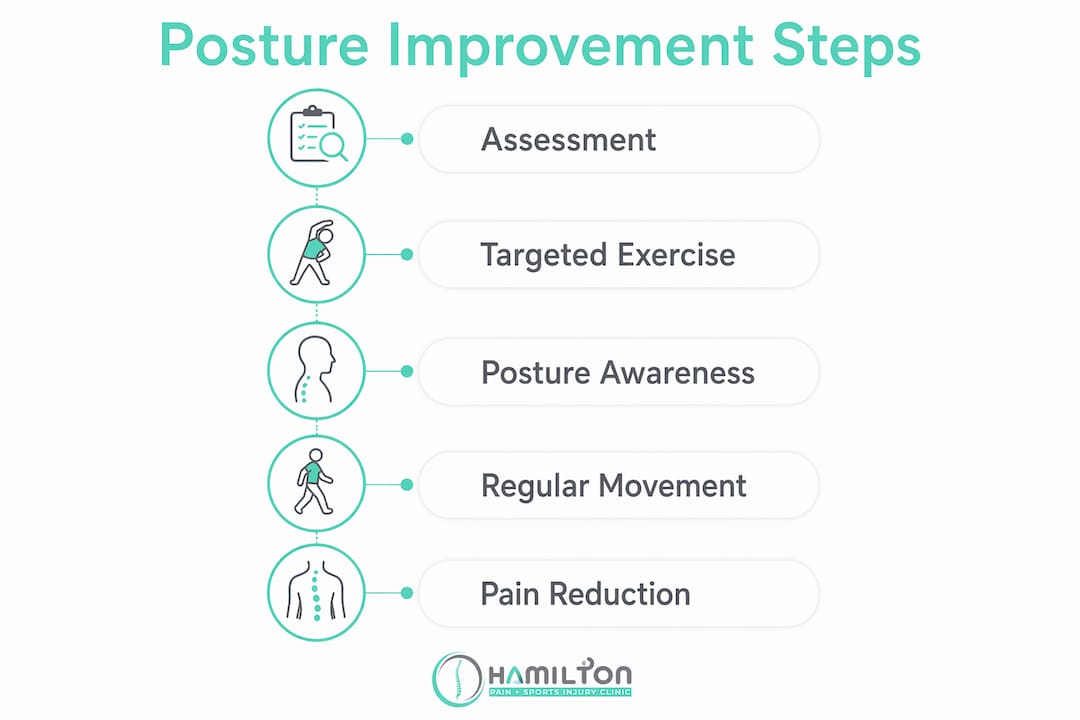
The Klapp method is another approach worth knowing about. It involves a series of spinal mobility exercises performed on all fours, originally developed for scoliosis but now used more broadly for kyphotic posture. Klapp exercises twice weekly for one month, in 50-minute sessions, reduced kyphosis and associated neck and back pain scores meaningfully. The frequency matters here. Twice a week is the minimum threshold that produced results in the research.
Beyond pain scores, exercise-based posture management improves self-efficacy. That means people feel more capable of managing their own condition, which is genuinely important for long-term recovery. A 2026 clinical trial (NCT03581123) found that biopsychosocial self-management produced lower pain impact scores at 10–12 months compared to standard care. Standard care, in this context, often means passive treatment and medication. Active management wins over the long term.
Key exercises to consider for posture-related pain:
- Chin tuck: Gently retract your chin to restore cervical alignment. Hold for five seconds, repeat ten times.
- Scapular retraction: Squeeze your shoulder blades together and hold for five seconds. Targets the mid-back muscles that support upright posture.
- Klapp crawling: On all fours, alternately arch and flex your spine in a controlled rhythm. Addresses thoracic mobility.
- Hip flexor stretches: Counteract anterior pelvic tilt caused by prolonged sitting.
Pro Tip: Aim for at least two dedicated posture exercise sessions per week, each lasting around 50 minutes. Shorter, more frequent sessions beat one long weekly session every time when it comes to building neuromuscular habit.
What does science say about the posture-pain relationship?
Here is where things get genuinely interesting, and a bit counterintuitive. Chronic pain is not always a straightforward signal from damaged tissue. The Generative Posture Framework proposes that chronic pain often reflects distorted predictive processing in the brain. In plain English: your nervous system builds an internal model of your body, and when that model becomes miscalibrated through years of poor posture and pain, it starts generating pain signals that no longer accurately reflect tissue damage.
"Postural variability, not static 'perfect posture,' is the hallmark of a healthy musculoskeletal system. Graded sensorimotor retraining reprogrammes dysfunctional pain perceptions more effectively than any fixed alignment target." — Generative Posture Framework, 2026
This is a significant shift from the old "stand up straight" model. The goal is not to freeze yourself in one correct position. The goal is to move well, move often, and gradually retrain your nervous system to interpret body signals accurately. That process is called graded sensorimotor retraining, and it is increasingly central to modern pain rehabilitation.
There is also a caution worth flagging. Pain medications mask symptoms but do not address the mechanical strain or nervous system factors driving postural pain. Relying on anti-inflammatories or painkillers as a long-term strategy, without also addressing alignment and movement, risks allowing the underlying problem to worsen quietly. The medication takes the edge off; it does not fix the cause.
Pro Tip: If you find yourself reaching for painkillers before a long sit at your desk, treat that as a signal to address your sitting posture and movement habits, not just the pain itself.
What practical posture habits can reduce chronic pain day-to-day?
Practical change does not require a complete life overhaul. It requires consistency with a few well-chosen habits.
The single most impactful habit is changing your posture regularly. Changing posture every 20 minutes and taking a five-minute movement break every hour prevents disc dehydration and muscle ischaemia more effectively than ergonomic devices alone. A standing desk without movement breaks is still a problem. Movement is the point, not the furniture.
When you do sit, minimising posterior pelvic tilt is the priority. Using a backrest to support lumbar alignment reduces mechanical stress on the lumbar spine during prolonged sitting. A rolled towel or lumbar support cushion placed at the small of your back achieves the same effect on most chairs.
Here is a practical summary of habits and their expected benefits:
| Habit | Expected benefit |
|---|---|
| Change posture every 20 minutes | Prevents disc dehydration and muscle fatigue |
| Use lumbar support when sitting | Reduces posterior pelvic tilt and lumbar disc pressure |
| Take a 5-minute walk every hour | Restores circulation and resets muscle tension |
| Practise chin tuck and scapular retraction daily | Corrects forward head posture over 6–8 weeks |
| Stretch hip flexors morning and evening | Counteracts anterior pelvic tilt from prolonged sitting |
For people dealing with neck and shoulder pain, forward head posture correction is the most direct lever. For those with persistent lower back issues, addressing posterior pelvic tilt through lumbar support and regular movement breaks tends to produce the fastest relief.
Pro Tip: Set a phone alarm every 20 minutes during your working day. When it goes off, stand up, roll your shoulders back, and do five chin tucks. It takes 30 seconds and makes a real difference over weeks.
Key takeaways
Poor posture drives chronic pain through measurable mechanical and neurological pathways, and targeted exercise combined with regular movement is the most evidence-backed route to lasting relief.
| Point | Details |
|---|---|
| Posture directly affects pain intensity | Forward head posture and posterior pelvic tilt both show strong correlations with increased chronic pain scores. |
| Exercise reduces pain meaningfully | Scapular retraction and chin tuck exercises reduced pain by up to 2.08 NPRS points over eight weeks in clinical trials. |
| Movement frequency beats static posture | Changing position every 20 minutes prevents disc dehydration more effectively than any single "correct" posture. |
| Active management outperforms passive care | Biopsychosocial self-management produced better long-term pain outcomes than standard care at 10–12 months. |
| Medication alone is not enough | Pain relief medication masks symptoms without addressing the mechanical or neurological causes of postural pain. |
What I have learned from watching people chase "perfect posture"
I have seen a lot of people come through the door convinced that if they could just find the perfect sitting position, their pain would disappear. Good on them for trying. But the research, and frankly the clinical reality, tells a different story.
The obsession with static "correct" posture is a bit of a red herring. What actually helps people is movement variability, building the habit of shifting position regularly, and doing targeted exercises that retrain the muscles and nervous system together. Chronic pain rehabilitation should prioritise restoring functional movement and social participation, not just eradicating pain scores on a chart.
The other thing I would flag is the medication trap. I have seen people use pain relief as a permission slip to keep sitting badly for another few hours. That approach accelerates the underlying damage quietly, while the person feels fine in the short term. It is a genuinely risky pattern, and one that is easy to fall into without realising it.
My honest advice: treat your posture habits the same way you treat brushing your teeth. Not a big dramatic intervention, just a consistent daily practice. The people who make the most progress are the ones who move a little more, sit a little better, and do their exercises twice a week without making a big fuss about it. Unglamorous, but it works.
— Mark
How Sportsinjurydublin can help with posture-related pain
Chronic pain linked to poor alignment responds well to personalised, clinician-led rehabilitation. At Sportsinjurydublin, the approach goes beyond generic advice.

The team at Sportsinjurydublin carries out detailed posture assessments and builds tailored exercise programmes targeting the specific deviations driving your pain, whether that is forward head posture, posterior pelvic tilt, or thoracic kyphosis. The biopsychosocial approach means your lifestyle, movement habits, and pain history all factor into the plan, not just your X-ray. If you are ready to address the root cause rather than manage symptoms, a sports rehabilitation consultation is the right starting point. You can also book an appointment directly online.
FAQ
Does posture actually cause chronic pain?
Poor posture causes chronic pain by increasing mechanical stress on spinal discs, joints, and muscles over time. Research confirms that forward head posture and posterior pelvic tilt both correlate strongly with higher pain intensity scores.
How long does it take for posture correction to reduce pain?
Clinical trials show meaningful pain reduction within six to eight weeks of consistent targeted exercise. Scapular retraction and chin tuck exercises produced significant improvements within that timeframe in randomised controlled studies.
Is sitting always bad for chronic back pain?
Prolonged sitting in a slumped position worsens chronic low back pain by inducing posterior pelvic tilt. Using lumbar support and changing position every 20 minutes significantly reduces this risk.
Can I manage postural pain without medication?
Active posture management through targeted exercise and regular movement outperforms medication-only approaches over the long term. A 2026 clinical trial found biopsychosocial self-management produced lower pain impact scores at 10–12 months than standard care.
What is the single most effective posture habit for pain relief?
Changing your posture at least every 20 minutes and taking a five-minute movement break every hour prevents disc dehydration and muscle ischaemia more effectively than any ergonomic device or static posture correction alone.