
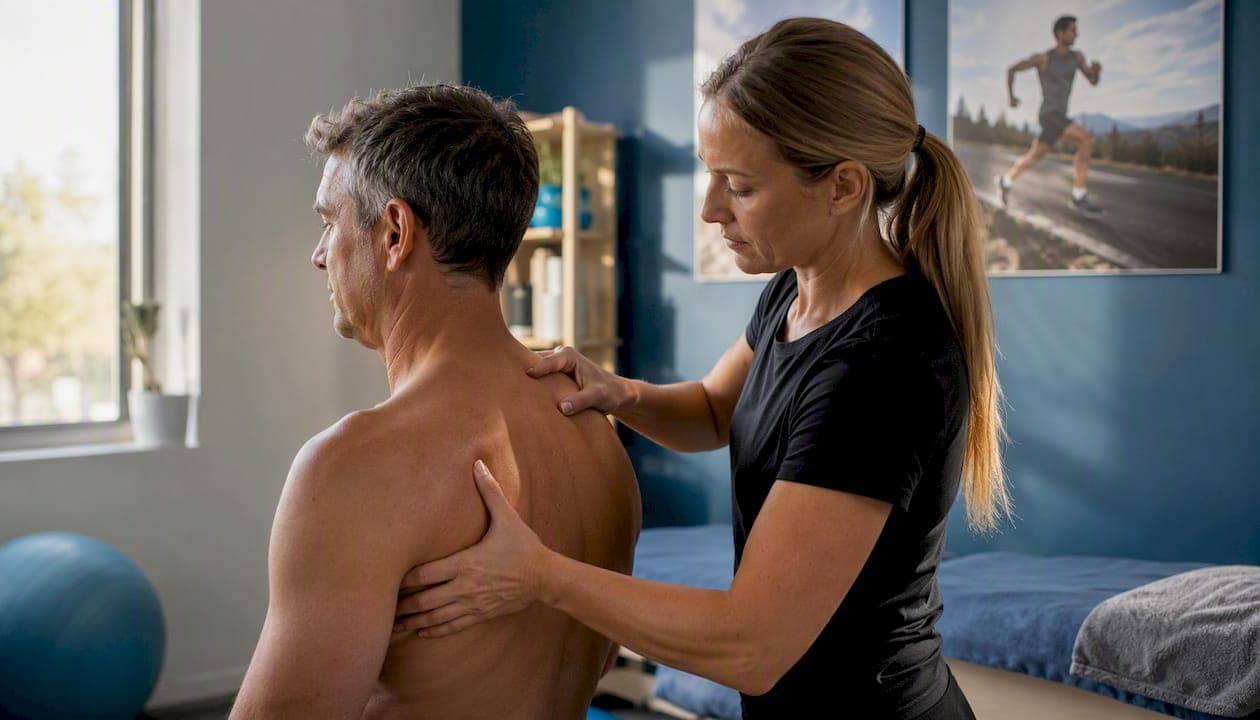
The trapezius region is the broad, kite-shaped muscle spanning from the base of your skull and your spine down to your collarbone and shoulder blade, and it's the muscle doing most of the work every time you shrug, row, or just try to hold your head up at a desk for a prolonged period. It controls how your shoulder blade sits and moves, which means it has a direct hand in your posture and a huge chunk of the neck and shoulder pain people walk into a clinic complaining about. Most trapezius pain is mechanical and manageable. But if you've got sudden severe pain, numbness or tingling running down an arm, or anything alongside chest symptoms, that's not a "stretch it out" situation. That needs a clinician, and it needs one now.
Key Takeaways
Trapezius region pain is usually mechanical and driven by posture or overload, and it responds well to a staged approach of mobility, targeted strengthening and gradual return to activity.
| Point | Details |
|---|---|
| Three functional regions | Upper fibres elevate the scapula, middle fibres retract it, lower fibres depress and rotate it upward. |
| Single motor nerve | The spinal accessory nerve (CN XI) drives the whole muscle, so injury to it causes visible, uncompensated weakness. |
| Static load is the real culprit | Sustained postures, like desk work, strain the trapezius more than dynamic movement does. |
| Trigger points need context | Treating the knot without correcting scapular or thoracic mobility issues invites recurrence. |
| Escalate when red flags appear | Progressive weakness, chest symptoms, fever or new numbness need urgent clinical assessment, not self-care. |
If pain has stuck around despite sensible self-care, or you're trying to get back to sport with confidence rather than guesswork, Sportsinjurydublin's return to sport rehabilitation programme is built around exactly this kind of staged approach, moving you from symptom control through to full, graded return to activity with an individualised plan rather than a generic handout.
Table of Contents
- Trapezius region anatomy: where it starts, where it ends
- Nerve and blood supply of the trapezius
- What the trapezius actually does when you move
- Common causes of trapezius region pain
- How trapezius problems get assessed
- Treating and self-managing trapezius pain
- How long does trapezius pain take to heal?
- A therapist's view on assessing and rehabbing trapezius pain
- What actually matters most about the trapezius region
- Frequently asked questions about the trapezius region
- Sources
Trapezius region anatomy: where it starts, where it ends
Picture a diamond draped over your upper back, and you've basically got it. The trapezius is one long sheet of muscle, but it's built from fibres running in three distinct directions, which is exactly why clinicians talk about it in three functional sections rather than as one uniform lump.
Here's where it actually attaches:
- Origins: the base of the skull (external occipital protuberance), the nuchal ligament running down the back of the neck, and the spinous processes of every vertebra from C7 down to T12
- Insertions: the outer third of the collarbone (clavicle), the tip of the shoulder blade (acromion), and the ridge along the top of the shoulder blade (spine of the scapula)
That's a genuinely huge span of attachment, from the skull to the middle of your back, which is why TeachMeAnatomy classes it among the largest superficial muscles in the entire back.
The three functional regions break down like this:
- Upper (descending) fibres run from the skull and upper neck down to the clavicle
- Middle (transverse) fibres run more or less horizontally, from the spine straight out to the scapula
- Lower (ascending) fibres run upward from the lower thoracic spine to the base of the scapular spine
If you want to actually picture this properly rather than take my word for it, find a labelled anatomical diagram (there are good ones on Kenhub and in most first-year anatomy atlases) and trace the fibre direction with your finger. It clicks far faster visually than it does in a paragraph of prose.
Nerve and blood supply of the trapezius
Two things run this muscle: one nerve does the driving, and one artery keeps it fed.
- Motor control: the spinal accessory nerve, cranial nerve XI, which is unusual since most muscles share their motor supply across several nerve roots
- Sensory feedback: cervical nerve roots C3 and C4
- Blood supply: primarily the transverse cervical artery, specifically its superficial branch
According to StatPearls, this reliance on a single motor nerve has real clinical weight. Damage to the accessory nerve, whether from surgery, trauma, or a nerve palsy, tends to produce visible, sometimes dramatic weakness: a drooping shoulder, a winged scapula, or trouble lifting the arm overhead, because there's no backup nerve pathway to compensate. Compromise to the transverse cervical artery is rarer but can slow healing in the region if surgery or significant trauma is involved.
What the trapezius actually does when you move
Each of the three fibre groups has its own job, and understanding which one does what makes it much easier to figure out why a particular movement hurts.
- Upper fibres elevate the scapula (think shrugging) and assist with tilting and rotating the neck
- Middle fibres retract the scapula, pulling your shoulder blades back towards your spine
- Lower fibres depress the scapula and, working together with serratus anterior, help rotate it upward
Three everyday movements show this off nicely. Shrugging your shoulders up towards your ears is almost entirely upper trapezius. Rowing, or pulling your shoulder blades back and together (think of pinching a pencil between them), is dominated by the middle fibres. Reaching overhead to a high shelf needs the lower fibres and serratus anterior working in tandem to rotate the scapula upward so your arm can clear your shoulder without pinching anything underneath. Kenhub's anatomy review notes this partnership with serratus anterior as one of the more clinically important relationships in the whole shoulder girdle.
Here's the bit that catches most people out: static postural loading is harder on this muscle than dynamic movement is. Sitting at a desk with your shoulders rounded and your head forward keeps the upper trapezius in a constant, low-level, sustained contraction for hours. Muscles are built to contract and release, not to hold one position indefinitely, so that sustained load is precisely what drives the tightness and fatigue so many desk workers know intimately. Our piece on the role of posture in chronic pain goes deeper into exactly why this static loading pattern causes so much trouble over time.
Common causes of trapezius region pain
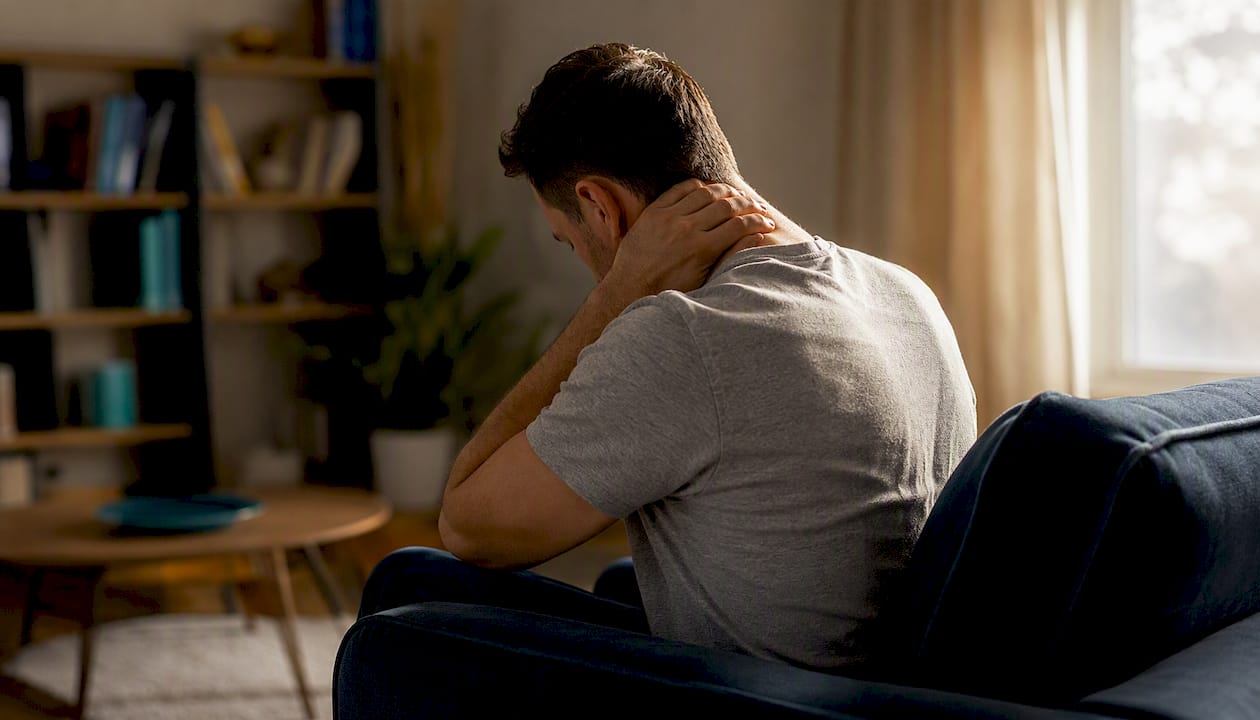
Most trapezius pain falls into a handful of recognisable patterns, and knowing which one you're dealing with matters for how you treat it.
- Acute strain: sudden onset after a specific overload, like an awkward lift or a fall, with pain localised to the affected fibres
- Myofascial trigger points: a palpable "knot" that produces pain not just where you press, but referred somewhere else too, often up into the head or down the arm
- Chronic postural overload: a slow-burn ache that builds over weeks of poor desk ergonomics or repetitive activity, rather than one clear injury moment
- Nerve injury: weakness or a visibly drooping shoulder following trauma or surgery near the neck, pointing to accessory nerve involvement
- Referred visceral pain: rare, but genuine, where pain felt in the upper back or between the shoulder blades actually originates from an internal organ
According to Cleveland Clinic, overuse, repetitive strain, poor posture and nerve damage are among the most common drivers of trapezius pain, which lines up with what most sports clinics see walk through the door week to week.
Two symptom patterns trip people up regularly. Upper trapezius tension frequently mimics or directly contributes to tension-type headaches, since tight fibres near the base of the skull can refer pain straight up into the head. And trigger-point referral patterns can look suspiciously like cervical radiculopathy (a pinched nerve in the neck), sending pain down towards the shoulder or arm even though the nerve itself is perfectly fine.
Pro Tip: A genuine pinched nerve comes with actual neurological signs, numbness, weakness, or reflex changes that follow a specific nerve pattern, whereas a trigger point produces referred pain without any of that. If you're only feeling an ache with no numbness, weakness or pins and needles, it's far more likely muscular than neurological. That distinction is exactly what a clinician is trained to tease out through hands-on assessment.
How trapezius problems get assessed
A proper assessment isn't complicated, but it does need to be done in order, because skipping steps is how things get missed. Here's the sequence most clinicians follow:
- Observation: checking posture, shoulder height symmetry, and any visible muscle wasting
- Palpation: feeling for tenderness, tightness, or trigger points along the fibres
- Range of motion: testing both active movement (what you can do yourself) and passive movement (what a clinician can move for you)
- Resisted testing: checking strength in shrugging, retraction and scapular upward rotation against manual resistance
- Neurological screen: a basic check of sensation, motor strength and reflexes covering C3 to C4 and accessory nerve function
A handful of symptoms should send you straight to a clinician rather than a foam roller: unexplained weight loss, fever, progressively worsening weakness, chest pain, or new numbness or bowel and bladder changes. Cleveland Clinic's guidance on upper back pain is clear that these red flags point towards causes well beyond a strained muscle, and they need proper investigation, not stretches. If your pain is mild, recent, and clearly tied to a specific activity, self-assessment and conservative care is usually a reasonable first step. Anything persistent, severe, or accompanied by the signs above deserves a proper examination.
Treating and self-managing trapezius pain
In the first day or two after an acute flare, the priorities are simple: modify the activity that aggravated it, get some relative rest without going fully sedentary, use appropriate pain relief if needed, and apply ice or heat depending on what settles your symptoms best. Adjusting your desk setup or sleeping position often does more than any single stretch.
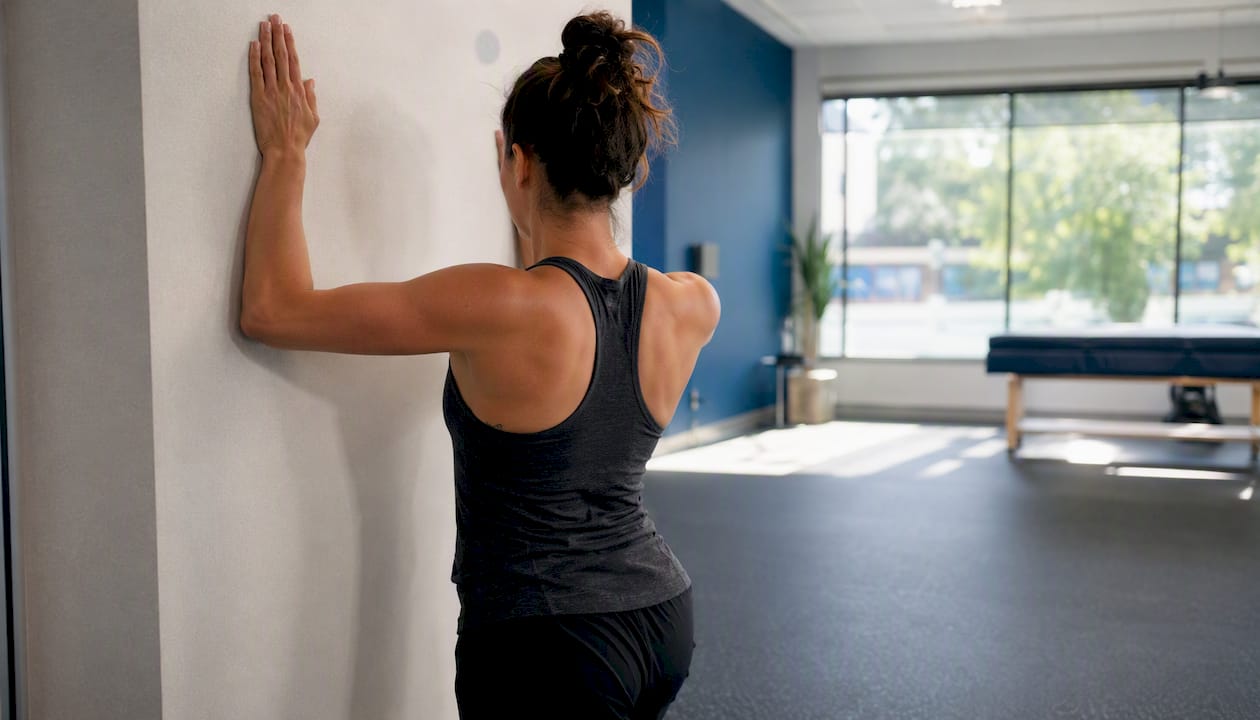
Once the acute soreness has calmed down, exercise does the heavy lifting. Stretches for the upper trapezius, tilting your ear towards your shoulder while gently pressing down on the opposite side, along with lengthening the levator scapulae and scalenes, help ease tightness in the upper fibres. Strengthening work, particularly scapular retraction drills and lower-trapezius activation exercises (think reverse flies or wall slides), builds the capacity to hold good posture rather than just easing today's ache. Medical News Today's patient-facing review lists stretching and strengthening among the standard first-line approaches, and that lines up with what most physiotherapists recommend as a starting point.
Manual therapies, including massage, dry needling and cupping, can genuinely ease tightness and reduce trigger point sensitivity. But treating the trigger point in isolation without correcting what's actually driving it (poor thoracic mobility, scapular dyskinesis, or hours of unbroken desk posture) tends to bring the same knot straight back within a few weeks. If self-care isn't shifting things after a couple of weeks, or the pain keeps recurring, that's the point to move into supervised physiotherapy rather than repeating the same stretches on a loop. Our guide to gentle strength training for chronic pain covers how to progress that strengthening work safely once the acute phase has settled, and if you're building back towards sport specifically, injury prevention habits for tactical athletes has useful conditioning principles that translate well to the shoulder girdle.
How long does trapezius pain take to heal?
Recovery timelines depend heavily on what's actually driving the pain:
- Acute strain: typically days to a few weeks with sensible load management
- Myofascial pain: usually several weeks, faster with active care like stretching, strengthening and manual therapy rather than rest alone
- Chronic postural overload: often months, since it needs genuine behaviour change (desk setup, movement habits) alongside a structured rehab programme
Most cases settle well with conservative care. Symptoms that persist beyond these windows or keep getting worse rather than better warrant a second look, not more patience.
A therapist's view on assessing and rehabbing trapezius pain
Good rehab for this region follows a clear progression: calm the acute symptoms down first, restore full mobility, build targeted strength through the weak fibre groups, then graded return to full activity or sport. Skipping straight to strengthening before mobility is restored is one of the most common ways people stall.
A first visit for trapezius-region pain usually involves a detailed history (what aggravates it, what eases it, how it started), a movement examination, targeted palpation to find exactly where the tension or trigger points sit, and a simple home programme to start immediately rather than waiting for a follow-up appointment.
Pro Tip: Small daily practices beat occasional long sessions. Two minutes of scapular retraction work done consistently every day outperforms one hour of stretching done once a week, largely because sustained postural muscles respond to frequency, not intensity.
What actually matters most about the trapezius region
Most articles on this topic treat the trapezius as a stretching problem. It isn't. It's a load-management problem that happens to respond to stretching temporarily.
The conventional advice, "stretch your traps," treats a symptom while ignoring the driver. If you spend nine hours a day with rounded shoulders and a forward head, no amount of evening stretching will outpace that daily static load. The fibre-specific anatomy backs this up clearly: your upper trapezius is being asked to hold a position it was never built to sustain, while your middle and lower fibres, the ones that should be doing the postural work, sit underused and weak.
What I'd prioritise first isn't a stretch at all. It's scapular retraction and lower-trap activation, done briefly but daily, alongside genuine changes to how you sit and carry weight through your day. Manual therapy and stretching have their place for symptom relief, but they're supporting acts. The main event is teaching the underused fibres to do their job again.
Frequently asked questions about the trapezius region
What is the trapezius region? It's the broad, diamond-shaped muscle running from the base of your skull and your spine down to your collarbone and shoulder blade, split into upper, middle and lower functional sections that control scapular movement and posture.
What usually causes trapezius muscle pain? Overuse, repetitive strain, poor posture and, less commonly, nerve injury are the most frequent causes, according to Cleveland Clinic. Sustained desk posture is one of the most common everyday triggers.
How do you relieve trapezius pain at home? Start with activity modification, ice or heat depending on what feels better, and gentle upper trapezius stretches once acute soreness settles. Add scapular retraction and lower-trap strengthening as tolerance improves.
Which stretches actually help the trapezius area? Tilting your ear towards your opposite shoulder while gently pressing down targets the upper fibres directly, while lengthening the levator scapulae and scalene muscles addresses closely related tension around the neck.
When should trapezius pain prompt a clinician visit? See a clinician if you notice progressive weakness, numbness, chest symptoms, fever, unexplained weight loss, or pain that hasn't improved after a couple of weeks of sensible self-care.
This article is general information, not a substitute for advice from a qualified doctor. Consult a qualified healthcare professional about your own circumstances before acting on anything here.
Sources
- Trapezius - TeachMeAnatomy
- Anatomy, Back, Trapezius - StatPearls - NCBI Bookshelf
- Trapezius muscle - Cleveland Clinic
- Trapezius muscle: Kenhub