

Persistent pain is defined as pain that continues beyond the normal healing period of an injury, but driven not by ongoing tissue damage but by changes in how your nervous system processes signals. Clinically, pain lasting more than 3 months crosses the threshold into chronic pain territory. That distinction matters enormously, because it shifts the focus from "what is still broken?" to "why is my nervous system still alarmed?" Understanding why pain persists after tissue heals is the first step toward doing something genuinely useful about it. Recent research into brain circuits, including the caudal granular insular cortex (CGIC), is reshaping how clinicians approach this problem entirely.
Why pain persists after tissue heals: what the biology tells us
Tissue healing follows three well-defined phases: inflammation, proliferation, and remodelling. Each phase has a job to do, and they do not always finish at the same time as your pain disappears.
- Inflammatory phase (days 1–5): Blood flow increases, swelling occurs, and the body clears damaged cells. Pain here is protective and expected.
- Proliferative phase (days 5–21): New collagen fibres are laid down. The tissue is patching itself, but it is fragile and disorganised.
- Remodelling phase (weeks 3 to 12+): Collagen fibres realign along lines of mechanical stress through a process called mechanotransduction. This is where real tensile strength is restored.
Here is the bit that catches most people off guard. For a Grade II muscle strain, remodelling continues for 4–5 months after pain has already gone. Pain may stop while muscle strength sits at only 50–60% of full recovery, which is a significant re-injury risk if you return to full activity too soon. Pain cessation and biomechanical readiness are two completely different things.
Mechanotransduction is the process by which physical forces on tissue stimulate cells to produce stronger, better-aligned collagen. Without controlled progressive loading during the remodelling phase, collagen fibres stay disorganised and weak. That is why complete rest is not the answer, and why "I feel fine" is not the same as "I am ready."
Pro Tip: If your pain has gone but you are only a few weeks post-injury, treat yourself as 60% recovered. Gradually reintroduce load rather than jumping back to full training.
How does the nervous system keep pain going after healing?
This is where things get genuinely fascinating, and a little bit mind-bending (in the best possible way).
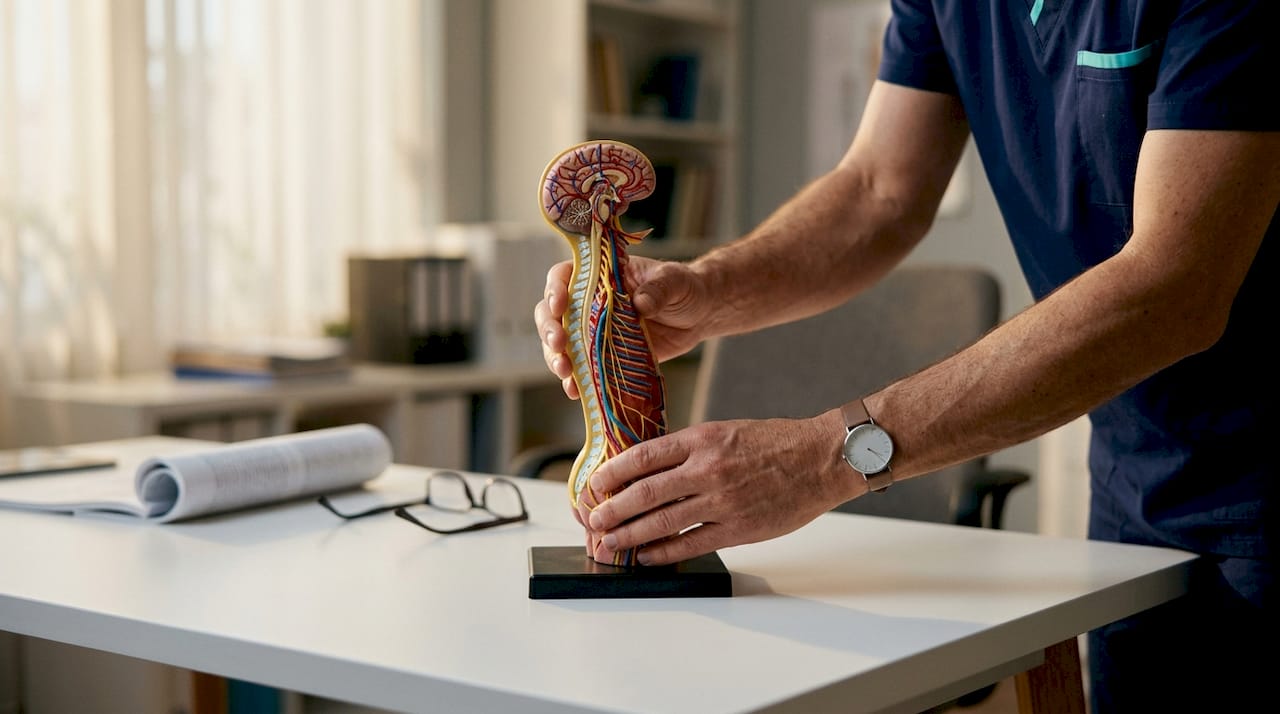
Pain is produced by the brain evaluating incoming signals and deciding whether to generate a protective response. It is not a direct readout of tissue damage. The brain weighs up your history, your stress levels, your sleep quality, and your previous pain experiences before deciding how loud to ring the alarm bell. That is a feature, not a bug. But it can go wrong.
Central sensitisation is the term clinicians use when the nervous system becomes so sensitised that it amplifies signals well beyond what the tissue situation warrants. Even harmless stimuli, like light touch or gentle movement, can trigger pain. Think of it like a smoke alarm that has been set to go off when you make toast. The alarm is real. The fire is not.
The nervous system can "learn" pain. Research into brain circuits shows that areas like the caudal granular insular cortex (CGIC) act as a command centre, maintaining persistent pain signals long after tissue has healed. Animal studies show that silencing these brain areas can erase established chronic pain entirely. That finding has significant implications for how we approach treatment.
Stress and sleep are not soft lifestyle factors here. They are direct modulators of nervous system sensitivity. Pain intensity fluctuates with stress and sleep quality, not just with injury status. A bad night's sleep genuinely turns up the volume on pain signals. A high-stress week can cause a flare-up with no new injury whatsoever. That is not in your head. That is neuroscience.
Chronic pain recovery is non-linear because the nervous system recalibrates gradually and imperfectly. Fluctuating symptoms over months are normal. They do not mean you are getting worse. They mean your nervous system is still working out its new normal.
What do clinical signs tell you about the source of your pain?
One of the most frustrating experiences in persistent pain is getting a scan back that says "all clear" while you are still in genuine discomfort. Here is the thing: that result is not a contradiction.
Imaging confirming tissue healing does not rule out ongoing pain. The nervous system can maintain pain signals independently of any structural pathology. A sensitised nervous system does not show up on an MRI. This is why diagnosis based solely on imaging misses a large proportion of persistent pain cases.
Pro Tip: Ask your clinician about functional assessments, not just imaging. Load tolerance tests and movement pattern analysis give a far more complete picture of where your pain is actually coming from.
Good clinicians look at a combination of factors: how your pain behaves under load, whether it is disproportionate to the stimulus, whether it spreads beyond the original injury site, and how it responds to stress or sleep changes. These are all signs of nervous system involvement rather than active tissue damage.
| Feature | Tissue-driven pain | Sensitised nervous system pain |
|---|---|---|
| Location | Localised to injury site | Spreading or diffuse |
| Behaviour under load | Predictable, proportionate | Disproportionate or unpredictable |
| Response to rest | Improves with rest | May not improve with rest |
| Triggers | Mechanical (movement, pressure) | Stress, fatigue, temperature, emotion |
| Imaging findings | Often correlates with symptoms | Normal or healed tissue |
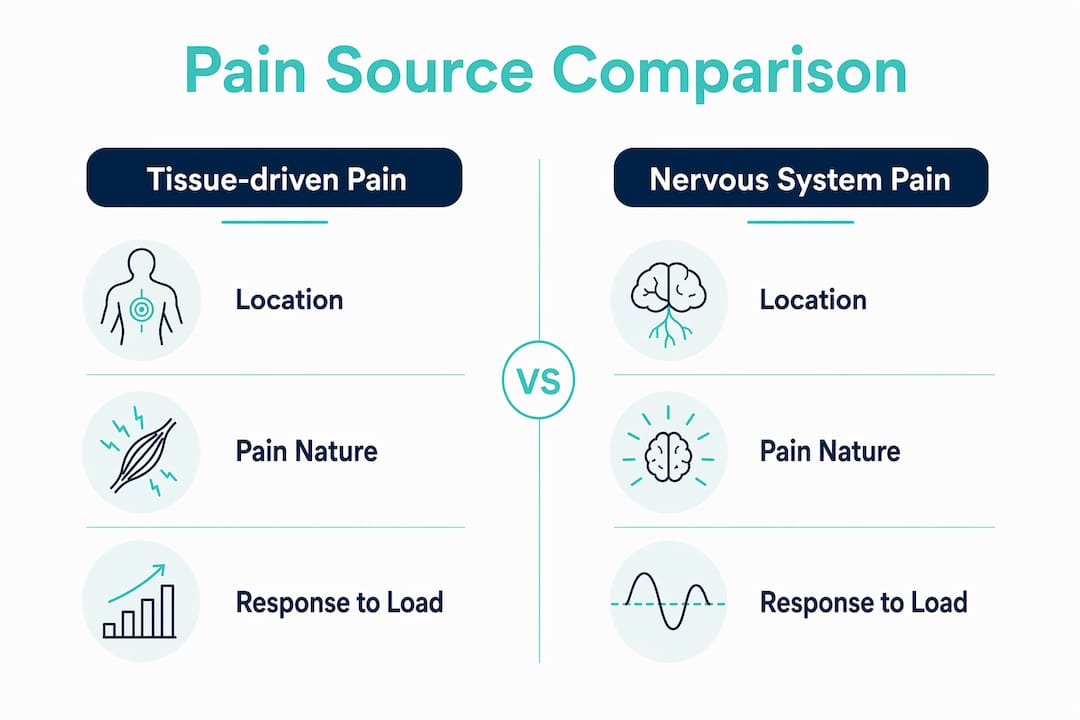
The table above is not a diagnostic tool. It is a conversation starter with your clinician. If your pain ticks several boxes in the right-hand column, nervous system sensitisation is worth exploring seriously.
How do you actually manage pain that outlasts the injury?
Effective management requires addressing movement patterns, strength, load capacity, and nervous system sensitivity together. Treating only one of these in isolation tends to produce short-term relief and long-term frustration.
Here is what a well-rounded approach looks like in practice:
- Progressive loading: Gradually reintroduce mechanical stress to the previously injured tissue. This drives collagen remodelling and rebuilds genuine load tolerance. Start well below your perceived capacity and increase slowly.
- Movement retraining: Pain changes how you move. You compensate, guard, and avoid. Retraining movement patterns breaks those compensatory habits before they become permanent.
- Sleep and stress management: These are not optional extras. Poor sleep and high stress directly amplify nervous system sensitivity. Addressing them is part of the treatment, not a nice-to-have.
- Avoiding prolonged rest: Extended rest reinforces avoidance behaviour and allows the nervous system to remain in a heightened protective state. Controlled, graded movement is almost always better than doing nothing.
- Professional guidance: A clinician who understands both tissue healing and nervous system sensitisation can build a programme that addresses both simultaneously. Therapies like shockwave and laser therapy can support tissue recovery, while deep tissue and sports massage can help calm an overactive nervous system response.
Pro Tip: Graded exposure is the gold standard for nervous system recalibration. Gradually reintroduce activities that previously caused pain, in small, manageable doses. The goal is to teach your nervous system that movement is safe.
Successful pain management includes sleep optimisation, stress reduction, and gradual movement to restore nervous system regulation. That is not a vague lifestyle recommendation. It is a clinical strategy backed by current neuroscience research.
Key takeaways
Persistent pain after tissue healing is primarily a nervous system problem, not a tissue problem, and treating it requires addressing both load tolerance and neurological sensitisation together.
| Point | Details |
|---|---|
| Pain and healing are separate | Tissue may be fully healed while pain persists due to nervous system sensitisation. |
| The 50–60% rule | Pain-free status often corresponds to only 50–60% tissue strength recovery, making early return risky. |
| Central sensitisation is real | Brain circuits like the CGIC can maintain pain signals long after injury has resolved. |
| Stress and sleep matter clinically | Poor sleep and high stress directly amplify pain signals, independent of injury status. |
| Progressive loading is the fix | Gradual reintroduction of movement and load recalibrates both tissue and nervous system together. |
What I have learned from years of watching people fight this
Honestly, the most common thing I see is people who have been told their scan is clear and then feel completely lost. They came in expecting a structural answer, and instead they got "nothing to see here." That is a genuinely disorienting experience, and I have a lot of empathy for it.
What I have found, over and over, is that the people who recover best are the ones who stop asking "what is still damaged?" and start asking "what does my nervous system need right now?" That shift in framing changes everything. It moves you from passive patient waiting for tissue to fix itself, to active participant in recalibrating your own pain system.
The research on the CGIC and brain-level pain maintenance is not just academically interesting. It is clinically liberating. It tells us that pain is a biopsychosocial construct, and that means it responds to biological, psychological, and social inputs. You have more levers to pull than you think.
I also want to be honest about something: this process takes time, and it is not a straight line. Flare-ups are not failures. They are part of how a sensitised nervous system gradually recalibrates. Patience is not passive. It is an active part of the treatment.
If you are dealing with persistent pain after injury, please do not just wait it out. Get a proper assessment from someone who understands both tissue healing and nervous system sensitisation. The sooner you start working with your nervous system rather than against it, the sooner things genuinely improve.
— Mark
Persistent pain after injury: how Sportsinjurydublin can help
If your pain has outlasted your injury, you are not imagining it and you are not stuck with it.

At Sportsinjurydublin, the team at Hamilton Pain and Sports Injury Clinic in Glasnevin, Dublin 11, takes exactly the kind of individualised approach that persistent pain demands. From sports rehabilitation programmes that rebuild load tolerance progressively, to recovery sessions that address nervous system sensitivity, every plan is built around you specifically. Not a generic protocol. Not a one-size approach. If you are ready to get a proper assessment and a clear path forward, book an appointment and find out what targeted, evidence-based care actually feels like.
FAQ
What is the clinical definition of chronic pain?
Chronic pain is defined as pain lasting longer than 3 months, which exceeds the expected tissue healing period for most injuries. This threshold distinguishes persistent pain from normal post-injury discomfort.
Can pain continue even when a scan shows full healing?
Yes. Imaging confirming tissue healing does not rule out ongoing pain, because the nervous system can maintain pain signals independently of any structural damage. This is central sensitisation, and it does not appear on an MRI.
Why does stress make my pain worse?
Stress directly amplifies nervous system sensitivity, which turns up the volume on pain signals. Pain intensity fluctuates with stress and sleep quality, not just with injury status, which is why managing both is a clinical priority.
Is it safe to exercise when pain persists after healing?
Controlled, progressive movement is generally the right approach. Returning to activity too early without progressive loading risks re-injury, but prolonged rest reinforces nervous system sensitisation. Graded exposure under professional guidance is the safest path.
How long does recovery from persistent pain typically take?
Recovery is non-linear and varies significantly between individuals. Fluctuating symptoms over months are normal as the nervous system recalibrates, and flare-ups during recovery do not indicate failure or worsening.