
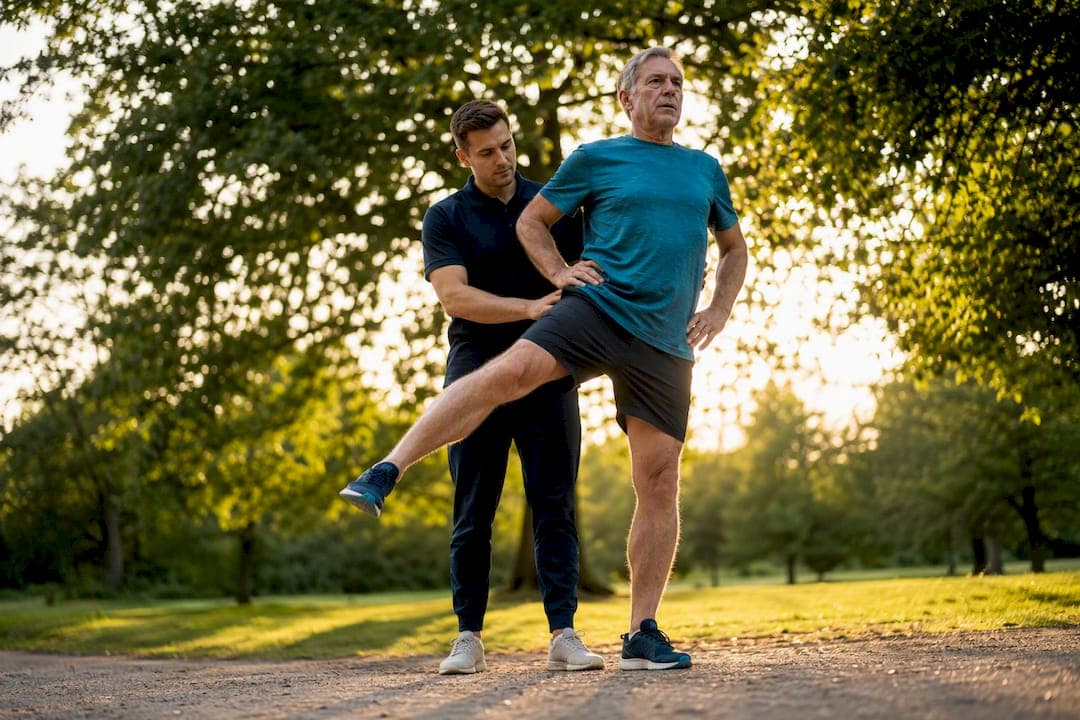
Yes, Trendelenburg gait can usually be fixed, and no, it doesn't happen overnight. Most cases come down to weak hip abductors (mainly the gluteus medius), and a progressive exercise programme, run properly, tends to correct or meaningfully improve the pattern over a few months. It's the mainstay treatment for a reason: it works when it's done consistently and in the right order.
Here's the thing though. You can't skip straight to lunges with a barbell and expect your pelvis to stop dropping. Physical therapy is the recognised first-line approach, and it starts with waking the muscle up before you load it hard.
Before you start any of this, run a couple of safe checks:
- Stand in front of a mirror, lift one foot off the floor, and watch whether your opposite hip drops.
- Walk normally past a window or mirror and see if your trunk sways side to side more on one leg than the other.
- If you notice sudden weakness, numbness, or you genuinely can't bear weight on the leg, that's a booking-a-clinician situation, not a start-a-programme situation.
Pro Tip: Nail activation drills for a week or two before you add resistance. A gluteus medius that hasn't "switched on" properly won't get stronger just because you're lifting heavier. You'll just teach your other muscles to cheat.
Key Takeaways
Trendelenburg gait improves in most cases through a structured, months-long exercise programme progressing from activation to strengthening to functional retraining, ideally guided by clinical assessment.
| Point | Details |
|---|---|
| Activation comes first | Wake the gluteus medius up with slow, controlled drills before adding resistance or load. |
| Weakness is the usual cause | Most cases stem from hip abductor weakness, though osteoarthritis and nerve issues need ruling out. |
| Progression beats intensity | Increase one variable at a time: resistance, reps, or difficulty, never all three together. |
| Timeline is months, not weeks | Expect early motor control gains within weeks, visible gait change over three to six months. |
| Professional assessment adds value | Sportsinjurydublin's structured, hands-on approach catches compensations home programmes often miss. |
Table of Contents
- What causes trendelenburg gait, and what's actually happening in the hip?
- What causes it, and when is it more than simple weakness?
- How do clinicians test for trendelenburg gait, and can I check it myself?
- What exercises actually fix trendelenburg gait?
- What does an 8-week trendelenburg gait rehabilitation plan look like?
- What equipment do you actually need for trendelenburg gait exercises?
- When do you need more than exercise for trendelenburg gait?
- What does the evidence say about recovery timelines?
- How does Hamilton Pain and Sports Injury Clinic approach trendelenburg gait?
- Why exercise consistency matters more than exercise perfection
- How do you book a session at Hamilton Pain and Sports Injury Clinic?
- Where can you read more about trendelenburg gait?
- Frequently asked questions about fixing trendelenburg gait
- Sources
What causes trendelenburg gait, and what's actually happening in the hip?
The gait gets its name from a simple bedside test, but what you're actually seeing is a pelvis that's lost its side-to-side stability during walking. When you stand on one leg, that leg's hip abductors are supposed to hold your pelvis level. When they can't, the opposite hip drops, or you lean your trunk over the standing leg to compensate. Either way, it looks lopsided, and it usually is.
The muscles doing the work (or not)
Two muscles run the show here: the gluteus medius and gluteus minimus, both tucked on the outer side of your hip. Their job during single-leg stance is to stop your pelvis tipping towards the unsupported side. They're switched on by the superior gluteal nerve, which is worth remembering because if that nerve's been irritated, compressed, or damaged (say, after certain hip surgeries), no amount of squatting will fix things until the nerve issue is addressed.
Think of the gluteus medius as a kickstand. When it's strong and firing correctly, one leg can hold the whole structure upright without wobbling. When it's weak, everything above it tips.
Signs clinicians actually look for
A few objective markers separate "probably fine" from "worth investigating properly":
- Pelvic drop on the side opposite the weak hip during single-leg stance or the stance phase of walking.
- Positive Trendelenburg sign: the pelvis visibly sags when you lift the opposite foot off the ground.
- Compensatory trunk lean, where you throw your upper body over the weight-bearing hip to reduce the demand on the abductors (this is sometimes mistaken for the "real" gait but it's actually a workaround for it).
None of this is cosmetic. Left unaddressed, the mechanics tend to load the lower back, knees and ankles unevenly, and over time that uneven loading has been linked to accelerated degenerative changes in the hip. It's not usually an emergency. It is, however, a pattern that gets more entrenched the longer it runs unchecked, which is exactly why "I'll sort it eventually" tends to be the wrong strategy.
What causes it, and when is it more than simple weakness?
Most Trendelenburg gaits trace back to one root cause: the hip abductors aren't strong enough, or aren't firing in the right sequence, to control the pelvis. But "weak glutes" isn't the only explanation, and figuring out which one applies to you changes what a sensible programme looks like.
The common causes include:
- Isolated hip abductor weakness, often from deconditioning, prolonged inactivity, or simply never having trained that muscle group directly.
- Hip osteoarthritis, where joint changes alter the mechanics and the abductors compensate poorly.
- Superior gluteal nerve injury or impingement, sometimes following hip replacement or other pelvic surgery.
- Post-operative inhibition, where the muscle is intact but "switched off" temporarily after surgery or injury, even without structural damage.
- Developmental hip conditions, such as hip dysplasia, particularly relevant if the gait has been present since childhood.
- Neuromuscular or muscular disease, which is less common but needs ruling out if weakness is widespread rather than localised to one hip.
Cleveland Clinic's overview of the condition notes it's rarely an isolated issue and that clinicians routinely check for osteoarthritis, nerve involvement, or post-surgical causes before settling on a plan, because each of those changes the approach substantially.
A few red flags mean you shouldn't just crack on with a home exercise routine: rapid worsening over days rather than weeks, severe pain rather than mild ache, numbness or tingling down the leg, or genuine inability to bear weight. Any of those warrant a proper assessment before you touch a resistance band, because in those cases the exercise programme might need to wait for imaging, medical review, or a different treatment entirely.
How do clinicians test for trendelenburg gait, and can I check it myself?
Clinicians lean on a handful of straightforward tests, and you can do rough versions of most of them at home, with caveats.
- The Trendelenburg sign test. You stand on one leg for around 30 seconds while the clinician watches your pelvis. If the opposite side drops, or you visibly compensate with a trunk lean, that's a positive sign.
- Single-leg stance observation. Similar idea, but sometimes assessed for duration and quality rather than just pass/fail, particularly to compare left and right sides.
- Gait observation. Walking is watched from behind and the side, checking for pelvic drop, trunk lean, and step width across several strides, not just one.
- Functional tasks. Step-ups, single-leg squats, and stairs can reveal weakness that doesn't show up in simple standing tests.
- Manual muscle testing. The clinician grades your hip abductor strength on a 0 to 5 scale. Anything below a 4 out of 5 generally shifts the plan towards a longer activation phase before heavier strengthening begins.
At home, the safest version is standing in front of a mirror or propping your phone up to film yourself walking and doing a single-leg stance. Watch for the same things: does one hip sag when you lift the other foot? Does your trunk lean noticeably to one side when walking?
What you shouldn't attempt without guidance: forcing single-leg balance if you feel genuinely unstable, pushing through sharp pain rather than a mild "working" ache, or continuing if you feel dizzy or lightheaded. Stop and get it looked at properly if any of that happens.
Pro Tip: Film yourself from behind, walking towards a mirror, on your phone at a slow, steady pace. Watch it back in slow motion. It's genuinely surprising how much clearer a pelvic drop looks on video than it feels when you're the one walking. Bring that clip to your clinician; it saves a lot of description and gives them something concrete to assess.
What exercises actually fix trendelenburg gait?
Here's where most people go wrong: they jump straight to strengthening and skip the bit that actually matters first, which is teaching the muscle to fire correctly at all. The Prehab Guys make a solid case for progressing through activation, then strengthening, then functional retraining, rather than treating it as one big "do glute exercises" blob.
Phase 1: activation (waking the muscle up)
This phase isn't about building strength. It's about re-establishing the connection between your brain and that muscle, sometimes called motor control or neuromuscular re-education. If the gluteus medius has been under-used for months or years, it needs to relearn its job before it can do it under load.
Good activation drills include clamshells done slowly with a pause at the top, standing hip abduction against a wall for gentle resistance, and simple glute bridges focusing on an even pelvis rather than raw height. The cue that matters most here: quality over intensity. If you're rushing the reps or feeling it more in your lower back than your hip, slow down.
Phase 2: isolation and strengthening
Once the muscle is firing reliably, you load it properly. Side-lying hip abduction, clamshells with a resistance band around the knees, and glute bridges with a band above the knees all target the gluteus medius directly without dragging other muscles into doing the work for it.
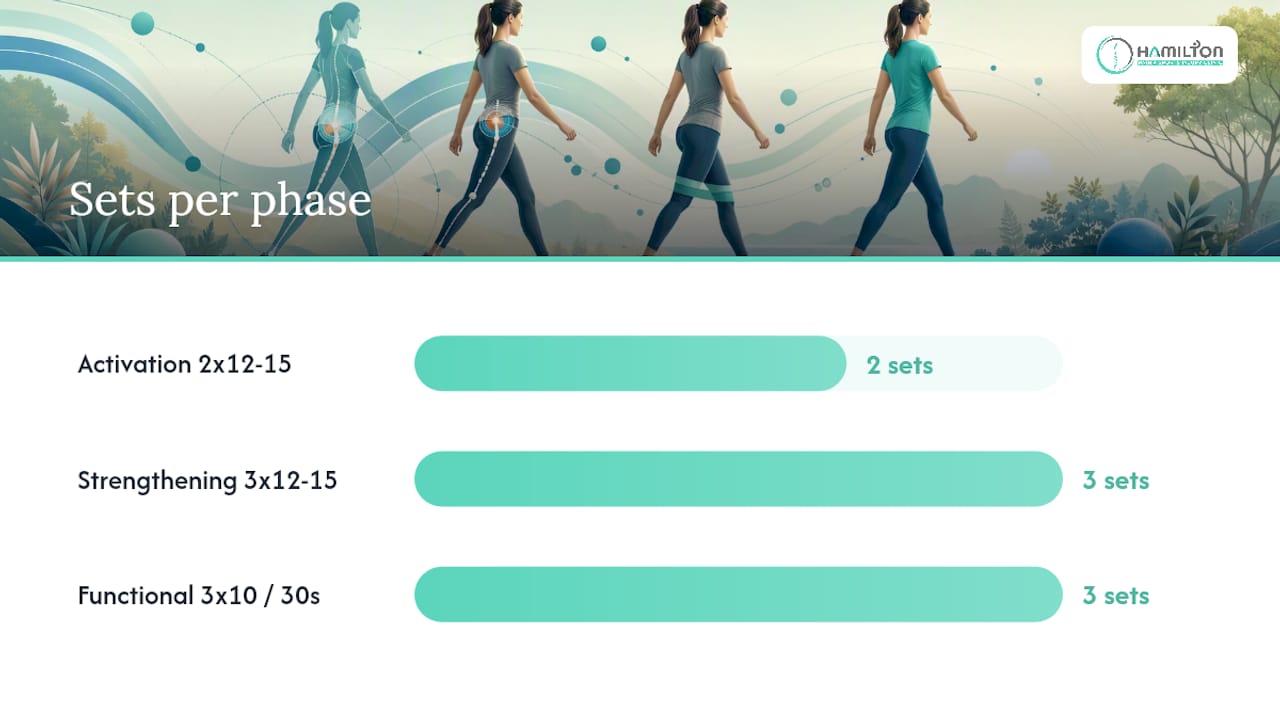
A rough starting point: 2 to 3 sets of 12 to 15 repetitions, three times a week, increasing resistance (heavier band, or added ankle weight) once the current level feels genuinely easy rather than just tolerable.
Phase 3: functional and weight-bearing progressions
This is where strength actually transfers to walking, because walking is a weight-bearing, single-leg activity, and non-weight-bearing exercises alone don't automatically translate to it. Band walks (lateral and monster walks), lateral step-ups onto a low box, single-leg squats, and single-leg balance work (progressing to standing on an unstable surface or catching a ball while balancing) all belong here.
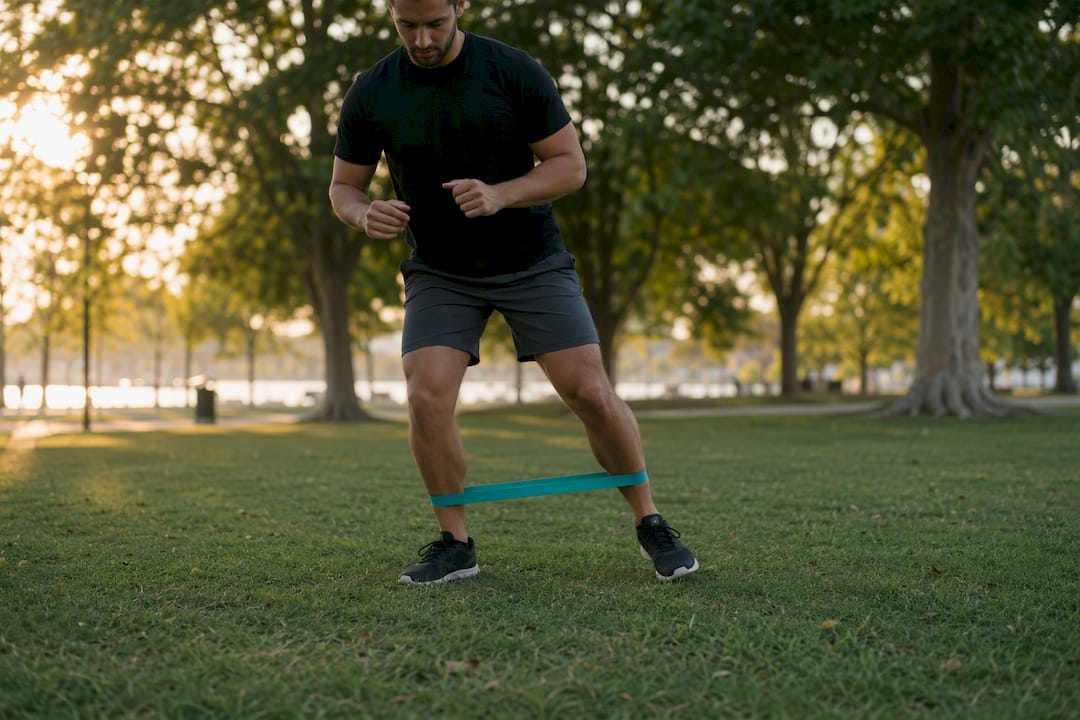
Research on hip abductor activation patterns supports weighting exercise selection towards functional, weight-bearing movements once basic activation is established, since these movements more closely mimic what the muscle needs to do during actual gait.
Form cues and the mistakes people make
Watch for two things constantly: a "pelvic hike" (yanking the hip up rather than controlling it) and a compensatory trunk lean that creeps back in once you're tired. Both mean the exercise has stopped training the right muscle and started training a workaround, which is precisely the pattern you're trying to undo.
Progression rules
A sensible decision tree looks like this: if you can complete your current sets and reps with good form and no more than mild fatigue, increase resistance or repetitions next session. If form breaks down before you finish, or pain increases rather than settles, drop back a level and stay there longer. Progress by one variable at a time; don't increase resistance and reps and difficulty all in the same week.
| Exercise | Phase | Sets x Reps | Notes |
|---|---|---|---|
| Clamshell (slow, no band) | Activation | 2 x 15 per side | Pause 2 seconds at top; stop if lower back takes over |
| Standing wall hip abduction | Activation | 2 x 12 per side | Light resistance only; focus on control |
| Side-lying hip abduction with band | Strengthening | 3 x 12 per side | Increase band tension once easy for 3 sets |
| Glute bridge with band above knees | Strengthening | 3 x 15 | Keep pelvis level throughout, not just at the top |
| Lateral band walk | Functional | 3 x 10 steps each direction | Stay in a slight squat; avoid standing tall |
| Lateral step-up | Functional | 3 x 10 per side | Start with a low box; control the descent |
| Single-leg balance | Functional | 3 x 30 seconds per side | Progress to eyes closed or unstable surface |
Pro Tip: Motor control training only works with repetition and feedback. Do the activation drills daily, not just on your "gym days," and check yourself in a mirror every few sessions. The brain needs the reps to relearn the pattern; the mirror tells you whether it's actually working.
What does an 8-week trendelenburg gait rehabilitation plan look like?
You don't need to guess at structure. A sensible 8-week framework, adaptable to your own starting point, looks roughly like this.
- Weeks 1 to 2 (activation phase). Daily activation drills, five to seven days a week, 10 to 15 minutes per session. Focus entirely on quality of movement, not intensity. This is also when you'd expect the earliest changes, mostly in how the muscle "feels" during single-leg stance, rather than visible gait changes yet.
- Weeks 3 to 5 (strengthening phase). Drop activation to a warm-up (5 minutes) and shift the main session to strengthening work, three times a week, with a rest day between sessions. Increase resistance roughly every 5 to 7 days if reps feel too easy.
- Weeks 6 to 8 (functional transfer phase). Add band walks, step-ups, and single-leg balance progressions two to three times a week, alongside continued strengthening once a week to maintain gains. This is typically when gait changes become noticeable to other people, not just to you.
| Week | Focus | Frequency | Example progression trigger |
|---|---|---|---|
| 1–2 | Activation | Daily, 10–15 min | Move to Week 3 once reps feel controlled, not fatigued |
| 3–5 | Strengthening | 3x/week | Increase band resistance once 3x15 feels easy |
| 6–8 | Functional transfer | 2–3x/week | Add unstable surface once 30 second balance is solid |
If you're recovering post-surgery, or pain flares during any phase, halve the volume and lean on isometric holds (simply holding a position rather than moving through reps) until things settle, ideally with a clinician checking in periodically rather than pushing through alone.
What equipment do you actually need for trendelenburg gait exercises?
Not much, honestly. A resistance band (or two, in different strengths) covers most of the strengthening and functional phases. A yoga mat makes the floor work more comfortable. A low step or sturdy box handles the step-ups, and light ankle weights let you progress the isolation exercises once bands stop feeling challenging.
No gym required, either. A rolled towel under the knee substitutes for a small step. Stairs at home work just as well as a gym step-up box. Tinned goods or a filled water bottle can stand in for ankle weights at a pinch.
One equipment note worth getting right: band placement changes the exercise. A band above the knees for bridges targets abduction; a band around the ankles for lateral walks increases the challenge considerably. If a band feels too easy after a week or two of consistent training, that's your cue to size up, not to just do more reps.
When do you need more than exercise for trendelenburg gait?
Exercise is the foundation, but it isn't the answer in every case, and knowing when to escalate matters as much as knowing the exercises themselves.
Get a referral or reassessment if any of these apply:
- Instability or pelvic drop is getting worse despite eight or more weeks of consistent, correctly performed exercise.
- Pain is severe, sharp, or worsening rather than settling with activity.
- You notice numbness, tingling, or other neurological signs alongside the gait change.
- Functional loss is progressing (struggling with stairs or walking distances you managed easily before).
When exercise alone isn't cutting it, clinicians have several adjuncts, not replacements, for the programme. A shoe lift or orthotic can offset a leg-length difference contributing to the pattern. Gait re-education sessions with a physiotherapist add real-time correction that's hard to replicate solo. Biofeedback, including EMG-based feedback, helps some patients literally see their muscle activating on a screen, which speeds up the motor relearning process considerably. In rare, severe cases involving significant nerve damage or structural joint problems, surgical options get discussed, though this is very much the exception rather than the rule.
The exercises don't stop when adjuncts get added. They usually continue alongside them, because strengthening the muscle and correcting the mechanical or neurological issue tend to work better together than either alone.
What does the evidence say about recovery timelines?
There's no single number that fits everyone, but the pattern across clinical sources is consistent: this takes months, not days, and adherence matters more than intensity.
Cleveland Clinic frames physical therapy as the standard treatment approach, built around that same activation, strengthening, and motor re-training progression covered earlier, with improvement tracked over a period of months rather than weeks. Early motor control gains, where the muscle fires more reliably during single-leg stance, tend to show up within a few weeks if activation work is done consistently. Measurable strength changes take longer and visible gait changes that others notice typically occur after several months of consistent training.
Variability between patients is real and worth naming honestly. Someone with straightforward deconditioning-related weakness often responds faster than someone recovering from hip surgery or managing early osteoarthritis alongside the gait issue. StatPearls identifies structured rehabilitation as the principal non-surgical management route, but it doesn't promise a fixed timeline, because the underlying cause shapes the trajectory as much as the exercises themselves.
The honest summary: there's no quick fix here, and rehabilitation depends heavily on sticking with a months-long routine rather than finding the perfect single exercise.
How does Hamilton Pain and Sports Injury Clinic approach trendelenburg gait?
Sportsinjurydublin builds Trendelenburg gait care around the same evidence-based sequence covered throughout this piece, but with hands-on clinical input at every stage rather than guesswork from a printout.
- Assessment first: proper testing (Trendelenburg sign, single-leg stance, gait observation, and functional tasks) to confirm the cause before any exercise gets prescribed.
- Targeted activation: individually cued drills, adjusted in real time if compensations creep in.
- Progressive loading: strengthening dosed to your current ability, not a generic template.
- Functional retraining: transferring strength gains into actual walking mechanics.
- Return-to-activity planning: particularly relevant for runners and weekend athletes who need the gait corrected before ramping training back up.
Hands-on assessment catches compensations a mirror often misses, and ongoing monitoring means red flags get flagged early rather than months into a stalled home programme.
Why exercise consistency matters more than exercise perfection
Most people fixate on finding the "correct" exercise, as though there's one secret movement clinicians are withholding. There isn't. The exercises in this guide are well established, and none of them are exotic. What actually separates the people who correct their gait from the people who don't is whether they do the boring activation work consistently for two weeks before rushing to the exciting strengthening phase.
Realistic expectations serve patients far better than optimistic ones. Progress is rarely linear. Some weeks feel like nothing's changing, and then a gait pattern that's been present for years shifts noticeably over a single month of consistent loading. That's the pattern to expect, not a straight upward line.
How do you book a session at Hamilton Pain and Sports Injury Clinic?
If you've read through the phases above and thought "I could genuinely use someone watching my form," that instinct is worth acting on. Home programmes work, but they work better with a second pair of eyes catching the pelvic hike or trunk lean you can't see from the inside of your own body.

Sportsinjurydublin's sports rehabilitation service is built around exactly this kind of individualised assessment and progressive plan, rather than a generic printed exercise sheet handed out regardless of cause. Your first appointment involves a proper assessment (single-leg stance, gait observation, strength grading) so the plan reflects what's actually driving your gait, not a guess. If your Trendelenburg gait is affecting running, football, or general sport, the return to sport rehabilitation pathway builds the functional retraining phase around getting you back to your activity confidently, not just walking normally on flat ground. Once the corrective phase is done, ongoing personal training keeps the strength gains from quietly sliding backwards. Book an assessment and get a plan built around your actual hip, not a template.
Where can you read more about trendelenburg gait?
A few sources are worth bookmarking if you're preparing for a clinic visit or want to dig deeper into the clinical detail behind this guide. NCBI's Trendelenburg gait overview covers the anatomy and complications in clinical depth. Cleveland Clinic's patient guide explains the treatment approach in plain terms. StatPearls offers a more technical breakdown for those who want the full clinical picture, and The Prehab Guys' exercise guide is genuinely useful for exercise selection detail. Save your mirror or video observations alongside these notes before your appointment; it gives your clinician something concrete to work from.
Frequently asked questions about fixing trendelenburg gait
Can Trendelenburg gait be fully corrected with exercise alone?
In many cases driven by straightforward hip abductor weakness, yes, a consistent progressive programme can substantially correct or resolve the pattern. Cases involving nerve damage, significant osteoarthritis, or structural issues may need additional treatment alongside exercise.
How long does it take to fix a Trendelenburg gait pattern?
Early improvements in muscle activation often appear within two to three weeks, measurable strength gains typically take six to eight weeks, and visible gait changes usually take three to six months of consistent training.
What is the best exercise for correcting Trendelenburg gait?
There isn't a single best exercise; the sequence matters more than any one movement. Activation drills like clamshells come first, followed by strengthening work like banded bridges, then functional exercises like lateral step-ups and band walks.
Can I fix Trendelenburg gait without a physiotherapist?
Mild cases from simple deconditioning sometimes respond to a well-structured home programme, but a professional assessment helps confirm the cause and catches compensations you can't see yourself, which generally speeds up progress.
Is Trendelenburg gait always painful?
No, it's not always painful, particularly in earlier stages. Pain can develop over time as the compensatory mechanics load the lower back, knees, or ankles unevenly.
This article is general information, not a substitute for advice from a qualified doctor. Consult a qualified healthcare professional about your own circumstances before acting on anything here.
Sources
- Trendelenburg gait — NCBI Bookshelf
- Trendelenburg gait — Cleveland Clinic
- Exercises To Fix Your Trendelenburg Gait — The Prehab Guys
- PubMed entry (related hip abductor research)