

Here's the verdict: how you breathe genuinely changes how fast and how comfortably you run, but only in specific ways, and only some of it matters below race-effort intensities. Get your mechanics right and you'll delay the point where your lungs start stealing blood from your legs. Get them wrong and you'll hit the wall earlier than your fitness says you should.
Three things to try this week. First, on your next easy run, breathe into your belly rather than your chest, you'll know you're doing it right if your hand on your stomach rises before your hand on your chest does. Second, before a hard middle-distance effort, spend two to three minutes on an inspiratory warm-up (more on this below), it's one of the cheapest performance gains going. Third, on that same easy run, try coupling your breath to your steps in a steady rhythm rather than letting it happen randomly.
Pro Tip: Don't try to change your breathing pattern and your running form on the same run. Pick one variable at a time, or you'll end up self-conscious about everything and smooth at nothing.
Key Takeaways
| Point | Details |
|---|---|
| Metaboreflex threshold | Breathing typically only limits performance above roughly 85 to 90% VO2max, prioritise respiratory training for hard efforts. |
| Inspiratory warm-ups work | A 30-breath IMW at 50% peak inspiratory strength improved 3,200m performance by 2.8% versus a sham warm-up. |
| Oronasal beats oral-only | Using nose and mouth together extended time to exhaustion by 2.8 to 4.2% compared with mouth breathing alone. |
| Match pattern to pace | Use 3:2 rhythmic breathing on easy runs, tightening toward 2:2 or 2:1 as effort rises. |
| Core and diaphragm are linked | Weak trunk stability increases diaphragm workload, so core exercises can directly improve breathing efficiency. |
| Get it properly measured | Sportsinjurydublin offers supervised MIP/MEP assessment and bespoke respiratory training plans through its sports rehabilitation service. |
Table of Contents
- How breathing affects running performance: the physiology every runner should know
- What the research actually says about breathing interventions
- Practical breathing techniques you can actually train
- Matching your breathing strategy to the run
- Training your respiratory muscles: a 6-week plan
- Common breathing problems and quick fixes
- How we look at breathing in the clinic
- Get your breathing properly assessed
- Frequently asked questions
- Sources
How breathing affects running performance: the physiology every runner should know
Let's get the vocabulary sorted first, because the rest of this article leans on it. Ventilation (VE) is the total volume of air you move in and out per minute. It's a product of tidal volume (VT, how much air per breath) and respiratory rate (RR, breaths per minute). Maximal inspiratory pressure (MIP) and maximal expiratory pressure (MEP) measure how strong your breathing muscles actually are, think of them as the deadlift max for your diaphragm and intercostals.
Here's the mechanism in plain terms: your lungs pull in oxygen and dump carbon dioxide, and as you run harder, your body demands more of both processes simultaneously. Ventilation scales up roughly in line with intensity, mostly through deeper breaths at first, then faster ones as you approach your limit. This isn't a passive process. Breathing has a metabolic cost of its own, your diaphragm and intercostal muscles are working muscles, and they compete with your legs for blood flow.
That competition has a name: the respiratory muscle metaboreflex. When your breathing muscles fatigue, they trigger a reflex that diverts blood away from your legs and toward your chest, effectively short-changing the muscles doing the actual running. It sounds almost unfair, your legs get punished for your diaphragm getting tired, but that's the deal.
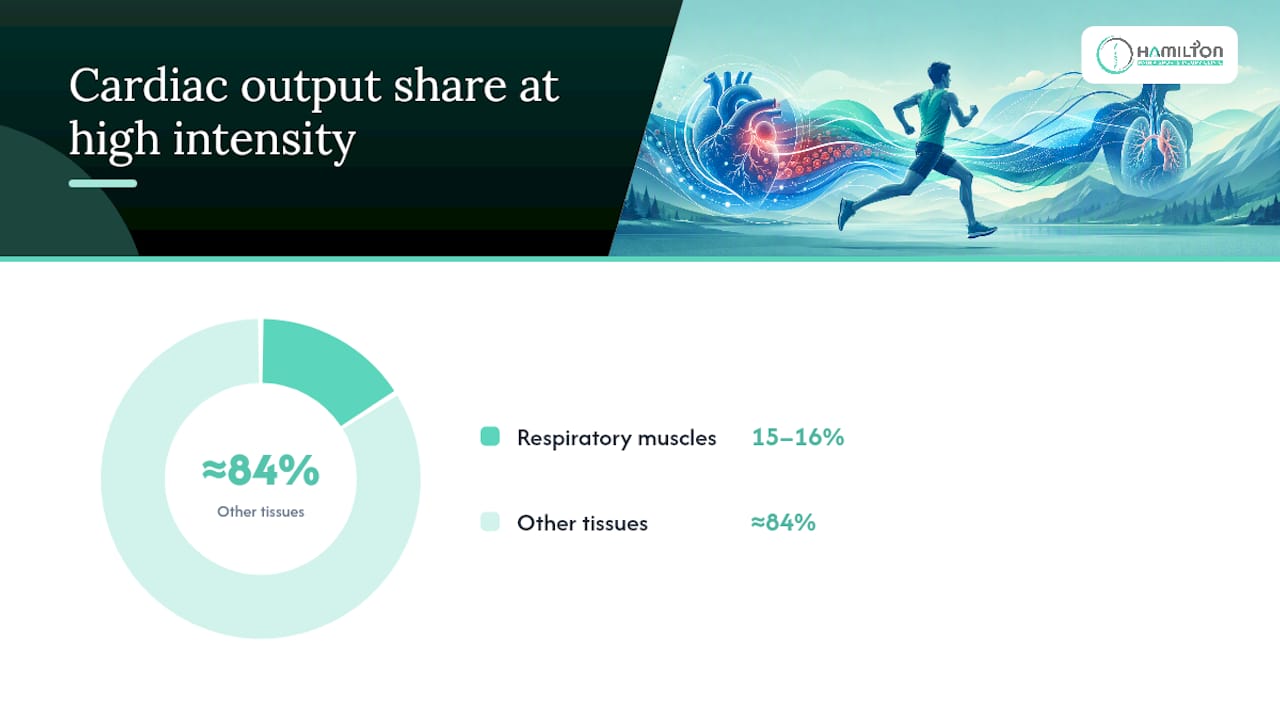
The good news is this reflex doesn't kick in for most of your training. A detailed review of pulmonary limitations to endurance performance found the respiratory system typically only becomes a limiting factor above roughly 85 to 90% of VO2max, and that in highly trained runners, the respiratory muscles alone can demand up to 15 to 16% of total cardiac output at that intensity.
Below that threshold, your lungs have spare capacity. Above it, they're fighting your legs for the same resource.
That threshold matters practically:
- Easy and steady runs (below ~80% VO2max): breathing is rarely your limiter, technique here is about comfort and efficiency, not survival.
- Threshold and tempo efforts (roughly 80 to 90% VO2max): the margin narrows, this is where breathing economy starts to show up in how a session feels.
- Hard intervals and race-pace efforts (above ~90% VO2max): this is metaboreflex territory, where respiratory muscle fatigue can genuinely cost you seconds.
One more piece worth knowing: breathing isn't just a gas-exchange job, it's also a stability job. Your diaphragm doubles as a core muscle, working alongside your abdominals to stabilise your trunk with every stride. Weak core control forces your diaphragm to do double duty, propping up your posture and moving air at the same time, which makes breathing less efficient exactly when you need it most.
What the research actually says about breathing interventions
Most runners assume breathing technique is either irrelevant folklore or an untapped goldmine. The truth, as usual, sits in between, and the quality of evidence varies a lot depending on which intervention you're talking about.
Inspiratory muscle warm-ups (IMW) have the strongest single result in this whole field. A controlled study found that 30 breaths against 50% of peak inspiratory strength, done as a warm-up before a hard effort, improved 3,200-metre running performance by an average of 2.8%, around 20.4 seconds, compared with a sham warm-up. That's a genuinely large effect for something that takes less time than tying your shoelaces twice.
Respiratory muscle endurance training (RMET) shows promise too, though the best data comes from cyclists rather than runners. Twenty sessions of RMET in fit cyclists produced a 4.7% average improvement in a 40-minute time trial, with nine out of ten participants improving. Whether that transfers cleanly to running is a reasonable question, the biomechanics differ, but the underlying principle, a stronger, more fatigue-resistant diaphragm delays the metaboreflex, should hold across sports.
Longer-term retraining also has evidence behind it. An eight-week yoga-based breathing intervention in endurance runners shifted effort away from upper-chest breathing toward abdominal and thoracic muscles, reducing respiratory rate and increasing tidal volume across a range of submaximal intensities. In other words, the runners learned to breathe deeper and slower for the same workload, which is exactly the efficiency gain diaphragmatic breathing promises.
A widely cited synthesis, Breath Tools, pulls together exercise physiology, yoga literature and breathwork research to propose that targeted breathing strategies can improve tolerance to hard efforts and reduce exercise-induced breathlessness, partly through psychological pathways rather than pure mechanics. The authors are honest about a real gap though: direct, high-quality experimental evidence specifically in runners remains thin. A lot of what we know is borrowed from cycling, rowing, or general respiratory training literature.
Nasal versus oral breathing has picked up fresh attention. Research comparing breathing routes found oronasal breathing (using both nose and mouth) extended time to exhaustion by 2.8 to 4.2% compared with oral-only breathing, with the larger gain seen when nasal passages were fully decongested. That's a meaningful endurance edge, and it argues against the popular idea that mouth breathing alone is somehow optimal for hard efforts.
Who benefits most from all this? The pattern across the evidence is consistent: high-intensity efforts and competitive athletes see the clearest gains, because that's where the metaboreflex actually bites. Recreational runners doing mostly easy mileage will notice comfort and perceived effort improvements more than stopwatch changes, and that's still worth having. Separately, respiratory muscle strength itself correlates strongly with VO2max, as detailed in Peptides and VO2 Max Research: What Athletes Need to Know, with one model explaining around 89.9% of the variance in VO2max across a sample of competitive athletes when MIP, MEP and ventilatory factors were included. Strong breathing muscles and a big aerobic engine tend to travel together.
Practical breathing techniques you can actually train
Right, theory's done. Here's how to actually change the way you breathe when you run, because knowing the physiology and applying it under fatigue are two very different skills.
Diaphragmatic breathing: the foundation
Stand still first. Put one hand on your chest, one on your belly. Breathe normally and watch which hand moves more. If it's the chest hand, you're a chest breather, like most of us, most of the time, and that's the pattern worth retraining.

To learn the diaphragmatic version, lie on your back, knees bent, and breathe so your belly hand rises on the inhale while your chest hand stays relatively still. Do this for two minutes a day for a week before trying it upright. Then try it standing, then walking, then on an easy jog.
The most common error is overcorrecting, exaggerating the belly movement so much that it becomes its own distraction. You're not trying to look like you're breathing, you're trying to breathe efficiently. Small, relaxed, natural.
Rhythmic breathing: matching breath to stride
This is where a lot of runners get curious once they've nailed the basics. Rhythmic (or locomotor-respiratory) coupling means syncing your inhale and exhale to a fixed number of foot strikes.
- Easy pace: 3:2 pattern. Inhale for three footfalls, exhale for two. This asymmetry is deliberate, it alternates which foot lands as you exhale, spreading the mechanical stress of breathing across both sides of your body rather than always loading the same leg. RunnersConnect's analysis of breathing patterns notes this asymmetric loading is one reason 3:2 patterns are linked to fewer side stitches than symmetrical ones.
- Moderate to tempo pace: 2:2 pattern. Two footfalls in, two out. Simpler to maintain when you're working harder and don't have spare attention for asymmetric counting.
- Hard efforts and late race: 2:1 or 1:1. Shorter cycles matched to a faster stride turnover, this is less about optimising mechanics and more about keeping some conscious control over your breathing when everything wants to go ragged.
Learn these on easy runs first. Trying to count breath ratios for the first time during an interval session is setting yourself up to fail at both the counting and the interval.
Nasal, oral, or both
Nasal-only breathing has become fashionable, largely off the back of general wellness advice rather than running-specific evidence. The running data actually favours oronasal breathing, nose and mouth working together, for endurance efforts, given the time-to-exhaustion gains mentioned earlier. Pure nasal breathing has real value on easy runs, where it naturally caps your pace and forces genuinely easy effort, but pushing nasal-only breathing into tempo or interval work usually just restricts your oxygen intake with no compensating benefit.
If you want to build nasal capacity anyway, adaptation typically takes six to eight weeks, and the sensible progression is to start with just the first and last three minutes of an easy run breathing through your nose only, extending gradually rather than forcing a full run on day one.
Drills worth actually doing
Diaphragmatic breath sets: three sets of ten slow belly breaths, done pre-run as part of your warm-up routine, four to six seconds per breath.
Step-coupling drills: on an easy run, spend three minutes locked into a 3:2 pattern, then three minutes breathing naturally, alternating for fifteen to twenty minutes total. This builds the skill without turning your whole run into a counting exercise.
You'll need an inspiratory training device for this one, more on options in the training section below.
Do this: breathe from the belly on easy runs, pick one rhythmic pattern and practise it deliberately, use oronasal breathing once effort climbs.
Don't do this: force nasal-only breathing during intervals, hold your breath over hills or during surges, or try to fix your breathing and your running form in the same session.
Pro Tip: Cue your breathing off your cadence, not the other way around. Count your steps first, settle into your natural rhythm, then layer the breath pattern on top of steps you're already taking. Trying to force your stride to match a breath count usually just makes your form worse.
Matching your breathing strategy to the run
Different sessions call for different breathing priorities, and mismatching them is a common reason runners feel like techniques "don't work" when really they were just applied at the wrong time.
- Easy and recovery runs: prioritise nasal or predominantly nasal breathing, and lean into diaphragmatic mechanics. Comfort and low effort are the whole point here, breathing hard on an easy run is usually a sign you're running it too fast.
- Aerobic threshold and long runs: oronasal breathing with a settled 3:2 rhythm works well, this is a good place to practise the pattern since you have time and headspace to focus on it.
- Tempo and lactate-threshold efforts: shift to oronasal breathing as demand rises, and expect your rhythm to naturally tighten toward 2:2 as you work harder.
- Interval sessions: don't fight for a fixed ratio here, prioritise getting enough air over maintaining a pattern, a looser 2:1 or 1:1 rhythm is normal and fine.
- Short races (5K to 10K): an inspiratory warm-up in the 10 to 15 minutes before the gun is well supported by the evidence, alongside a conservative, controlled breathing rhythm for the first kilometre before letting effort dictate the rest.
- Middle and long-distance races: settle into oronasal breathing early, keep some rhythmic structure through the middle portion, and accept that pattern will break down in the closing stages, that's expected, not a failure.
The rationale threads back to the physiology: nasal breathing naturally limits ventilation and pace, which is exactly what you want on easy days and exactly what you don't want once effort climbs past threshold.
Training your respiratory muscles: a 6-week plan
Respiratory muscle training isn't exotic gym equipment, it's closer to doing wrist curls for your diaphragm. Resisted inspiratory trainers are small handheld devices with an adjustable valve, you inhale against resistance, exhale normally, and the device forces your inspiratory muscles to work harder than they would breathing room air. Threshold devices work similarly but use a fixed pressure threshold rather than a flow restriction, simpler to use, slightly less precise to calibrate.
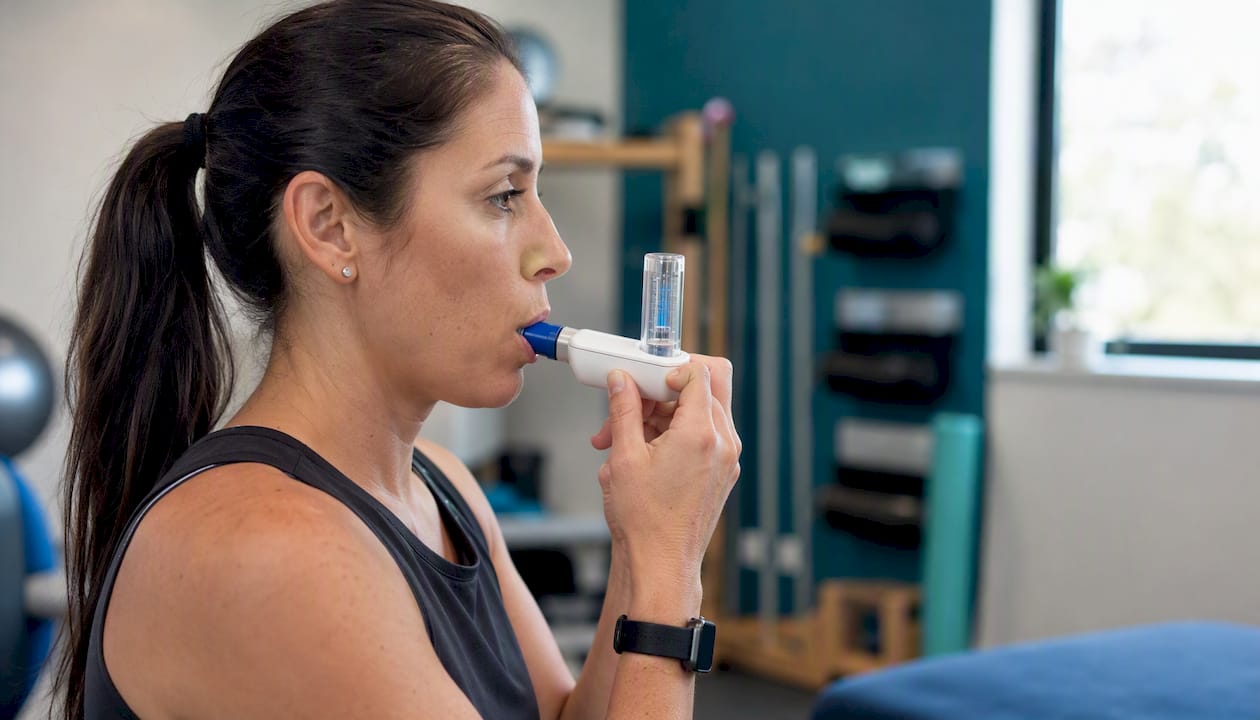
Both are inexpensive, portable, and don't require supervision for basic use, though calibrating intensity properly benefits from a baseline strength test.
Here's a six-week progressive structure, similar in shape to protocols used in the RMET research referenced earlier:
- Weeks 1 to 2: two sessions per week, two sets of 30 breaths at around 40% of your measured or estimated peak inspiratory strength. Focus on technique and consistency over intensity.
- Weeks 3 to 4: three sessions per week, two sets of 30 breaths at 50% peak strength. This is where the IMW protocol from earlier becomes relevant, you can also start using a shortened version as a pre-hard-run warm-up.
- Weeks 5 to 6: three to four sessions per week, building to three sets of 30 breaths at 50 to 60% peak strength, and introduce the full pre-race IMW protocol before at least one hard session per week to rehearse it under real conditions.
The respiratory muscle strength research linking MIP and MEP to VO2max is the reason clinicians bother measuring these numbers at all, they're not just diagnostic curiosities, they're genuinely predictive of aerobic capacity.
Safety first, though. This kind of training isn't appropriate for everyone without guidance. Stop and seek assessment if you have uncontrolled asthma, any history of exercise-induced bronchoconstriction that isn't well managed, chest pain, unusual breathlessness at rest, or any cardiovascular symptoms during exercise. Respiratory training should support your breathing, not mask a problem that needs medical attention.
Pairing that with a look at core stability and running mechanics, since diaphragm efficiency and trunk control are linked, as covered in strength training for runners, gives a genuinely complete picture rather than treating breathing as an isolated system.
Pro Tip: If you don't have access to inspiratory training equipment yet, twenty slow, resisted breaths through pursed lips, like blowing gently through a straw, gives you a rough approximation of the effect while you decide whether to invest in a proper device.
Common breathing problems and quick fixes
Side stitches usually respond to two things: switching your breathing pattern (try 3:2 if you've been running symmetrically) and slowing your pace slightly until the cramp eases. Weak core stability is a frequent underlying cause, since a tired diaphragm working alone strains against poor trunk support, so exercises like planks, dead bugs and the Pallof press genuinely help prevent recurrence, not just treat the symptom mid-run.
Feeling like you "can't get enough air" on an easy run is very often a pacing problem disguised as a breathing problem, slow down and reassess before assuming something's wrong. If it persists at genuinely easy effort, that's worth investigating further.
Quick checklist for common issues:
- Side stitch: switch breathing ratio, slow down, press gently on the area, breathe out fully as the opposite foot lands.
- Breathlessness that feels disproportionate to effort: ease off, check posture (slouching restricts the diaphragm), reassess after a few easy runs.
- Wheezing, tightness or a persistent cough during or after runs: this can indicate exercise-induced bronchoconstriction, and around 40% of runners experience some degree of exercise-induced dyspnoea, so it's more common than most people assume, but persistent symptoms still warrant proper assessment rather than working through it.
- Chest pain, dizziness, or breathlessness wildly out of proportion to effort: stop running and seek medical assessment, these aren't breathing-technique problems.
If breathing issues keep recurring alongside other niggles, it's worth reading about why injuries keep coming back, the same "treat the pattern, not just the symptom" logic applies to breathing dysfunction as much as it does to recurring strains.
How we look at breathing in the clinic
When a runner comes in complaining their legs "just don't feel like they've got anything," breathing is one of the first things we screen, alongside gait and core control, because the three are so tightly linked. We'll typically watch someone breathe at rest, then on a treadmill at an easy and a harder pace, checking whether their pattern holds up or collapses into shallow upper-chest breathing under fatigue. That observation, paired with strength and mobility screening around the trunk and hips, usually tells us more than any single test in isolation.
One case that sticks in memory: a club runner plateaued for months despite solid training, kept getting side stitches on tempo days, and turned out to be an almost pure chest breather with noticeably weak core endurance. Four weeks of diaphragmatic retraining alongside targeted core work, and the stitches stopped, tempo pace felt noticeably easier at the same heart rate. Not every case resolves that cleanly, but the pattern, breathing mechanics tangled up with core function, comes up more often than most runners expect.
Get your breathing properly assessed
Reading about diaphragmatic breathing is one thing, knowing whether your own pattern is actually holding you back is another. Sportsinjurydublin runs supervised breathing assessments that measure your actual MIP and MEP rather than relying on the generic thresholds covered in this article, then builds a training plan around your numbers, not an average runner's.

A first visit typically involves a strength and ventilatory assessment, a look at how your breathing holds up as effort increases, and a check of the core and postural factors that often sit underneath poor breathing mechanics. From there you get a bespoke plan rather than a generic six-week template, useful whether you're chasing a 5K PB or coming back from an injury that's disrupted your training rhythm. If you'd like that assessment built into a broader return-to-fitness plan, sports rehabilitation at Sportsinjurydublin is the place to start, book an initial assessment and find out what your own numbers actually say.
Frequently asked questions
Does breathing technique actually improve running performance, or is it mostly placebo? Both, honestly.
How do I know if I'm a chest breather or a diaphragmatic breather? Lie down, put one hand on your chest and one on your belly, and breathe normally. If your chest hand rises more than your belly hand, you're breathing predominantly from your chest, the less efficient pattern most people default to under stress.
What's the best breathing pattern for a 5K race? A controlled 3:2 or 2:2 rhythm for the opening kilometre, shifting toward whatever ratio keeps you getting sufficient air as effort climbs through the middle and closing stages. Don't force a fixed pattern once you're deep into race effort, prioritise oxygen over rhythm.
Can nasal breathing alone improve my running? It's genuinely useful on easy runs, where it naturally caps your effort and reinforces diaphragmatic mechanics, but the evidence favours oronasal breathing (nose and mouth together) for endurance performance at moderate to high intensity, not nasal-only.
When should I see a professional about breathing problems while running? If you experience chest pain, wheezing, a persistent cough, or breathlessness that feels wildly out of proportion to your effort, get assessed rather than trying to train through it. A supervised assessment can measure your actual respiratory muscle strength and rule out issues like exercise-induced bronchoconstriction.
This article is general information, not a substitute for advice from a qualified doctor. Consult a qualified healthcare professional about your own circumstances before acting on anything here.
Sources
- PubMed 30640308
- Breath Tools: A synthesis of evidence-based breathing strategies to enhance human running