

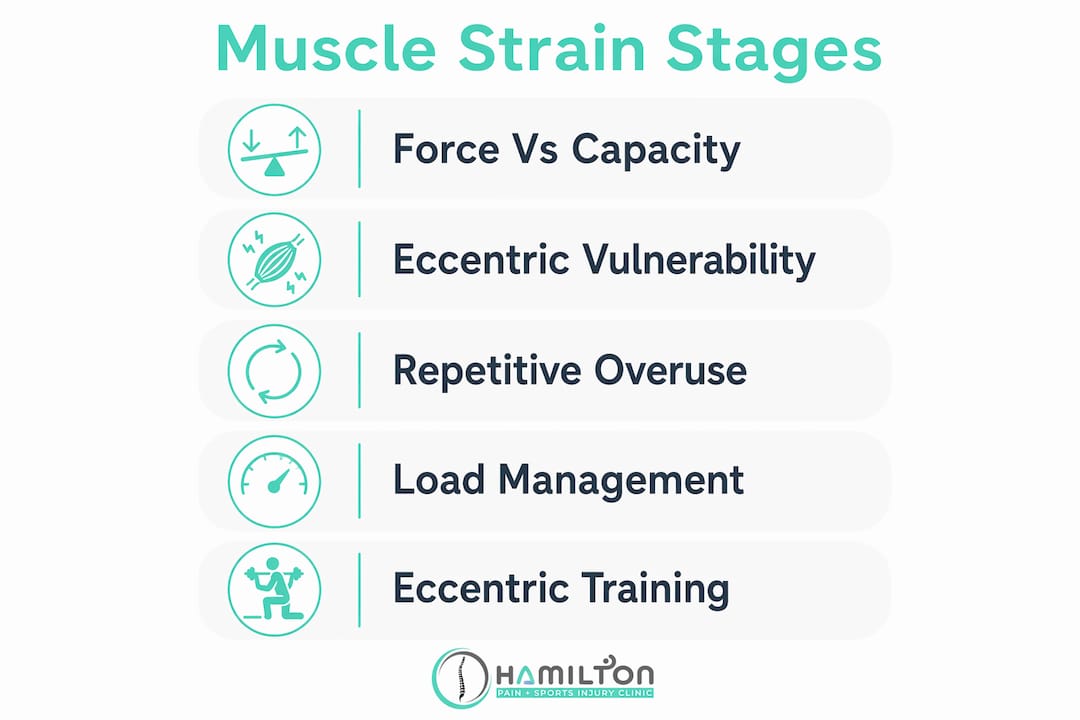
A muscle strain happens when the force placed on a muscle exceeds what that tissue can handle, causing the fibres to overstretch or tear. That's the short answer. The three situations where this plays out most often are:
- Acute overload: a sudden, unexpected force or overstretch (think slipping on a wet floor or yanking a heavy box)
- Eccentric contraction failure: the muscle tears while it's lengthening under load, which is exactly what happens at a sprint start or when lowering a heavy weight
- Repetitive overuse: cumulative microtrauma from doing the same movement over and over without enough recovery time (hello, weekend gardeners)
Pro Tip: The single most modifiable risk factor you can act on today is load management. Doing too much, too soon is behind more strains than almost anything else. Slow the progression, and you take a huge chunk of risk off the table.
Table of Contents
- What actually happens inside a muscle when it strains
- Grades of muscle strain and which muscles get hit most
- How strains actually happen: the mechanisms behind the injury
- What makes your muscles more likely to strain
- How a strain feels and what else it could be
- How clinicians diagnose a strain and when to see a GP
- First aid and how to recover properly
- How long does recovery actually take?
- How to prevent muscle strains from happening in the first place
- When a specialist assessment makes a real difference
- Key takeaways
- The part most people get wrong about muscle strains
- Useful sources
What actually happens inside a muscle when it strains
A muscle strain, sometimes called a pulled muscle, is the tearing or overstretching of muscle fibres or the musculotendinous junction — the point where the muscle transitions into tendon. That junction is a particular weak spot because it's where two very different tissue types meet, and force concentrates there under load.
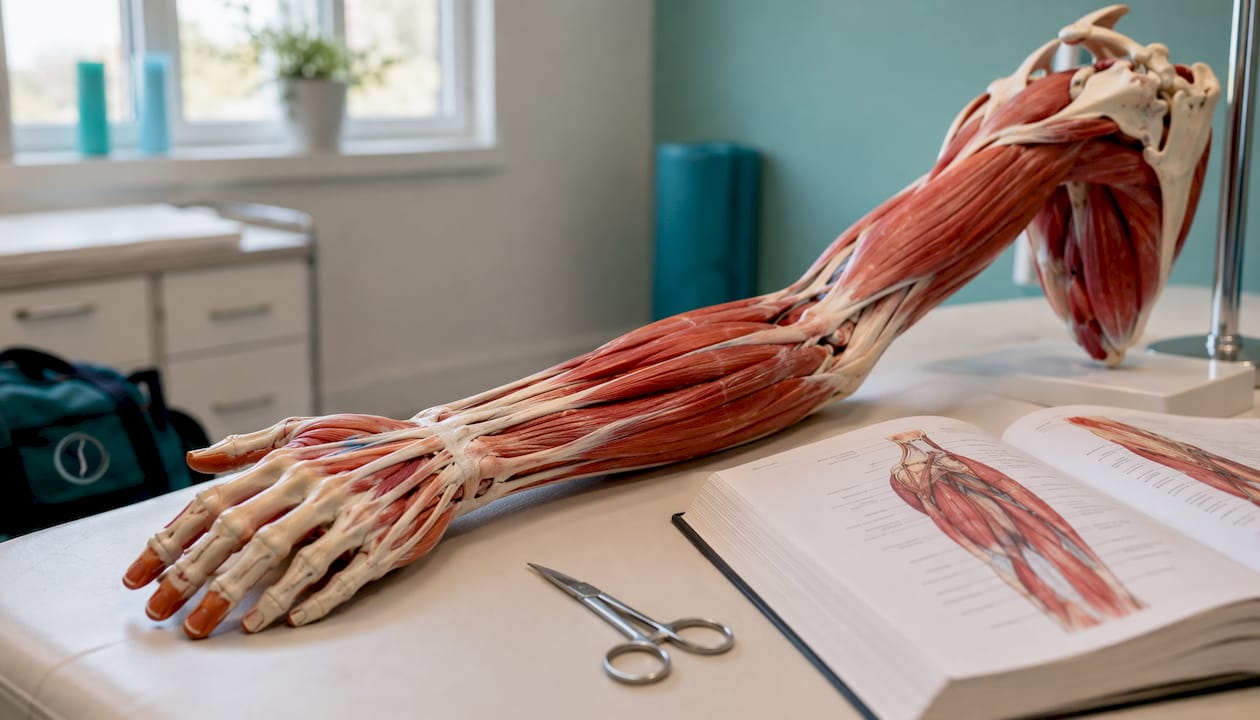
In plain terms, your muscles are made up of bundles of fibres wrapped in a connective tissue called fascia, which then taper into tendons that attach to bone. Under normal conditions, the muscle generates or absorbs force smoothly. When the demand outstrips the tissue's capacity — whether from a sudden spike in load or from fatigue grinding down that capacity — fibres begin to fail. A few fibres tearing is a mild strain. A large portion tearing is a severe one.
The force-versus-capacity framework is the key idea here. A movement that's completely safe on a fresh, well-warmed muscle can cause a muscle strain when that same muscle is fatigued, cold, or already carrying scar tissue from a previous injury. The movement didn't change; the tissue's ability to cope did.
One thing worth clearing up: a strain involves muscle or tendon, while a sprain involves ligament. They feel similar and people use the terms interchangeably all the time, but they're different structures and the rehab differs too. Getting the distinction right early changes your recovery expectations.
Grades of muscle strain and which muscles get hit most
Not all strains are equal, and clinicians use a three-grade system to describe severity.
Grade I is a mild strain. A small number of fibres are torn, the muscle still functions, and pain is localised but manageable. You'll feel tenderness and some tightness, but you can usually still move the limb.
Grade II is a partial tear. A significant proportion of fibres are disrupted, there's noticeable swelling and bruising, strength is reduced, and certain movements become genuinely painful. This is the grade most people mean when they say they've "properly pulled" something.
Grade III is a complete or near-complete rupture. Function is severely compromised, there may be a visible gap or dent in the muscle, and the pain can paradoxically feel less sharp immediately after because the tension is gone. This needs urgent clinical assessment.
| Grade | Fibres affected | Functional impact |
|---|---|---|
| I | Minor tear, few fibres | Mild pain, near-normal function |
| II | Partial tear, significant fibres | Reduced strength, swelling, pain with use |
| III | Complete or near-complete rupture | Severe loss of function, possible visible defect |
As for where strains tend to happen, some muscles are just more vulnerable than others:
- Hamstrings — the classic sporting strain, especially in sprinting
- Calf (gastrocnemius) — common in racket sports and middle-aged runners (affectionately called "tennis leg")
- Lower back (lumbar erector spinae) — the most common strain in everyday life
- Quadriceps — often strained during kicking or sudden deceleration
- Shoulder (rotator cuff muscles) — frequent in overhead sports and manual work
Muscles that cross two joints — like the hamstrings, which cross both the hip and the knee — are especially prone because they have to manage force at both ends simultaneously. That's a lot to ask.
How strains actually happen: the mechanisms behind the injury
Acute overload
This is the classic "something went wrong" scenario. A sudden, unexpected force overwhelms the muscle before it can adapt. Lifting a heavy object with poor form, slipping on ice, or making a sharp change of direction in sport are all examples. The muscle simply doesn't have time to prepare, and fibres fail.

Eccentric phase vulnerability
This one surprises people. Most strains don't happen when a muscle is shortening (concentric) — they happen when it's lengthening under load (eccentric). The hamstring at the end of a sprint stride is a perfect example: it's decelerating the leg while simultaneously being stretched. That combination of length and load is where the tissue is most vulnerable. Lowering a heavy barbell, walking downhill with a loaded pack, or the follow-through of a kick all involve the same principle.
Repetitive overuse
Not every strain arrives with a dramatic moment. Repetitive motions — raking leaves for three hours, typing with a tense forearm, or running the same route every day without variation — create cumulative microtrauma. Each individual repetition is fine; the problem is the accumulated load without adequate recovery. The tissue degrades gradually until a relatively minor effort tips it over the edge.
What makes your muscles more likely to strain
Some of these you can change; some you can't. Worth knowing both.
Modifiable risk factors:
- Poor warm-up: cold, stiff muscle tissue has less elasticity and absorbs force less efficiently. The NHS identifies inadequate warm-up as a primary modifiable risk factor.
- Fatigue and overtraining: a tired muscle loses its ability to generate protective tension, so the passive structures (fascia, tendon) take more of the load
- Inadequate eccentric strength: if your muscles haven't been trained to handle load while lengthening, they're underprepared for the most common strain mechanism
- Muscle imbalances: when one muscle group is significantly stronger or tighter than its opposing group, the weaker side is exposed during dynamic movement
- Poor technique: inefficient movement patterns distribute load unevenly across tissues
- Sudden load increases: jumping training volume or intensity too quickly is the "too much, too soon" trap
Non-modifiable or harder-to-change factors:
- Previous injury is the strongest single predictor of a future strain. Scar tissue is stiffer and less elastic than healthy muscle, creating a weak link in the musculotendinous unit that's more likely to fail again.
- Age: tendons and connective tissue become less pliable with age, reducing the margin for error
- Certain systemic conditions: inflammatory conditions and some medications (notably fluoroquinolone antibiotics) can affect tendon integrity
Pro Tip: If you can only focus on two things, make them progressive load management and eccentric strength training. Those two address the most common mechanisms and the most preventable risk factors at the same time.
How a strain feels and what else it could be
Typical muscle strain symptoms
A strain usually announces itself clearly. You'll notice:
- Sudden, localised pain at the site of injury (often mid-muscle or near the musculotendinous junction)
- Possibly an audible or felt "pop" at the moment of injury
- Tenderness to touch over a specific area
- Swelling and bruising developing over hours
- Reduced strength in the affected muscle
- Pain that gets noticeably worse when you use that specific muscle
The localised nature is key. A strain hurts there, in a defined spot, and it hurts more when you contract or stretch that particular muscle.
Conditions that can look similar
Don't assume it's a strain just because it hurts after exercise. A sprain (ligament injury) causes similar pain but is typically worse with joint loading rather than muscle contraction. A tendon tear shares some features but often involves a different pain location and mechanism. Nerve root compression or a herniated disc can cause muscle-region pain with added numbness, tingling, or pain that radiates down a limb — those neurological symptoms are a red flag that it's not a simple strain. And if there's fever alongside muscle pain, infection needs to be ruled out promptly.
Distinguishing DOMS from a true strain matters too. Delayed onset muscle soreness is diffuse, peaks 24–48 hours after exercise, and settles within a few days. A strain is focal, may have that "pop" sensation, and doesn't follow that pattern.
Red flags that need urgent attention:
- A visible gap, dent, or deformity in the muscle
- Complete inability to use the limb or bear weight
- Severe, worsening swelling
- Neurological symptoms (numbness, tingling, weakness beyond the injured muscle)
- Fever alongside muscle pain
If any of those apply, don't wait it out.
How clinicians diagnose a strain and when to see a GP
Clinical history and physical examination are the primary diagnostic tools for the vast majority of muscle strains. A clinician will ask how the injury happened, where exactly it hurts, and what movements make it worse. They'll then palpate the muscle, test resisted contraction, and check the range of motion. That's usually enough to grade the injury and plan management.
Imaging isn't routine for mild or moderate strains. Ultrasound or MRI is reserved for suspected Grade III tears, cases where the diagnosis is genuinely unclear, or when a patient isn't recovering as expected. Requesting a scan for every sore muscle would be both unnecessary and unhelpful.
When to contact NHS 111 or your GP:
- Severe pain that isn't improving after 48 hours
- Inability to weight-bear or use the limb
- Worsening swelling beyond the first 24 hours
- Any suspicion of a Grade III tear (visible defect, complete loss of function)
- Neurological symptoms: numbness, tingling, or weakness that doesn't match the injury site
- No meaningful improvement after two weeks of appropriate self-management
The first 48–72 hours are about protection and settling the acute response. If things aren't moving in the right direction by then, that's the time to escalate.
First aid and how to recover properly
The first 48 hours
The NHS-aligned approach for immediate management follows the PRICE framework:
- Protect the area from further injury — modify activity, use a support if needed
- Rest from aggravating activity (short-term, not prolonged bed rest)
- Ice the area for 15–20 minutes every 2–3 hours in the first 48 hours (cloth between ice and skin)
- Compress with a bandage to limit swelling
- Elevate the limb where possible to reduce swelling
Over-the-counter pain relief (paracetamol or ibuprofen, following standard dosing guidance) can help manage pain and inflammation in the early stages.
Why prolonged rest is the wrong call
Here's the thing: staying completely still for days on end actually slows recovery. Modern guidelines favour early, controlled reintroduction of movement as soon as pain allows. Prolonged immobility leads to muscle atrophy and poor collagen alignment in the healing tissue. The goal is protection in the acute phase, then progressive loading to guide proper tissue repair.
Think of it like this: the scar tissue that forms during healing will align itself according to the stresses placed on it. Load it gently and progressively, and it aligns well. Leave it completely alone, and it forms in a disorganised way that's weaker and more prone to re-injury.
Rehabilitation principles
- Progressive loading: start with gentle, pain-free range of motion, then build through isometric holds, then isotonic movement, then full functional loading
- Eccentric strengthening: once the acute phase passes, eccentric training is the most important component of rehab for preventing recurrence
- Restore full range of motion before returning to full activity
- Return-to-activity criteria: pain-free at rest, full range of motion, strength at least 90% of the uninjured side, and ability to perform sport-specific movements without compensation
For a deeper look at staged rehabilitation and what each phase involves, it's worth understanding the full process before you rush back.
How long does recovery actually take?
Realistic timelines depend heavily on the grade of the strain, the muscle involved, and individual factors like age and whether there's been a previous injury at the same site.
| Grade | Typical recovery range | Notes |
|---|---|---|
| I | Days to 2 weeks | Most return to full activity within 1–2 weeks with appropriate management |
| II | 2 weeks | Requires structured rehab; rushing return increases re-injury risk |
| III | Months; possible surgical review | Needs specialist assessment; timeline highly variable |
Signs that recovery is slower than expected and warrants reassessment:
- Pain increasing rather than gradually reducing after the first week
- Failure to regain meaningful strength or range of motion by the expected timeframe
- New neurological symptoms appearing during recovery
- A second injury at the same site
Age, comorbidities, and the presence of scar tissue from previous injuries all influence how quickly tissue heals. A 22-year-old with a first-time Grade I hamstring strain will recover faster than a 50-year-old with a history of the same injury. That's not pessimism; it's just physiology.
How to prevent muscle strains from happening in the first place
Prevention is genuinely achievable for most people, and the evidence points to a fairly consistent set of strategies.
- Warm up properly: 5–10 minutes of progressive movement that raises tissue temperature and increases blood flow to the muscles you're about to use. Dynamic movements (leg swings, arm circles, light jogging) are more effective than static stretching before activity.
- Progress load gradually: the "10% rule" — don't increase weekly training volume by more than 10% at a time — is a reasonable starting point. Avoid dramatic spikes in intensity or duration.
- Train eccentrically: most strains happen during the lengthening phase, so training that phase specifically is protective. Nordic hamstring curls, Romanian deadlifts, and slow lowering movements are your friends here. A solid mobility restoration checklist can help you build this into your routine systematically.
- Address muscle imbalances: if one side is significantly weaker or tighter, work on it specifically rather than hoping it sorts itself out.
- Recover properly: sleep, nutrition, and managing cumulative training load are not optional extras. Fatigue is a direct risk factor, and recovery is when adaptation happens.
- Check your technique: poor movement patterns under load are a fast track to tissue failure. If you're unsure, get a movement screen from a qualified professional.
- Don't ignore previous injuries: a muscle that's been strained before needs specific rehab to restore full strength and elasticity, not just rest until it stops hurting. The injury recurrence cycle is real, and it's almost always driven by incomplete recovery.
When a specialist assessment makes a real difference
Some situations genuinely benefit from a clinician's eyes rather than self-management alone. At Hamilton Sports and Injury Clinic, the cases that typically need specialist input include:
- Suspected Grade III strains where there's significant loss of function or a possible visible defect
- Recurrent strains at the same site — if it keeps happening, something in the rehab or loading pattern isn't right
- Diagnostic uncertainty — when you're not sure whether it's a strain, a tendon issue, or something neurological
- Performance concerns — athletes who need to return to sport safely and want objective return-to-sport criteria rather than guesswork
- Persistent pain beyond the expected timeline for the grade of injury
A specialist assessment goes beyond a GP appointment in practical terms. It includes a detailed movement history, functional testing under load, identification of contributing factors (imbalances, technique, training load), and a bespoke progressive rehabilitation plan with clear return-to-activity milestones. The approach at Sportsinjurydublin is built around the individual — lifestyle, activity level, and goals — rather than a generic protocol.
If you're dealing with a strain that isn't following the expected recovery curve, or you want a structured return-to-sport plan, Sportsinjurydublin's sports rehabilitation service is designed for exactly that. Specialist input at the right moment can mean the difference between a full recovery and a recurring problem.
Key takeaways
Muscle strains are caused by force exceeding tissue capacity, and the most preventable cases come down to load management, adequate warm-up, and eccentric strength training.
| Point | Details |
|---|---|
| Force vs capacity | A strain occurs when demand on the muscle exceeds what the tissue can absorb — not just from big loads, but from fatigue reducing capacity. |
| Eccentric phase is highest risk | Most strains happen while the muscle is lengthening under load; training this phase specifically is the most protective thing you can do. |
| Previous injury is the top predictor | Scar tissue is less elastic than healthy muscle, making a previously strained site significantly more vulnerable to recurrence. |
| Early controlled loading beats rest | Prolonged immobility slows recovery; gentle progressive movement as pain allows leads to better tissue healing. |
| Red flags need prompt attention | Visible defect, inability to weight-bear, neurological symptoms, or no improvement after 48 hours all warrant NHS 111 or GP contact. |
The part most people get wrong about muscle strains
The conventional wisdom around muscle strains tends to focus on the dramatic moment — the sprint, the lift, the slip. And yes, those acute events matter. But in my experience working with people across a wide range of activity levels, the more interesting (and more preventable) story is almost always about what happened in the weeks before the injury.
The tissue didn't fail because of that one sprint. It failed because the training load had been creeping up without adequate recovery, or because the previous strain at the same site was never fully rehabilitated, or because the eccentric component of the muscle's function had never been specifically trained. The sprint was just the moment the accumulated deficit became visible.
What I'd push back on is the idea that strains are bad luck. Some are. But a large proportion are the predictable result of identifiable, modifiable patterns. The "too much, too soon" error is almost embarrassingly common, and it's entirely avoidable with sensible load progression. Eccentric training is still underused in most recreational programmes despite being the most evidence-backed prevention tool we have for the most common strain mechanisms.
If you've had a strain before — especially a recurrent one — the question worth asking isn't "how do I rest it?" but "what was the deficit that made this happen, and have I actually addressed it?" That reframe tends to produce better outcomes than another two weeks on the sofa.
Useful sources
A short list of reputable places to read further, all UK-relevant or major clinical authorities:
- NHS: Sprains and strains — the primary UK guidance on first aid, when to seek help, and home management
- MedlinePlus: Strains — clear medical encyclopedia entry covering causes, symptoms, and treatment
- Harvard Health: Muscle strain A to Z — accessible clinical overview including grading and differential diagnosis
- Cleveland Clinic: Muscle strains — detailed explainer on causes, types, and rehabilitation principles
- Stronger by Science: How to prevent muscle strains — evidence-based breakdown of eccentric training and prevention strategies
- Sportsinjurydublin.ie — for readers in Dublin seeking specialist assessment or a structured rehabilitation programme
This article is general information, not medical advice. For your specific situation, confirm current guidance with NHS 111, your GP, or a qualified clinician.