
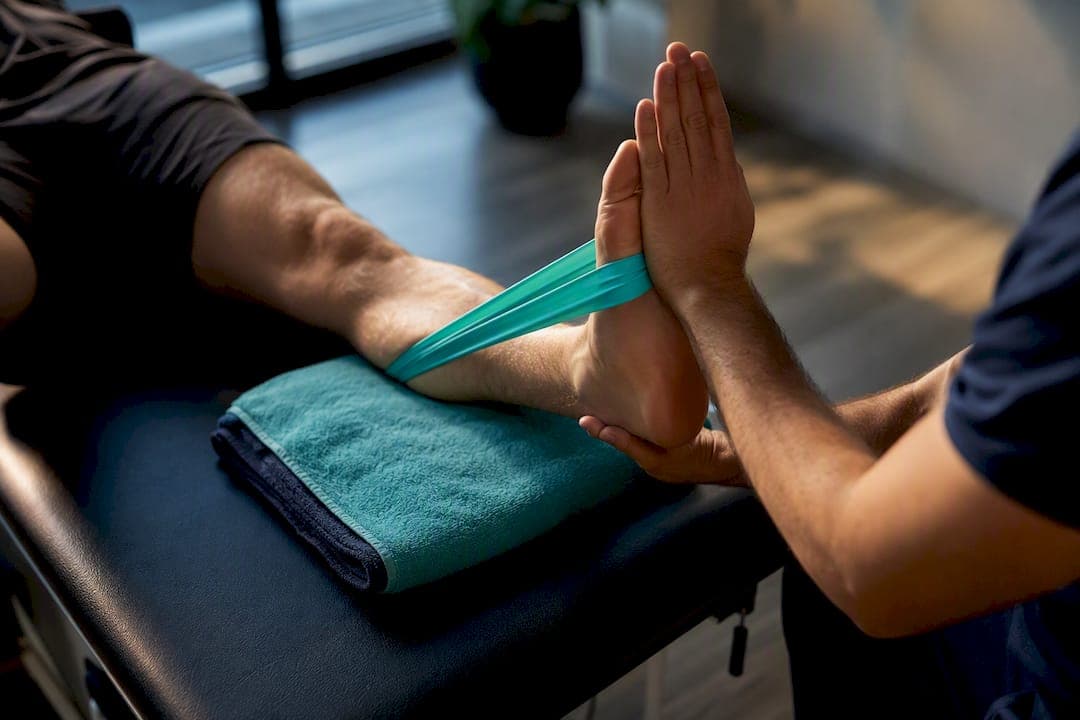
Manual therapy techniques are hands-on procedures, think joint mobilisation, manipulation, soft-tissue work, muscle energy techniques and nerve gliding, applied by a trained clinician to reduce pain and restore movement. The main categories cover a spectrum from gentle oscillations to quick manipulative thrusts, and research on integrated manual therapies generally shows benefits of varying size when these methods sit inside a broader plan that includes exercise. Used by a properly trained clinician, manual therapy is safe for most people, though certain conditions call for caution or medical clearance first.
TL;DR:
- Manual therapy techniques are tailored based on the patient's symptoms, with gentler approaches for irritable tissues and firmer techniques for stiffness.
- Proper assessment, including history, movement testing, and identifying comparable signs, guides clinicians in selecting and grading appropriate manual techniques.
- Techniques like joint mobilization, soft-tissue work, and neurodynamic methods should be used cautiously or avoided in cases of red flags, systemic illness, or recent trauma.
- Manual therapy offers short-term pain relief with the best outcomes when combined with active exercise and structured rehabilitation.
- Practitioners require proper training and credentials, with specific techniques contraindicated or modified depending on individual health status.
Table of Contents
- What are the main categories of manual therapy techniques?
- How do therapists choose and grade specific techniques?
- What happens during common manual therapy techniques?
- How does manual therapy actually work?
- Which conditions respond best to manual therapy?
- Is manual therapy safe, and what should you expect in a session?
- How does manual therapy fit into a full treatment plan?
- What does Sportsinjurydublin see in practice?
- What contraindications apply to specific manual therapy techniques?
- What does manual therapy look like for different body regions?
- What training do practitioners need to perform manual therapy?
- How is a patient assessed before choosing a technique?
- When should manual therapy be offered, and when shouldn't it be?
- How Sportsinjurydublin can help with hands-on treatment
- Sources
What are the main categories of manual therapy techniques?
Right, let's sort the toolbox before we start pulling things out of it. Manual therapy isn't one thing, it's a family of related approaches, and knowing the difference actually matters if you want to understand what's happening to your body on the treatment table.
Mobilisation is slow, controlled, graded movement of a joint within (or occasionally at the edge of) its normal range. Think of it as coaxing a stiff hinge rather than forcing it. Manipulation, by contrast, is a quick, small-amplitude thrust, often called an HVLA (high-velocity, low-amplitude) technique, delivered right at the end of the available range. Both work on joints, but the speed and intent differ enormously.
Soft-tissue mobilisation and myofascial techniques target muscle, fascia and connective tissue rather than the joint itself, using sustained pressure, stretching or gliding strokes to change tissue tone and reduce local sensitivity. Muscle energy techniques flip the script slightly: instead of the therapist doing all the work, you actively contract a muscle against gentle resistance, which then allows a bit more range once you relax. Neurodynamic techniques address the nervous system directly, gliding or gently tensioning a nerve that's become irritated or stuck against surrounding tissue.
Clinicians reach for these categories based on straightforward decision cues, and this is where manual therapy vs physiotherapy questions usually start making sense:
- Pain-dominant presentations (sharp, easily provoked, irritable) tend to get gentler grades of mobilisation or soft-tissue work first.
- Stiffness-dominant presentations (a joint that's simply tight, with pain only at end range) often respond better to firmer mobilisation grades or manipulation.
- Neural symptoms (tingling, radiating pain, a nerve that seems "caught") point towards neurodynamic sliders or tensioners.
- Muscle guarding or spasm often responds well to muscle energy techniques because they use the patient's own nervous system to switch tension down.
None of this is guesswork dressed up as science. Practitioners typically use grading systems, most commonly Maitland and Kaltenborn scales, to match the dose of a technique to what the tissue can tolerate on that particular day. A joint that's screaming at you gets a very different approach to one that's just a bit sulky.
How do therapists choose and grade specific techniques?
This is where manual therapy stops being a checklist and starts being genuine clinical judgement. A good therapist doesn't pick a technique because it's their favourite, they pick it because the assessment told them to.
The process starts with a proper history: what aggravates the problem, what eases it, how long it's been going on, and whether there are any red flag symptoms that need medical attention rather than hands-on treatment. Range of movement gets tested, along with basic neurological checks (reflexes, strength, sensation) where nerve involvement is suspected.
One of the more useful concepts here is the comparable sign, essentially a movement, position or test that reliably reproduces your symptoms. The therapist finds it, then uses a test-treatment approach: apply a small dose of a technique, then immediately recheck that comparable sign. Did the range improve? Did the pain ease? If yes, that direction of treatment is probably worth progressing. This kind of immediate test-and-recheck logic stops treatment being a shot in the dark.
Dosing follows a few consistent rules:
- Irritable, easily aggravated tissue gets lower grades (Maitland I–II), shorter holds, and less frequent sessions until things calm down.
- Stiff but non-irritable tissue can tolerate firmer grades (III–IV) and more repetitions.
- Grade V thrusts (manipulation) are used sparingly, only when clearly indicated, and only by clinicians specifically trained in that technique.
- Progression typically means increasing grade, increasing repetitions, or shortening the interval between sessions, always guided by how you respond, not by a fixed protocol.
- Manual therapy is layered with active exercise fairly early, because passive treatment on its own rarely holds gains long-term.
Red flags, unexplained weight loss, night pain that doesn't ease with position change, saddle anaesthesia, progressive neurological deficit, mean manual therapy gets paused and you get referred on. A good clinician treats this as a filter they apply every single session, not a box ticked once at intake.
What happens during common manual therapy techniques?
Here's where we get into the actual mechanics, because I think patients deserve to know what's genuinely happening to their body rather than a vague "we'll loosen things up."
1. Joint mobilisation and manipulation
Mobilisation grades run I to IV on the Maitland scale: Grades I to IV involve increasing amplitude and range from gentle oscillations to movements reaching the limit of range to gain mobility. Grade V is the manipulation, a single, fast thrust delivered right at end range. That "pop" you sometimes hear during manipulation isn't a bone going back into place, it's a pressure change releasing gas within the joint fluid, a detail that tends to put nervous patients at ease once they understand it. Indications range from a stiff facet joint in the spine to a restricted shoulder capsule. Immediate effects can include a sense of easier movement, sometimes mild soreness for a day or so afterwards.
2. Soft-tissue mobilisation and myofascial release
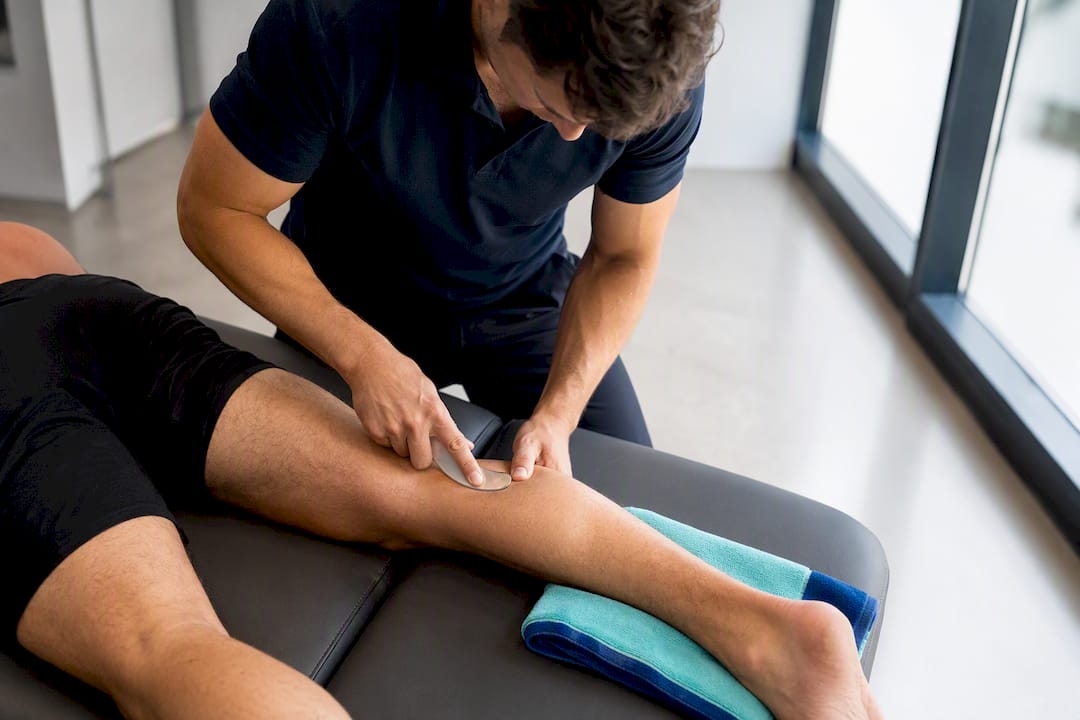
This involves sustained or rhythmic pressure through muscle and fascia, sometimes with the therapist's hands, sometimes with an instrument (IASTM, instrument-assisted soft-tissue mobilisation, uses a smooth-edged tool to apply targeted pressure along a muscle or tendon). The goal is usually to reduce local tenderness, improve tissue glide, and calm an overactive muscle. Dosing is typically 30 to 90 seconds per area, repeated across a session, with pressure adjusted to what you can comfortably tolerate. For anyone wanting a deeper look at when this approach is chosen over joint work, myofascial release therapy covers the practical decision-making in more detail.
3. Muscle energy techniques
You contract a specific muscle group against the therapist's resistance, hold for several seconds, then relax. On relaxation, the therapist takes up the new slack, gaining range without any forceful stretching. It's particularly useful where muscle guarding is limiting movement, because you're doing the work rather than having it done to you, which tends to feel less confrontational for people who are a bit tense about hands-on treatment anyway.
4. Trigger-point therapy and dry needling
Manual trigger-point work uses sustained finger or thumb pressure on a hyperirritable knot within muscle tissue until tension eases. Dry needling is a different beast entirely, it's an invasive technique using a thin filiform needle inserted directly into the trigger point, and it should only be performed by a clinician specifically trained and credentialed in the technique, with appropriate hygiene and consent procedures. The rationale overlaps (both aim to desensitise an irritable point), but the risk profile does not. Needling carries minor risks such as bruising and soreness, with rare serious complications possible depending on the treatment area.
5. Neurodynamic techniques
These target nerves that have become sensitised or mechanically restricted, sciatic nerve irritation is a classic example. Sliders move a nerve back and forth relative to surrounding structures without increasing overall tension, which is gentler and often used first. Tensioners load the nerve more directly and are usually introduced once the nervous system has calmed down a bit. Both are indicated where symptoms suggest nerve entrapment or irritation rather than pure muscle or joint pathology.
6. Traction and instrument-assisted methods
Manual or mechanical traction gently distracts joint surfaces, often used in the spine where nerve root compression is suspected. Instrument-assisted methods extend a therapist's reach and precision for soft-tissue work, useful for chronic, dense scar tissue that's hard to shift with hands alone.
Pro Tip: Speak up during treatment. If a technique reproduces sharp, electric, or radiating pain rather than a dull "working" sensation, tell your therapist immediately, that's the stopping criterion, not something to grit your teeth through.
How does manual therapy actually work?
The honest answer is more interesting than "it loosens tight muscles." Modern mechanistic reviews suggest manual therapy works through several overlapping pathways, not one single mechanism, and that's actually good news because it means multiple routes to feeling better.
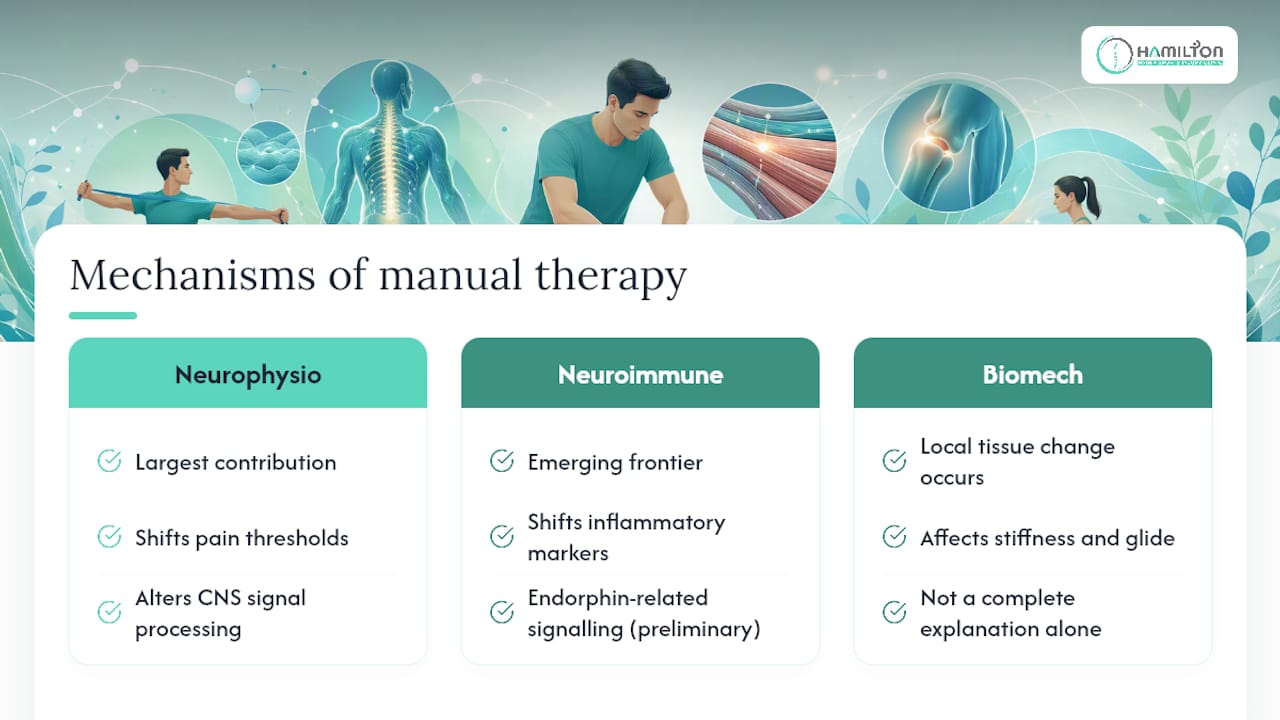
Neurophysiological effects are probably the biggest piece of the puzzle. Manual techniques appear to shift pain thresholds and influence how the central nervous system processes incoming signals, a process related to conditioned pain modulation, essentially the body's own volume dial for pain. This is quite different from the old idea that a therapist is "realigning" something structural.
Reviews synthesising manual therapy's effects report that changes in pain thresholds and inflammatory markers follow hands-on treatment, pointing to neurophysiological and neuroimmune pathways alongside any local tissue change, not instead of it.
Neuroimmune and biochemical changes are the newer, more cautious frontier. Some research points to shifts in inflammatory markers and endorphin-related signalling following treatment, though this area is still being mapped out and shouldn't be oversold.
Biomechanical effects do exist, tissue can genuinely change stiffness and glide locally, but the purely biomechanical model (the idea that a therapist is physically "fixing" misaligned structures) doesn't hold up as a complete explanation on its own.
Here's the practical takeaway: because the mechanisms vary between people and conditions, mechanistic-based treatment matching, pairing the presumed dominant mechanism with the chosen technique, tends to produce better outcomes than a one-size-fits-all protocol. This is precisely why a good clinician asks so many questions before touching you at all.
Which conditions respond best to manual therapy?
Let's be straight about this, because I'd rather under-promise than have you disappointed. Evidence strength varies quite a bit by condition, and knowing where manual therapy earns its keep helps you set realistic expectations.
- Low back pain and neck pain: this is where the evidence is strongest. Systematic reviews of manual medicine report spinal mobilisation and manipulation outperforming no treatment or usual care in many trials, particularly for short-term pain and function, especially when combined with exercise rather than used alone.
- Headache and cervicogenic pain: manual approaches targeting the upper neck show a genuine effect on tension-type and cervicogenic headache frequency and intensity for a meaningful proportion of patients.
- Temporomandibular disorder (TMD): hands-on jaw and neck work can reduce jaw pain and improve opening range as part of a broader management plan, usually alongside education on habits like clenching.
- Knee osteoarthritis and selected extremity conditions: manual therapy tends to function as a useful adjunct here rather than a standalone fix, helping with pain and function alongside strengthening work rather than replacing it.
The important caveat, and I'll say this plainly because too many clinics gloss over it: short-term gains are well documented, but long-term outcomes are less certain across the board. That's not a knock against manual therapy, it's just reality, and it's exactly why multimodal care (hands-on treatment plus exercise plus education) consistently beats any single approach used in isolation. If you're weighing up physiotherapy versus chiropractic care for back pain specifically, the evidence points less towards which profession you see and more towards whether the plan includes active rehabilitation, not just passive treatment.
Is manual therapy safe, and what should you expect in a session?
Manual therapy is generally safe when performed by qualified clinicians, but "generally safe" isn't the same as "safe for everyone in every situation," so it's worth knowing where the lines sit.
Absolute contraindications (situations needing medical clearance before any hands-on treatment) include suspected fracture, active infection or inflammation at the treatment site, recent surgery in the area, and certain vascular conditions, particularly relevant for techniques involving the neck.
Relative contraindications and precautions, meaning proceed with caution and often a modified approach, include osteoporosis (lighter grades, avoiding forceful thrust techniques), patients on anticoagulant medication (soft-tissue work adjusted to reduce bruising risk), pregnancy, and long-standing steroid use affecting tissue integrity. A clinician should be asking about all of this before laying a hand on you.
Common, entirely normal short-term effects include mild soreness for a day or two, similar to how you'd feel after a decent gym session, and occasionally minor bruising from soft-tissue or instrument-assisted work.
- A typical session runs: assessment and history, informed consent and a chance to ask questions, a brief test-treatment to gauge your response, the chosen technique itself, then exercise instruction and home advice to carry the benefit forward.
- Documentation of consent and a discussion of rare risks (very rarely, neurovascular events following cervical thrust techniques) should be standard practice, not an afterthought.
Pro Tip: If a clinician skips the questions about your medical history and goes straight for a joint crack, that's a red flag about their process, not a sign you're in efficient hands.
How does manual therapy fit into a full treatment plan?
Manual therapy on its own provides symptom relief but is most effective when incorporated into a broader treatment plan. The real value comes from what happens around it.
- Pair it with targeted exercise. Mobility work and progressive strengthening consolidate the range and reduced pain that manual therapy creates, rather than letting the gains slip away within days.
- Set short-term and long-term goals separately. Short-term might be "reduce morning stiffness" or "improve shoulder rotation by next week." Long-term is about resilience, being able to run, lift, or play sport without the issue creeping back.
- Build a simple home programme. A handful of exercises done consistently between sessions, tracked loosely (better, same, worse), tells both you and your therapist whether the plan is working. Our guide on muscle recovery techniques covers practical ways to support this between clinic visits.
What does Sportsinjurydublin see in practice?
At Sportsinjurydublin, manual therapy is never the whole plan, it's one tool that earns its place alongside exercise, education, and honest conversation about what's actually driving someone's pain. Our approach, treating the person rather than a generic protocol, means the technique chosen for a marathon runner with a stiff hip is rarely identical to the one chosen for a weekend footballer with the same diagnosis on paper.
Our approach relies on test-treatment logic: we check if the specific technique applied changes the comparable sign, avoiding guesswork in treatment. For readers wanting the deeper mechanistic picture behind why hands-on treatment eases pain, our piece on how manual therapy reduces pain goes further into the nervous system side of things than we've had room for here.
We won't pretend every case responds the same way, that would contradict everything the evidence actually says about mechanistic variability between patients. What we can say is that combining hands-on techniques with structured rehabilitation is a pattern that shows positive results across athletes and everyday clients with varying sports or activity levels.
What contraindications apply to specific manual therapy techniques?
Different techniques carry different risk profiles, so a blanket "manual therapy is safe" statement doesn't quite cut it, precision matters here.
Joint manipulation (Grade V thrusts) carries the tightest restrictions: avoid in cases of suspected vertebral artery insufficiency, recent neck trauma, inflammatory arthropathies affecting spinal stability, or unexplained neurological symptoms. This technique should only ever be performed by a clinician specifically trained in HVLA delivery.
Soft-tissue mobilisation and IASTM need caution around varicose veins, active skin conditions, recent bruising, and patients on blood thinners, where lighter pressure and modified technique reduce bruising risk.
Muscle energy techniques, being lower-force by nature, have a shorter list of precautions but still warrant caution with acute muscle tears or very recent injury where active contraction could aggravate healing tissue.
Neurodynamic techniques require care in cases of severe nerve irritability, where aggressive tensioning can flare symptoms rather than settle them, gentler sliders are typically the safer starting point.
Dry needling, being invasive, carries its own separate consent process: avoid in needle phobia without appropriate preparation, active infection at the site, lymphoedema risk areas, and for patients on certain anticoagulants without medical sign-off. A properly trained practitioner will screen for all of this before the needle comes anywhere near you.
What does manual therapy look like for different body regions?
Neck (cervical spine): Gentle rotational mobilisations (Grade I–III) address stiffness and headache-related restriction; manipulation is used sparingly given the region's vascular sensitivity, always preceded by screening questions about dizziness or visual disturbance.
Shoulder: Capsular mobilisation, sustained stretching at end range, addresses the stiff, "frozen" shoulder pattern, while soft-tissue work on the rotator cuff and surrounding muscles targets tendinopathy-related tightness.
Lower back: Rotational and posterior-anterior mobilisations target facet joint stiffness; muscle energy techniques help release guarded paraspinal muscles without direct spinal loading.
Hip: Long-axis traction and capsular mobilisation address deep stiffness, particularly useful for early-stage osteoarthritis where joint space feels compressed.
Knee: Patellar mobilisation and soft-tissue work around the quadriceps and IT band address restricted tracking and referred tightness, usually paired with strengthening almost immediately.
Foot and ankle: Talocrural joint mobilisation restores dorsiflexion range, commonly limited after sprains, while soft-tissue work through the plantar fascia addresses heel and arch pain.
Each region carries its own grading logic, but the underlying principle stays constant throughout: match the grade and technique to what the tissue can tolerate that day, not to a fixed script.
What training do practitioners need to perform manual therapy?
This matters more than most patients realise, because "manual therapy" isn't a protected term everywhere, and scope of practice varies by profession and country. Physiotherapists, chartered physiotherapists specifically, typically complete a recognised degree followed by postgraduate manual therapy training, often to the standards set by organisations like IFOMPT (International Federation of Orthopaedic Manipulative Physical Therapists), which sets rigorous benchmarks for advanced joint manipulation competency.
Sports therapists and massage therapists receive training focused more heavily on soft-tissue and myofascial techniques, with scope typically excluding high-velocity spinal manipulation unless additional postgraduate certification has been completed. Chiropractors follow a separate training pathway centred heavily on spinal manipulation technique.
The practical upshot for you as a patient: ask what qualifications your therapist holds for the specific technique being proposed, not just their general job title. A clear distinction between practitioner roles helps you understand who's trained for what, and it's a perfectly reasonable question to ask before treatment starts. Terminology inconsistency across professions and countries is a genuine issue in this field, which is exactly why credentials matter more than titles.
How is a patient assessed before choosing a technique?
Nobody should be manipulating your spine five minutes after you walk through the door, and if that happens, it's worth asking questions.
A proper assessment starts with a detailed history: onset, aggravating and easing factors, previous injuries, medication (particularly anticoagulants or long-term steroids), and screening questions for red flags like unexplained weight loss or progressive neurological symptoms. Range of movement gets measured actively and passively, comparing both sides where relevant.
Neurological screening, reflexes, muscle strength, sensation, follows where nerve involvement is suspected, and special orthopaedic tests help narrow down which structures are actually contributing to your symptoms. The therapist identifies that comparable sign we mentioned earlier, the specific movement or position that reproduces your problem, because that becomes the yardstick for everything that follows.
Only once this picture is complete does technique selection happen, irritable tissue steers towards gentler grades and soft-tissue approaches, stiffness-dominant presentations towards firmer mobilisation, and nerve-related symptoms towards neurodynamic work. Assessment isn't a formality before the "real" treatment starts, it's what makes the treatment appropriate in the first place.
When should manual therapy be offered, and when shouldn't it be?
I'll be direct about this because vague positioning helps nobody. Manual therapy earns its place when someone presents with mechanical, movement-related pain, a stiff joint, a guarded muscle, an irritated nerve, where hands-on assessment can identify a comparable sign and a test-treatment response confirms the approach is working. It's particularly valuable early in a plan, when pain is limiting someone's ability to even begin exercising properly.
Other approaches take priority when red flags are present, when pain has a clear inflammatory or systemic driver rather than a mechanical one, or when someone's main barrier is deconditioning rather than joint stiffness, in that case, loading and strength work matter more than hands-on treatment. Manual therapy also shouldn't become a crutch someone returns to weekly indefinitely without progressing towards independent management.
Shared decision-making runs through all of this. We explain what we're finding, what a technique is likely to achieve, and what the realistic timeline looks like, then let the person's goals and preferences shape the plan alongside the clinical picture. Someone chasing a return to marathon training needs a different conversation to someone just wanting to sleep through the night without shoulder pain.
— Mark
How Sportsinjurydublin can help with hands-on treatment
If you've read this far, you're probably not looking for another generic explainer, you want to know what happens next for your actual injury. We treat each person individually rather than using standardised protocols, so treatment plans vary significantly depending on individual needs and activities.
An initial assessment covers everything outlined above: history, movement testing, identifying your comparable sign, and a test-treatment to see how your body actually responds before committing to a full plan. From there, manual therapy techniques get combined with structured rehabilitation through our sports rehabilitation programme, built around your specific sport, activity level and recovery timeline rather than a generic six-week template. For those managing a single stubborn issue rather than a full rehab journey, standalone recovery sessions offer a focused, hands-on option without a long-term commitment. Book an assessment and find out exactly what's driving your pain, and what it'll actually take to fix it.
Sources
The clinical claims throughout this piece draw on a handful of genuinely authoritative sources worth your own time if you want to dig deeper.
- Integrated manual therapies: IASP taskforce viewpoint
- Manual Therapy — Physio‑pedia
- The mechanisms of manual therapy: A living review of systematic, narrative, and scoping reviews | PLOS One
- Systematic review summary on manual medicine and manual therapy
This article is general information, not a substitute for advice from a qualified doctor. Consult a qualified healthcare professional about your own circumstances before acting on anything here.