
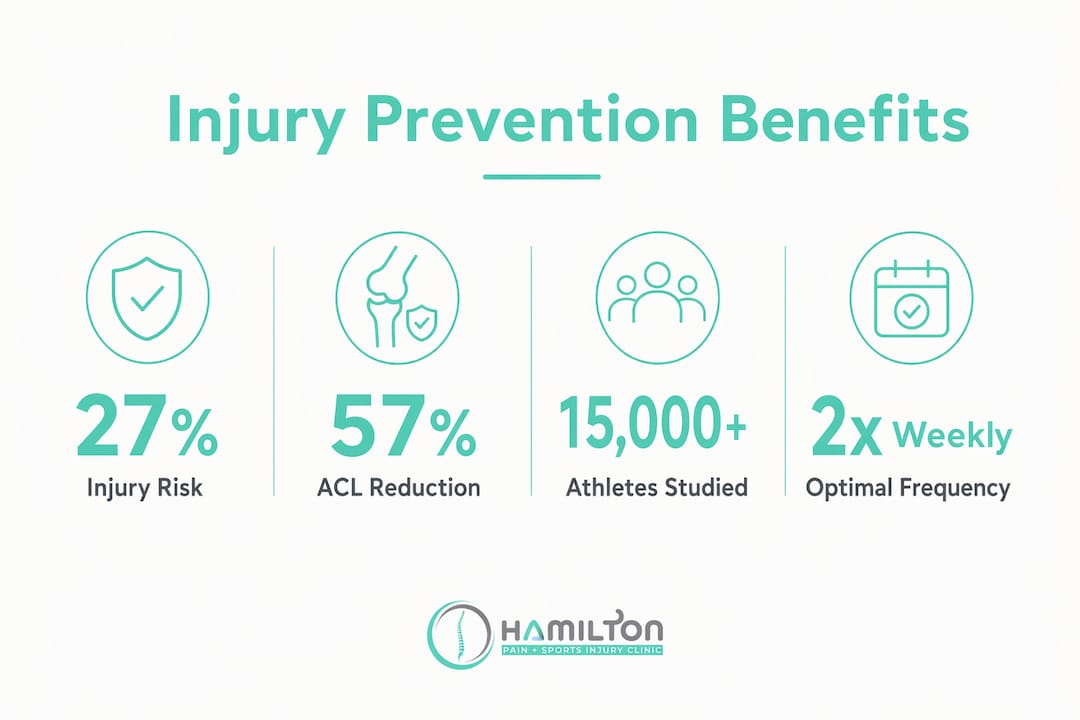
Injury prevention is defined as the systematic practice of reducing injury risk through targeted training, load management, and recovery protocols. It directly improves athletic results by building neuromuscular efficiency, the body's ability to produce and transfer force cleanly and quickly. Neuromuscular training reduces injury risk by up to 27% overall and ACL injury risk by 57%, while simultaneously improving sprint speed, jump height, and dynamic balance. That is not a side effect. That is the point. Understanding why injury prevention improves results changes how you approach every training session.
What does the science say about injury prevention and performance?
The evidence is clear and it is worth getting excited about. Meta-analyses of 25 randomised controlled trials involving over 10,000 participants confirm that integrative neuromuscular training produces statistically significant improvements in sprint speed, jump height, dynamic balance, and change-of-direction ability alongside meaningful injury risk reductions. These are not marginal gains. They are the kind of numbers that show up in competition results.
"Neuromuscular efficiency achieved through injury prevention fosters improved force production and transfer, directly enhancing athletic performance. The same adaptations that protect your joints and tendons are the ones that make you faster, more explosive, and better coordinated."
Separate research focusing on knee injuries reinforces this picture. A meta-analysis of 10 studies covering 15,296 athletes found that targeted preventive training reduces knee injury incidence by 32% and ACL injury risk by 57%. That is a dramatic reduction in one of the most career-disrupting injuries in sport.
The mechanism behind these gains is neuromuscular efficiency. When you train your nervous system to activate muscles in the right sequence, at the right speed, and with the right force, you move better. You absorb ground contact more effectively. You change direction without dumping load into passive structures like ligaments. The injury prevention work and the performance work are the same work.
| Outcome measure | Improvement from neuromuscular training |
|---|---|
| Overall injury risk | Reduced by up to 27% |
| ACL injury risk | Reduced by 57% |
| Knee injury incidence | Reduced by 32% |
| Sprint speed | Statistically significant improvement (p < 0.001) |
| Jump height | Statistically significant improvement (p < 0.001) |
| Dynamic balance | Statistically significant improvement (p < 0.001) |
Which injury prevention strategies most effectively improve results?
The most effective injury prevention strategies combine multiple training components rather than relying on a single method. Multicomponent programmes that blend strength training, balance work, plyometrics, and dynamic warm-ups consistently outperform single-method approaches in both injury risk reduction and performance gains. Think of it as attacking the problem from several angles at once.
Here are the proven injury prevention techniques and what each one delivers:
- Dynamic warm-ups (leg swings, hip circles, lateral shuffles): activate the neuromuscular system before loading, reduce acute muscle strains, and improve movement quality from the first rep
- Eccentric hamstring training (Nordic curls, Romanian deadlifts): directly targets the most common mechanism of hamstring tears and builds the posterior chain strength that drives sprint speed
- Plyometric training (box jumps, bounding, depth drops): develops reactive strength and tendon stiffness, improving jump height and ground contact efficiency
- Balance and proprioception work (single-leg stance progressions, wobble board drills): trains the ankle and knee stabilisers that prevent sprains and improve change-of-direction control
- Strength training (squats, hip thrusts, split squats): builds the tissue capacity to handle training loads without breaking down
Dose-response studies show that performing these programmes at least twice-weekly, in sessions of 30–45 minutes, with at least 75% adherence, maximises both injury risk reduction and performance gains. Frequency and consistency matter more than perfection on any single session.
The optimal injury prevention approach blends generic sport-wide exercises with individualised components tailored to each athlete's risk profile and injury history. A footballer with a history of ankle sprains needs different emphasis than a swimmer with shoulder impingement. Generic programmes are a good starting point. Personalised ones are where the real gains live.
Pro Tip: Do not treat injury prevention work as a warm-up add-on. Schedule it as a dedicated training block, ideally after your main session when you can give it proper attention without compromising your primary training goals.
How does progressive load management improve injury prevention outcomes?
Load spikes are one of the primary causes of sports injuries. When training volume or intensity increases too quickly, connective tissue and the neuromuscular system cannot adapt fast enough. The result is overuse injuries, stress fractures, and muscle tears that sideline athletes for weeks or months. Structured progressive loading reduces lower-extremity strains by approximately 25% and improves training readiness across a season.
Progressive overload means increasing training demands gradually, typically no more than 10% per week in volume or intensity. This gives tendons, ligaments, and muscles time to remodel and strengthen. It also gives the nervous system time to encode new movement patterns properly. Rush the process and you get injured. Respect it and you get stronger.
Recovery is where the adaptation actually happens. Active recovery including sleep, nutrition, and hydration consolidates neuromuscular adaptations and reduces the risk of overuse injuries. Rest alone is not enough. Recovery is an active process that requires managing all the stressors your body faces, not just the ones from training.
Here is what a proper recovery protocol looks like in practice:
- Sleep (7–9 hours per night): the primary window for tissue repair, hormonal regulation, and motor pattern consolidation
- Nutrition (adequate protein and carbohydrate timing): fuels muscle protein synthesis and replenishes glycogen for the next session
- Hydration (consistent fluid intake throughout the day): maintains joint lubrication, blood volume, and neuromuscular signalling
- Active recovery sessions (light movement, mobility work, sports massage): accelerate waste product clearance and maintain tissue quality between hard sessions
- Monitoring training load (using perceived exertion or session RPE): catches fatigue accumulation before it becomes injury
Pro Tip: Track your weekly training load using a simple session RPE score (effort out of 10 multiplied by session duration in minutes). If your weekly load jumps by more than 10% compared to the previous week, pull back. Your future self will thank you.
What common pitfalls reduce the effectiveness of injury prevention?
Poor adherence is the single biggest reason injury prevention programmes fail to deliver results. Each 10% increase in adherence is associated with an approximate 10% reduction in injury risk, based on analysis of 37 trials involving 36,385 athletes. That relationship is linear and unforgiving. Do the work consistently or do not expect the benefits.
Here are the most common pitfalls and how to fix them:
- Treating prevention as temporary: athletes complete a programme after an injury, feel better, and stop. Injury prevention works as a lifestyle habit, not a short course. Build it into your training permanently.
- Mistiming intense prevention work: performing heavy strength work immediately before competition causes fatigue and reduces performance. Save intensive prevention sessions for training days, not match-day mornings.
- Neglecting the maintenance phase: after initial gains plateau, many athletes reduce frequency. This is exactly when consistency matters most. Maintain at least one dedicated session per week to preserve adaptations.
- Using a one-size-fits-all programme: generic programmes miss individual risk factors. An injury prevention checklist tailored to your sport and history is far more effective than a generic template.
- Skipping progressive loading: jumping straight to high-intensity plyometrics or heavy eccentric work without building a base is a fast route to the injury you were trying to prevent.
Pro Tip: Attach your injury prevention work to an existing habit, like doing your balance and eccentric work immediately after your main training session ends. Habit stacking removes the decision fatigue that kills consistency.
Key takeaways
Injury prevention improves athletic results because the same neuromuscular adaptations that protect joints and tendons also drive faster sprints, higher jumps, and better movement control.
| Point | Details |
|---|---|
| Prevention equals performance | Neuromuscular training reduces ACL injury risk by 57% while improving sprint speed and jump height. |
| Consistency is non-negotiable | Each 10% increase in adherence produces an approximate 10% reduction in injury risk. |
| Multicomponent programmes win | Combining strength, plyometrics, balance, and dynamic warm-ups outperforms single-method approaches. |
| Recovery is active work | Sleep, nutrition, hydration, and load monitoring are required for neuromuscular adaptation, not optional extras. |
| Timing matters | Intensive prevention work belongs in training sessions, not pre-competition warm-ups. |
What I have learned from watching athletes get this right (and wrong)
I have seen athletes treat injury prevention like a punishment. They do it grudgingly after getting hurt, feel better, and quietly drop it the moment training gets busy again. Then they wonder why the same injury keeps coming back. It makes ya think.
The athletes who genuinely improve their results through injury prevention share one thing: they stop seeing it as separate from performance training. The Nordic curls, the single-leg work, the progressive loading, it is all just training. Good training. The kind that makes you faster and more durable at the same time.
What the 2026 research has made clearer than ever is that neuromuscular training is not a niche rehabilitation tool. It is a performance tool with injury prevention as a bonus. The athletes who understand this do not skip their prevention sessions when they feel good. They do them because they feel the difference on the pitch or the track.
The other thing I would push back on is the idea that a generic programme is good enough. It is a starting point, full stop. The benefits of personalised sports therapy show up precisely because individual risk profiles, movement patterns, and training histories are different. A programme built around your specific weaknesses will always outperform a template. Always.
If there is one mindset shift worth making, it is this: consistency beats intensity every single time. Two solid sessions per week, every week, for six months will do more for your injury risk and your performance than a perfect programme you follow for three weeks and abandon.
— Mark
How Sportsinjurydublin helps athletes stay fit and perform better
Sportsinjurydublin works with athletes at every level, from weekend runners to competitive team sport players, to build injury prevention into their training in a way that actually sticks.
The clinic's approach at Hamilton Pain and Sports Injury Clinic is built around individual assessment rather than generic protocols. Whether you need sports rehabilitation after an existing injury or a personal training programme designed around your specific risk profile, the team builds a plan that fits your sport, your body, and your goals. Clients regularly report returning to full training faster than expected, and performing better than before their injury. That is what good injury prevention looks like in practice.
FAQ
What is the main benefit of injury prevention for athletes?
Injury prevention reduces injury risk while simultaneously improving neuromuscular performance measures including sprint speed, jump height, and dynamic balance. The same training adaptations that protect joints and tendons also make athletes faster and more explosive.
How often should athletes do injury prevention training?
Performing injury prevention sessions at least twice weekly, in 30–45 minute blocks, with at least 75% adherence, produces the greatest reductions in injury risk and the strongest performance gains.
Does injury prevention actually improve athletic performance?
Yes. Meta-analyses of over 10,000 athletes confirm statistically significant improvements in sprint speed, jump height, and change-of-direction ability from neuromuscular training programmes, alongside injury risk reductions of up to 57%.
What is the biggest mistake athletes make with injury prevention?
Poor adherence is the most common and costly mistake. Research across 36,385 athletes shows a direct linear relationship between compliance and injury risk reduction, meaning skipping sessions directly increases your risk of getting hurt.
When should athletes do injury prevention exercises?
Intensive injury prevention work, such as heavy eccentric training or plyometrics, belongs in dedicated training sessions rather than immediately before competition. Pre-competition warm-ups should use dynamic movement preparation only, with heavier prevention work saved for separate recovery sessions.