
Movement reduces chronic pain by triggering immediate neurochemical analgesia and, over weeks and months, retraining the nervous system to process pain signals differently. That's the short version. The longer version is genuinely fascinating, and understanding it tends to make the whole "just keep moving" advice feel a lot less dismissive.
Here's what you need to know right now:
- Start small and stay consistent. A ten-minute walk counts. Seriously. The EFIC position paper recommends physical activity as the primary intervention for chronic pain, and brief, low-intensity sessions are enough to begin the process.
- Pain during movement isn't automatically a red flag. A mild increase (say, 2–3 points on a 0–10 scale) that settles within 24 hours is generally acceptable. Sharp, escalating, or new pain that persists is a signal to stop and seek advice.
- Get professional input if you're unsure. Your GP, an NHS physiotherapist, or a specialist clinic can rule out red flags and build a plan that fits your specific situation. You don't have to figure this out alone.
Throughout this article, you'll see references to IASP, NHS guidance, and peer-reviewed research from PubMed/NCBI. These are the sources the evidence is built on.
Table of Contents
- Why does movement reduce chronic pain? The biology explained
- What does the research actually say?
- Which types of movement actually help?
- How to start moving safely without making things worse
- What's stopping you? Barriers, fear, and how to move past them
- What to expect and when: realistic timelines
- When should you see a professional?
- Clinician insights from Hamilton Pain & Sports Injury Clinic
- Key takeaways
- A clinician's honest take on movement and pain
- How Sportsinjurydublin can help you move with less pain
- Useful sources and further reading
Why does movement reduce chronic pain? The biology explained
Right, so why does moving your body actually help? It's not just distraction or willpower. There are real, measurable biological processes happening, and they work on multiple levels simultaneously.
The immediate hit: exercise-induced hypoalgesia
Within minutes of moderate exercise, your body releases a cocktail of pain-dampening chemicals. Endogenous opioids (your body's own morphine-like compounds), endocannabinoids (yes, the same system cannabis acts on), and monoamines like serotonin and noradrenaline all spike during and after physical activity. The result is what researchers call exercise-induced hypoalgesia: a measurable, transient reduction in pain sensitivity that can last for minutes to a couple of hours after a single session.
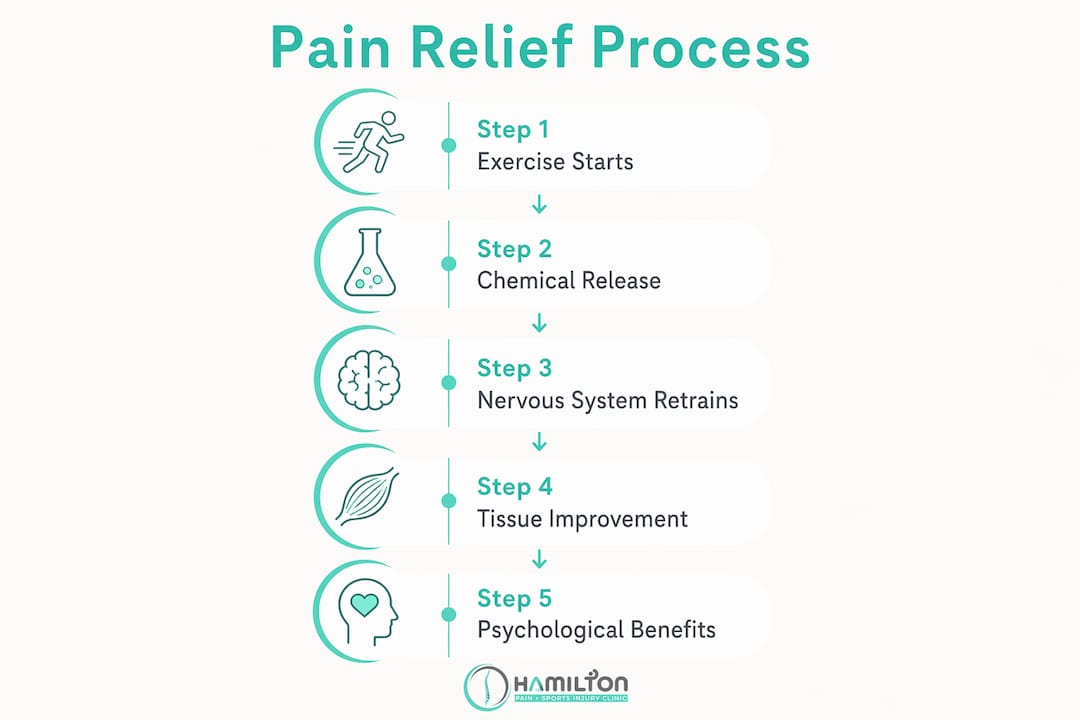
One bout of exercise gives you a short window of relief. Repeated bouts start to shift the baseline.
Retraining the nervous system over time
Chronic pain isn't just about damaged tissue. In many cases, the nervous system itself has been recalibrated to amplify pain signals, a process called central sensitisation. The brain and spinal cord essentially get stuck in a high-alert state, responding to ordinary movement as though it were a threat.
Consistent exercise gradually reverses this. It strengthens the brain's descending inhibitory pathways, the neural circuits that tell the spinal cord to turn the volume down on incoming pain signals. Over weeks and months, the nervous system learns that movement is safe, and pain sensitivity measurably decreases. A PMC review on central mechanisms describes this as a genuine neuroplastic change, not just a mood effect.
Peripheral and tissue-level changes
Away from the brain, movement improves blood flow to muscles and joints, reduces circulating inflammatory markers, and builds muscular strength around vulnerable structures. Stronger muscles share the load more effectively across joints, meaning less mechanical stress on any single point. For conditions like osteoarthritis or chronic low back pain, this load redistribution is a big part of why exercise helps.

Pro Tip: Posture and movement patterns interact closely with pain. If you're curious how they connect, posture and chronic pain is worth a read alongside this.
The psychological loop (and why it's biological too)
Here's something that often surprises people: the psychological benefits of movement, better mood, improved sleep, greater self-efficacy, are themselves biological pain modulators. Improved sleep quality, for instance, directly reduces central sensitisation. A sense of control over your body lowers the threat response that amplifies pain. Moving the body in chronic pain retrains active coping, which breaks the emotional cycle that often keeps persistent pain going. These aren't soft benefits. They're mechanisms.
What does the research actually say?
The evidence base for movement and chronic pain is substantial, and the headline finding is consistent: physical activity reduces pain severity and improves function across a wide range of conditions. The effects are typically small to moderate in size, which sounds underwhelming until you realise that's roughly equivalent to many commonly prescribed analgesics, and with a far better safety profile.
A Cochrane overview of systematic reviews found that exercise generally produces favourable outcomes for chronic pain, with minimal adverse events. Only around a quarter of included trials even recorded adverse events, and those that did reported mainly transient muscle soreness that settled with adaptation. That's a reassuring safety signal.
For chronic low back pain specifically, the evidence is particularly strong. Research from NCBI Bookshelf draws on over 200 studies involving around 25,000 participants, consistently showing that exercise therapy produces clinically meaningful pain reductions compared with no intervention. Back pain is probably the best-studied condition in this space.
A systematic review with meta-analysis in JOSPT specifically examined movement-evoked pain (pain that occurs during activity, rather than at rest) and found exercise therapy produces a moderate effect (SMD −0.65) on this type of pain in musculoskeletal populations. That matters because movement-evoked pain is often what stops people from exercising in the first place.
Conditions with the strongest evidence
| Condition | Evidence strength | What helps most |
|---|---|---|
| Chronic low back pain | Strong | Aerobic, resistance, multicomponent |
| Osteoarthritis (knee/hip) | Strong | Aerobic, resistance, aquatic |
| Fibromyalgia | Moderate | Aerobic, mind–body (tai chi, yoga) |
| Chronic neck pain | Moderate | Resistance, multicomponent |
| Widespread chronic pain | Moderate | Multicomponent, graded activity |
The EFIC position paper goes further, recommending physical activity as the primary intervention for people living with chronic pain, not an add-on. Five specific recommendations for health professionals include assessing physical activity levels, advising on safety, delivering brief interventions, discussing acceptable soreness, and providing ongoing support.
A few honest caveats: effect sizes vary considerably by condition, programme quality, and individual factors. Supervised and individualised programmes tend to outperform generic advice. Most trials also include people with mild-to-moderate pain, so extrapolation to severe or complex cases requires care.
- Supervised programmes generally produce better outcomes than self-directed ones.
- Individualised plans that account for comorbidities and preferences tend to have better adherence.
- Combining exercise with psychological support (e.g. pain education, CBT) often produces larger effects than exercise alone.
Which types of movement actually help?
Good news: there's no single "correct" exercise for chronic pain. Several different approaches work, through overlapping mechanisms, and the best one is usually the one you'll actually do.
Aerobic exercise
Walking, cycling, swimming, water aerobics. These are the most studied forms of exercise for chronic pain, and they work primarily through the neurochemical pathways described earlier. Low-to-moderate intensity (roughly 50–60% of your maximum heart rate, or "you can hold a conversation but it's a bit of an effort") produces the strongest analgesic effects. Going flat-out to exhaustion actually reduces the benefit and can provoke flares, so steady and sustainable beats intense every time here.
Aim for 20–30 minutes, three to five times a week. If that sounds like a lot right now, start with five minutes and build from there.
Resistance and strength training
Building muscular strength around painful joints improves load-sharing and functional capacity. For chronic low back pain, strengthening the muscles of the trunk, hips, and legs reduces mechanical stress on the spine. For knee osteoarthritis, quadriceps strength is directly linked to pain and function outcomes. Gentle strength training for chronic pain is a practical starting point if you're new to this.
Two to three sessions per week, with a day's rest between, is a sensible frequency. Bodyweight exercises (chair squats, wall press-ups, glute bridges) are a perfectly valid starting point.
Multicomponent exercise
A narrative review in PMC recommends combining aerobic work, resistance training, and flexibility into a single programme, performed at light-to-moderate intensity two to three times weekly for at least four weeks. This multicomponent approach tends to produce the largest practical benefits for chronic musculoskeletal pain because it addresses multiple mechanisms simultaneously.
Mind–body practices
Tai chi and yoga have solid evidence for fibromyalgia, osteoarthritis, and chronic low back pain. They combine gentle movement with breath awareness and relaxation, which addresses both the physical and psychological drivers of pain. If you've been put off by the idea of "exercise," a yoga class or tai chi session might feel like a more accessible entry point.
Choosing what suits you
Preference matters enormously for adherence. If you hate swimming, a swimming programme won't work long-term regardless of its theoretical benefits. Consider access (can you get there easily?), comorbidities (joint problems might favour water-based exercise), and what you've enjoyed in the past. The movement therapies guide covers a broader range of physiotherapy-based approaches if you want to explore further.
How to start moving safely without making things worse
This is where most people either go too hard too fast or avoid starting at all. Both are understandable. Here's a practical, stage-based plan.
Your step-by-step starter plan
- Establish your baseline. Before you start, note what you can currently do without a significant pain increase. A five-minute walk? Ten minutes of gentle stretching? That's your starting point, not your goal.
- Set a small daily goal for week 1. Choose one activity you can do at 50–60% effort. Keep it short (5–10 minutes). Do it daily, or on most days. Consistency matters more than duration at this stage.
- Increase gradually from weeks 2–6. Add roughly 10% more duration or frequency each week, not both at once. So if you're walking ten minutes daily, try eleven minutes next week. Boring? Yes. Effective? Also yes.
- Monitor your response. After each session, rate your pain on a 0–10 scale. A mild increase (2–3 points) that returns to baseline within 24 hours is acceptable. Pain that spikes sharply, doesn't settle, or is accompanied by new symptoms is a signal to reduce the dose and seek advice.
- From week 7 onwards, add variety. Once you have a consistent aerobic base, consider adding two short resistance sessions per week. This is where personalising your chronic pain treatment plan becomes really useful.
Pain rules to keep in mind
The "no pain, no gain" rule does not apply here. Acceptable discomfort is a mild, familiar ache that settles quickly. Unacceptable pain is sharp, shooting, or accompanied by neurological symptoms (numbness, tingling, weakness), or any new pain in a different location. If you experience progressive weakness, new bowel or bladder symptoms, fever alongside pain, or unexplained weight loss, stop exercising and contact your GP promptly. These are red flags that need medical assessment before you continue.
Managing flares
Flares happen, even when you're doing everything right. When one occurs: reduce your activity dose (don't stop entirely), maintain gentle low-level movement like short walks, use ice or heat for local comfort, and give it 48–72 hours. If the flare doesn't settle, or if it's accompanied by any red-flag symptoms, seek professional advice. The chronic pain flare-up recovery guide has a detailed step-by-step approach worth bookmarking.
Pro Tip: You do not need to be pain-free to start exercising. Maintaining baseline activity prevents the rapid deconditioning that makes long-term outcomes significantly worse.
What's stopping you? Barriers, fear, and how to move past them
Let's be honest: knowing that movement helps and actually doing it are two very different things when you're in pain. The gap between them is usually psychological, and that's completely normal.

Kinesiophobia and catastrophising
Kinesiophobia (fear of movement) and catastrophising (expecting the worst from pain) are among the most powerful predictors of chronic pain disability. They're not character flaws. They're learned responses, often reinforced by well-meaning advice to "rest and avoid aggravating activities." The problem is that avoidance leads to deconditioning, which increases pain sensitivity, which increases fear. It's a cycle that movement is specifically designed to interrupt.
The EFIC position paper explicitly calls for clinicians to move away from the rest-first paradigm, noting that kinesiophobia is a leading barrier and that supervised, personalised programmes are the most effective way to make the transition.
Reframing the fear
A few language shifts that can genuinely help:
- Instead of "movement causes damage," try: "my nervous system is sensitised, and movement is how I recalibrate it."
- Instead of "if it hurts, I should stop," try: "mild, familiar discomfort during movement is expected and safe."
- Instead of "I need to be pain-free before I exercise," try: "I can start where I am, and progress from there."
These aren't just positive thinking. They reflect what the biology actually shows.
Practical behaviour-change tools
- Goal setting: small, specific, achievable goals outperform vague intentions. "Walk to the end of the street and back on Monday, Wednesday, and Friday" beats "exercise more."
- Self-monitoring: a simple pain and activity diary (even just a note on your phone) helps you spot patterns and build confidence.
- Graded exposure: gradually increasing exposure to feared movements, in a controlled way, reduces the threat response over time.
- Social support: having someone to walk with, or even just to check in with, significantly improves adherence. For older adults particularly, fall prevention and balance work can be a natural entry point for building a movement habit with support.
When self-management isn't enough, a supervised programme with a physiotherapist or pain specialist is the next step. Brief interventions by non-specialists can also be effective, according to EFIC guidance, so don't underestimate the value of a single good conversation with a knowledgeable clinician.
What to expect and when: realistic timelines
One of the most common reasons people give up on exercise for chronic pain is that they expect too much too soon, or they don't realise that the immediate effect and the long-term effect are completely different things.
Immediately (during and after a single session)
Exercise-induced hypoalgesia kicks in during moderate activity and can persist for minutes to a couple of hours afterwards. It's real, it's measurable, and it's a useful signal that your body's pain-modulating systems are working. Don't be surprised if you feel noticeably better after a short walk. That's not coincidence.
Short term (4–15 weeks)
With consistent low-to-moderate exercise, most people notice measurable improvements in pain sensitivity, daily function, and mood within this window. The PMC narrative review identifies four to fifteen weeks as the key period for producing benefit from structured programmes. For chronic low back pain, research across thousands of participants consistently shows clinically meaningful pain reductions within this timeframe compared with no intervention.
Statistic to hold onto: Exercise therapy for chronic low back pain has been studied in over 200 trials involving approximately 25,000 participants, consistently showing clinically meaningful improvements in pain and function compared with no treatment.
Medium to long term (3–6 months and beyond)
This is where the deeper changes happen. Reductions in central sensitisation, genuine improvements in physical conditioning, and sustained quality-of-life benefits accumulate over months of consistent activity. The benefits of back pain rehabilitation are well-documented at this timescale. The key word is consistent: sporadic bursts of activity followed by long rests don't produce the same nervous-system retraining as steady, regular movement.
When should you see a professional?
Self-managed exercise is a great starting point, but there are times when professional input isn't optional.
Red flags that need urgent review
- Progressive muscle weakness or new neurological symptoms (numbness, tingling, loss of bladder or bowel control)
- Fever, unexplained weight loss, or night sweats alongside pain
- Pain following a significant trauma (fall, accident)
- Pain that is constant, worsening, and unrelated to movement or position
- Signs of infection around a joint or wound
Any of these warrants a GP appointment before you continue with exercise.
Who to see and why
Your GP is the right first stop for ruling out red flags, getting a diagnosis, and obtaining referrals. They can refer you to NHS physiotherapy or a pain clinic depending on your situation.
NHS physiotherapy provides supervised, evidence-based exercise programmes tailored to your condition. Waiting times vary by area, but an initial assessment will typically focus on your movement patterns, pain behaviour, and functional goals.
A pain clinic is appropriate for complex or long-standing cases where standard physiotherapy hasn't produced sufficient improvement. Pain clinics use multidisciplinary teams including physiotherapists, psychologists, and pain medicine specialists.
A specialist sports and injury clinic like Sportsinjurydublin can provide faster access to individualised assessment and supervised rehabilitation, particularly useful if you're waiting for NHS referral or want a more tailored approach. Individualised care for pain consistently produces better outcomes than generic programmes.
What to bring to your appointment
- A brief symptom diary (when pain is worst, what makes it better or worse, how it affects daily activities)
- Any previous scans, reports, or letters from other clinicians
- A list of current medications
- Questions about graded exercise plans and what to expect from treatment
Clinician insights from Hamilton Pain & Sports Injury Clinic
At Hamilton Pain & Sports Injury Clinic (Sportsinjurydublin), the approach to chronic pain is built around one principle: treat the person, not just the symptom. Generic protocols rarely work for persistent pain because chronic pain is rarely generic.
A practical starter template
Here's a simple weekly framework adapted by pain severity:
Mild pain (0–3/10 at rest): Three sessions per week of 20–30 minutes aerobic activity at conversational pace, plus two short resistance sessions (bodyweight, 10–15 minutes). Progress duration by 10% weekly.
Moderate pain (4–6/10 at rest): Two sessions per week of 10–15 minutes gentle aerobic activity (walking, pool walking), plus one short mobility session. Focus on consistency over intensity. Progress only when the previous week felt manageable.
Severe or fluctuating pain (7+/10 or highly variable): Start with five minutes of gentle movement daily (seated exercises, short walks). Prioritise not stopping entirely over any particular intensity target. Seek supervised input early.
Common mistakes and clinician tips
The most common error is progressing too quickly to high intensity before building tolerance. Many patients feel better after two weeks and immediately double their activity, which provokes a flare and reinforces the belief that exercise makes things worse. Slow, boring, consistent progression over 4–15 weeks is the actual medicine.
Another common misconception: "if the scan shows nothing, the pain isn't real." In non-specific chronic pain, tissue damage rarely explains ongoing symptoms. Inactivity-driven deconditioning and central sensitisation are usually the major contributors, and movement is central to addressing both.
Pro Tip: Keep an activity log for the first four weeks. Seeing your progress in writing, even tiny increments, is one of the most effective tools for maintaining motivation when pain fluctuates.
This article provides general information and is not a substitute for individual professional assessment. Please consult a qualified clinician for advice specific to your situation.
Key takeaways
Movement reduces chronic pain through neurochemical analgesia, nervous-system retraining, and tissue conditioning, with consistent low-to-moderate activity over four to fifteen weeks producing the most meaningful improvements.
| Point | Details |
|---|---|
| Immediate relief is real | A single session triggers exercise-induced hypoalgesia, producing measurable pain reduction within minutes. |
| Lasting change takes weeks | Consistent activity over four to fifteen weeks produces meaningful improvements in pain sensitivity, function, and mood. |
| Start small, progress slowly | Begin at 50–60% effort for 5–10 minutes; increase by roughly 10% per week to avoid flares. |
| Fear of movement worsens pain | Kinesiophobia drives avoidance and deconditioning; graded exposure and education are the evidence-based fix. |
| Sportsinjurydublin offers tailored support | Individualised assessment and supervised rehabilitation at Hamilton Pain & Sports Injury Clinic complement self-managed activity plans. |
A clinician's honest take on movement and pain
Here's something I think gets lost in a lot of chronic pain advice: the emphasis on "just keep moving" can feel dismissive when you're the one in pain. And I get that. The biology is real, the evidence is solid, but none of that makes it easy to lace up your trainers when every step feels like a negotiation.
What I find genuinely encouraging, though, is that the threshold for benefit is lower than most people think. You don't need a gym membership or a structured programme to start shifting the nervous system. A short daily walk, done consistently, is enough to begin the neurochemical process. The goal in the early weeks isn't fitness. It's safety. Showing your nervous system, repeatedly, that movement doesn't equal damage.
The fear is understandable. The avoidance makes complete sense as a short-term response. But the research is clear that avoidance is the mechanism that keeps chronic pain chronic. Movement, even imperfect, inconsistent, slightly uncomfortable movement, is how you interrupt that cycle. Real examples of successful pain recovery show just how varied and non-linear that process can look in practice.
How Sportsinjurydublin can help you move with less pain
Chronic pain responds best to a plan built around you, not a generic protocol handed to everyone with the same diagnosis. That's the core difference at Sportsinjurydublin (Hamilton Pain & Sports Injury Clinic): every assessment starts with your specific movement patterns, pain behaviour, lifestyle, and goals.

The clinic offers individualised assessment, supervised rehabilitation, and return-to-activity planning for people living with persistent pain. Whether you're managing chronic back pain, recovering from a musculoskeletal injury, or simply trying to get back to daily activities without dreading every step, the team builds a programme that fits where you actually are, not where a textbook says you should be. For older adults managing pain alongside balance concerns, the approach also draws on strategies for improving quality of life through active support.
Book an initial assessment through the sports rehabilitation page to get a clear picture of what's driving your pain and a structured plan to address it.
Useful sources and further reading
The evidence and guidance referenced throughout this article comes from the following sources:
- Physical activity and exercise for chronic pain in adults: an overview of Cochrane Reviews (PMC) — the most comprehensive overview of systematic reviews on exercise and chronic pain.
- The Role of Physical Exercise in Chronic Musculoskeletal Pain: Best Medicine — A Narrative Review (PMC) — practical guidance on programme design, intensity, and duration.
- EFIC Position Paper: Physical activity should be the primary intervention for individuals living with chronic pain — the European Pain Federation's five recommendations for health professionals.
- Low back pain: Why movement is so important (NCBI Bookshelf / InformedHealth.org) — evidence summary for chronic low back pain and exercise.
- Does exercise increase or decrease pain? Central mechanisms (PMC) — mechanistic review of central nervous system changes with exercise.
- Movement-evoked pain and exercise therapy: systematic review with meta-analysis (JOSPT) — evidence on exercise effects specifically for movement-evoked pain.
- Moving the Body in Chronic Pain — VA Whole Health Library — accessible overview of psychological and physical mechanisms.
- NHS: Exercise — UK activity guidelines and general physical activity advice.
- IASP: International Association for the Study of Pain — authoritative definitions and position statements on pain science.