

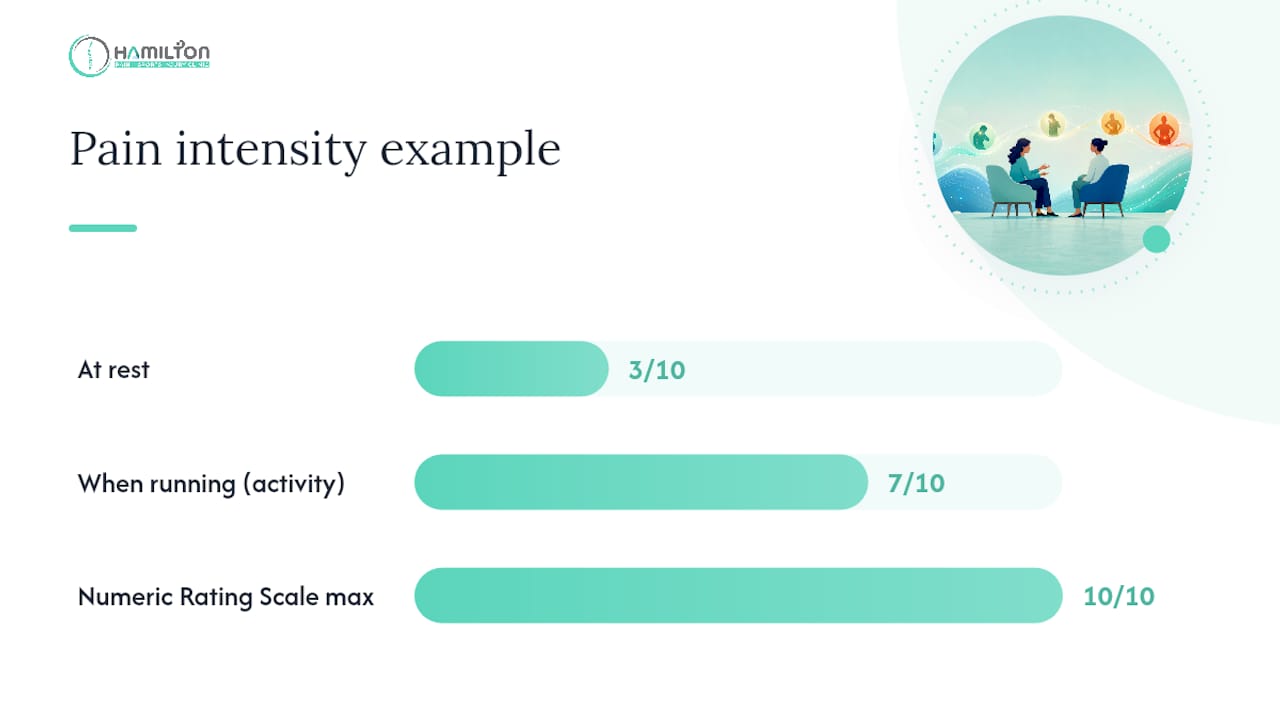
The single most useful thing you can do at the start of a session is give your therapist the CLODIERS elements plus a 0 to 10 intensity score and one activity that changes it. Something like: "Sharp pain on the outside of my knee, started three weeks ago running downhill, worse on stairs, 3 out of 10 at rest but 7 out of 10 when I run." That one sentence does more work than five minutes of vague description.
At Sportsinjurydublin, we use a structured pain interview called CLODIERS (Character, Location, Onset, Duration, Intensity, Environment, Relievers, Severity) because it turns a woolly complaint into something we can act on immediately, using the Numeric Rating Scale (0 to 10) to track it over time.
Here's your copy-paste opener for your next appointment:
"It's a [character] pain in my [location], started [onset], been going on [duration]. It's [X]/10 at rest and [Y]/10 when I [activity]. [What helps/what makes it worse]."
Before you walk in, jot down:
- Where exactly it hurts (point with one finger if you can)
- What made it start, or if it crept up
- Your rest number and your "doing the thing" number
Pro Tip: Short on time? Skip the backstory. Give your therapist the number and the activity first. Everything else can come out in the follow-up questions.
Key Takeaways
Clear, structured pain reporting using CLODIERS and a 0 to 10 intensity score speeds up diagnosis and keeps hands-on treatment safer for the patient.
| Point | Details |
|---|---|
| Lead with CLODIERS and a number | Give character, location, onset, duration, and a 0 to 10 score with one activity that changes it. |
| Pair intensity with context | State your rest number and your activity number together, not one figure alone. |
| Point, don't wave | Use one finger or a body map to mark the exact spot rather than a general area. |
| Report red flags immediately | Night pain, weight loss, fever, or spreading numbness need reporting the moment you notice them. |
| Sportsinjurydublin uses structured intake | The clinic's CLODIERS-based pain interview shapes each individualised rehabilitation plan from the first session. |
Table of Contents
- How to communicate pain levels to a therapist using CLODIERS
- How do you rate pain intensity so it's actually useful?
- How to show exact location and pain pattern
- Which pain symptoms are red flags?
- What does your therapist do with this information?
- What should you say in a short appointment?
- What should you record between sessions?
- Why structured pain reporting improves your treatment
- What therapists wish every patient told them
- Get a structured assessment at Sportsinjurydublin
- Sources
How to communicate pain levels to a therapist using CLODIERS
CLODIERS is a mnemonic, not homework. Each letter is answered in a phrase, not a paragraph, which is exactly why it works in a rushed clinic slot.
- Character — what it feels like: sharp, dull, burning, throbbing, pinching
- Location — where, precisely, and whether it stays put or travels
- Onset — sudden ("stepped awkwardly") or gradual ("crept in over training block")
- Duration — how long this episode has lasted, and whether it's constant or comes and goes
- Intensity — your number, at rest and during load
- Environment — what you were doing, on what surface, in what footwear
- Relievers — what eases it: rest, ice, stretching, painkillers
- Severity — how much it stops you doing (training, sleeping, walking)
A physiotherapy history-taking approach recommends recording location, type, and 24-hour pattern because those details help separate inflammatory pain from a straightforward mechanical injury. Two examples from real training weeks: "sharp pain on the front of my knee, only when sprinting" and "dull ache down the back of my thigh after long rides, eases with foam rolling." Both take under ten seconds to say and both hand the clinician a clear starting hypothesis.
How do you rate pain intensity so it's actually useful?
A number on its own tells your therapist almost nothing. "It's a 6" could mean anything from a niggle to a training-stopper, depending on what you were doing when you felt it. The fix is pairing the number with context, at rest and under load.
Rough anchors that clinicians recognise:
- 1 to 2 — barely noticeable, only aware of it if you focus on it
- 3 to 4 — present but doesn't change what you do
- 5 to 6 — limits training intensity, but you can still get through a session
- 7 to 8 — stops you playing or training altogether
- 9 to 10 — the worst pain you've experienced, hard to think about anything else
Say it like this: "It's 4 out of 10 sitting here, but 7 out of 10 when I jog." Or for a chronic ache: "Baseline is 2, flares hit 6 after a long shift on my feet." A single point-in-time rating rarely tells the full story, so give your therapist the range, not just the peak, and mention if a 1 to 2 point shift happened after a specific session or exercise change.
How to show exact location and pain pattern
Point with one finger rather than waving a whole hand over the area. "Somewhere around my hip" leaves too much room for guesswork; "just below the right iliac crest" or "inside edge of the kneecap" gives your therapist an exact target. Body maps and printed silhouettes are recommended specifically because they let you mark spreading patterns that words struggle to convey.
Describe the behaviour of the pain, not just its address:
- Local ("stays right on the outside of my ankle") versus referred or radiating ("starts in my lower back and shoots down the back of my leg")
- Direction it travels, and what brings it on (bending, twisting, a specific stride pattern)
- Whether it's one spot or a spreading, harder-to-pin-down ache
Pro Tip: Print a simple body outline before your appointment and shade the area in pen. It takes thirty seconds and removes any ambiguity about exactly where "there" means.
Which pain symptoms are red flags?
Some symptoms need reporting the moment you notice them, not saved for a passing mention halfway through your session. These change what your therapist does next, sometimes immediately.
Tell your therapist straight away if you have:
- Unexplained weight loss alongside your pain
- New night pain that doesn't ease with rest or changing position
- Fever, chills, or feeling generally unwell
- Sudden changes in bowel or bladder function
- Progressive numbness, weakness, or pins and needles that's getting worse
- A recent significant fall, collision, or trauma you haven't mentioned
If any of these apply, your therapist will likely pause hands-on treatment and arrange an urgent referral rather than proceed with a routine session. Reporting red flags is a mandatory part of current professional history-taking guidance, and flagging them early is what keeps rehabilitation genuinely safe rather than just efficient.
What does your therapist do with this information?
Everything you report feeds three decisions: is this safe to treat today, which techniques to use, and how to load you going forward. A sharp, localised pain that spikes with a specific movement points towards one treatment approach; a dull, diffuse ache that's worse in the morning points towards another entirely.
Your intensity and severity answers also set stop criteria. If your pain is highly irritable (a low number sets it off and it takes ages to settle), your therapist will likely go gentler and check in more often during the session. If it's stable and only bothers you at extremes, they can push loading harder.
- Safety screening: does anything you've said suggest treatment should wait
- Technique choice: hands-on manual therapy, dry needling, or exercise-led
- Progress tracking: comparing this week's numbers to last week's
Pro Tip: If you'd rather your therapist skip a hands-on technique that day, say so before they start: "Can we avoid deep pressure on that area today, it's quite reactive."
What should you say in a short appointment?
Time pressure is real, and vague answers under pressure waste everyone's minutes. A structured template shortens that gap considerably. Here's your opener, then your fuller version if there's time.
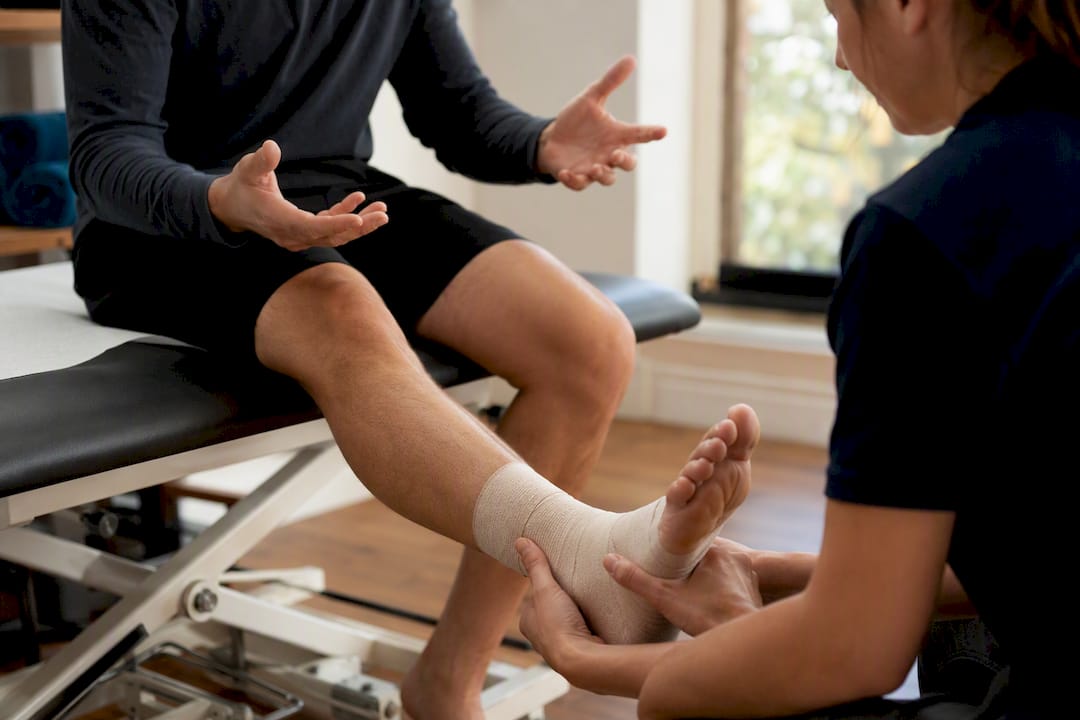
Ten to fifteen second opener: "Sharp lateral ankle pain after I rolled it Saturday, 6 out of 10 when I try to hop on it, eased by rest and ice."
Acute injury: "Twisted my knee landing from a jump two days ago. Sharp on the inside, 7/10 straight after, now settled to 4/10 at rest but jumps to 8/10 going downstairs."
Chronic flare: "My usual low back ache has flared this week. Normally a 2, it's been sitting at 6 since Tuesday, worse after driving, better lying flat."
Gradual overuse: "Dull ache in my Achilles that's crept up over three weeks of increased mileage. 3/10 most days, 6/10 first thing in the morning."
Worsening or neurological: "Numbness down my left leg that's spreading and getting worse over the last week, not just pain now."
What should you record between sessions?
A short pain diary bridges the gap between visits far better than memory alone, which tends to smooth over the bad days. One daily line is enough:
"Date, rest pain (0 to 10), pain during [key activity], one trigger, one thing that helped."
Keep it wherever you'll actually use it: a phone note, a printed weekly grid, or three lines on paper by your bed. Daily entries work well for acute injuries; after key training sessions is often enough for a chronic, stable issue. Bring it to your next appointment rather than trying to recall a fortnight of ups and downs from memory. Our guide on personalising a chronic pain treatment plan has a fuller template if you want something more detailed than three lines.
Why structured pain reporting improves your treatment
Mark, a clinician at Hamilton Pain and Sports Injury Clinic, built the clinic's assessment approach around the idea that individualised rehabilitation starts with an accurate picture, not a generic protocol. Structured pain interviews using frameworks like CLODIERS support therapeutic alliance and speed up accurate diagnosis, because they let patients describe the sensory and functional sides of their pain rather than just handing over a single number.
Readers wanting to see how this translates into outcomes can look through examples of successful pain recovery on the clinic's site.
What therapists wish every patient told them
The biggest mistake I see isn't under-reporting pain, it's over-smoothing it into something vague like "it's just a bit sore." Specificity beats stoicism every time. Tell us the number, the activity, and how it's affecting your mood or training plans. Trust builds fast when a patient gives us something concrete to work with.
Get a structured assessment at Sportsinjurydublin
Sportsinjurydublin builds every rehabilitation plan around the exact picture you give us in that first appointment, not a generic protocol pulled off a shelf. Whether you're carrying an acute strain, a stubborn overuse injury, or working your way back after time out, a clear CLODIERS-style report from you means less guesswork and a faster start to the right treatment.
Our sports rehabilitation service covers assessment through to full recovery, and if you're specifically working your way back to competition, the return-to-sport rehabilitation programme is built for exactly that progression. Bring your pain diary, your CLODIERS notes, or even just the one-line script from earlier in this article, and we'll take it from there. Book an assessment through the sports rehabilitation programme page and get a plan built around what you've actually told us, not a template.
Sources
This article is general information, not a substitute for advice from a qualified doctor. Consult a qualified healthcare professional about your own circumstances before acting on anything here.