
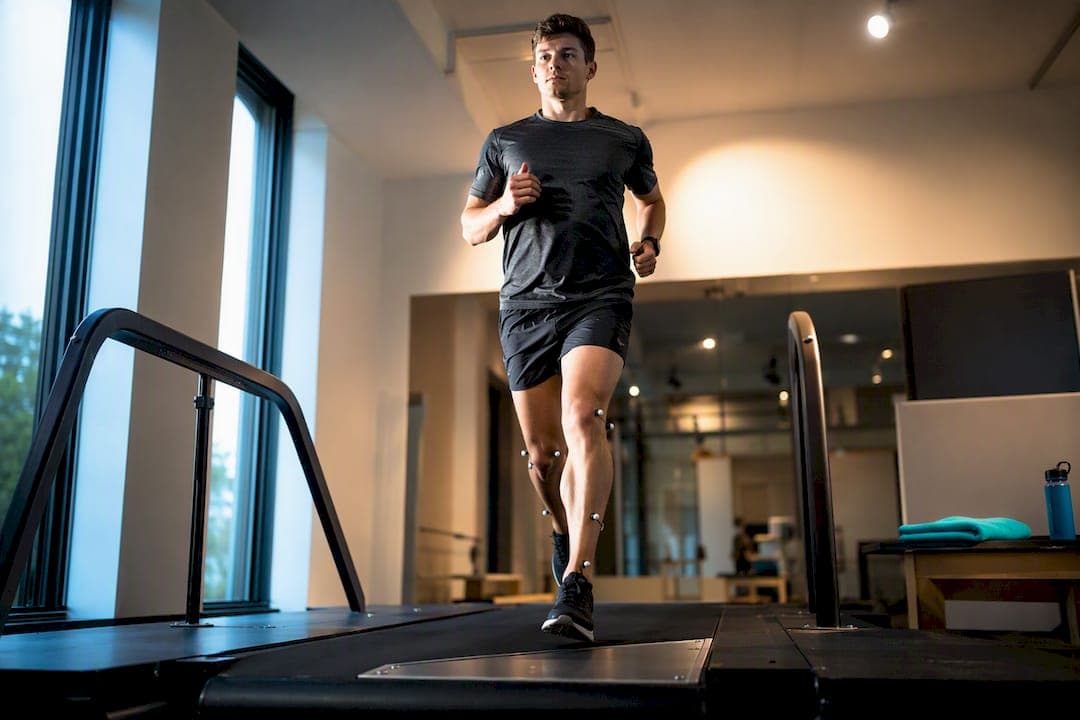
A clinical gait analysis helps runners dealing with persistent pain, recurring injury or a genuine performance plateau by turning your stride into measurable numbers rather than a guess. That's different from a retail shoe-fitting video, which gives you a quick visual steer, not data. Do it properly and you walk away with a measured report and a testable plan, not just an opinion about your feet.
TL;DR:
- Gait analysis measures specific variables like cadence, ground contact time, and force distribution, which must be interpreted together to inform treatment strategies.
- A comprehensive clinical assessment includes history, musculoskeletal screening, and motion capture during running, unlike quick retail treadmill tests focused on shoe fitting.
- Changes in running form typically take several weeks of targeted intervention and consistent retesting to produce measurable improvements.
- Gait analysis is most beneficial for persistent injuries, asymmetries, or performance goals, but not for acute neurological or systemic health issues.
- Proper preparation involves wearing fitted clothing, bringing usual running shoes, and warming up, with costs varying based on assessment detail and equipment used.
Table of Contents
- What is gait analysis and what does it actually measure?
- What happens during a clinical running gait assessment?
- What are the key metrics in a running gait assessment?
- How do clinicians turn gait data into a treatment plan?
- When should you get gait analysis, and when should you see a clinician first?
- Clinical perspective: how Hamilton Pain and Sports Injury Clinic runs a gait analysis
- How to prepare for a gait analysis and what it costs
- Clinician's perspective: what realistic progress looks like
- Book a gait analysis with Hamilton Pain and Sports Injury Clinic
- Sources
What is gait analysis and what does it actually measure?
Gait analysis, at its core, is measurement plus interpretation. Anyone can watch you run and have a hunch. A proper analysis captures numbers and then a clinician makes sense of them.
There are several domains worth knowing. Spatio-temporal measures cover things like cadence and stride length. Kinematics looks at joint angles and how your limbs move through space. Kinetics gets into forces, and pressure mapping shows where load lands on your foot. Some setups even track muscle activity through electromyography, though that's less common outside research labs.
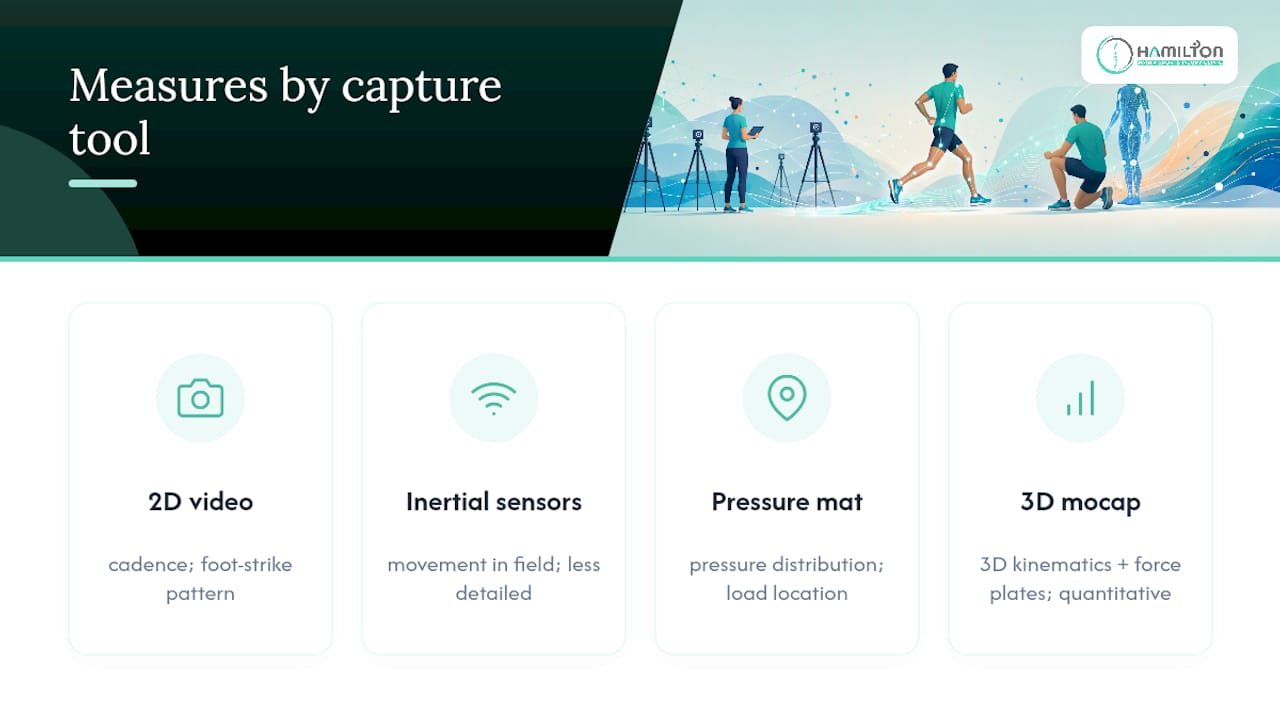
The technology varies enormously in what it can capture. Simple 2D video is fine for spotting cadence and foot strike pattern, but it cannot measure forces. Full 3D motion capture, combined with force plates and biomechanical modelling, gives you repeatable, quantitative data that visual observation alone can't match. Inertial sensors and pressure mats sit somewhere in between, useful for field measurement but generally less detailed than a proper lab setup, according to a review of gait analysis methods.
Here's the bit people miss: no single variable diagnoses anything on its own. A high loading rate or an asymmetric stride is a clue, not a verdict.
What happens during a clinical running gait assessment?
A proper clinic visit and a five-minute treadmill screen at a shoe shop are not the same product, and it's worth knowing which one you're actually booking.
The clinical sequence usually runs like this:
- A history of your training, injuries and goals, taken before anything else happens
- A musculoskeletal screen of hip, core and ankle control, since weaknesses well away from your sore spot often cause the symptom itself
- Running trials at your normal pace and a faster one, because gait changes with speed
- Motion capture or video data collection during those trials
- A written report and an intervention plan based on what showed up
That sequence reflects the kind of integrated assessment that medically based running analysis standards recommend, and functional screening beforehand exists partly for safety.
Retail screens are a different animal entirely. You'll usually get a short treadmill jog filmed on a phone, a quick look at strike pattern, and a shoe recommendation. Handy for buying trainers, not built to explain chronic knee pain. If you've got a nagging issue rather than a shoe question, that's your cue to look for clinical oversight instead.
What are the key metrics in a running gait assessment?
Numbers only mean something once you know what they're measuring. Here's what tends to show up on a decent report:
- Cadence – steps per minute; low cadence at a given pace often means longer, higher-impact strides
- Ground contact time – how long your foot stays on the floor, which speaks to stiffness and reactive strength
- Shank angle and stride geometry – how vertical your shin is at foot strike, a common flag for overstriding
- Pressure distribution and force peaks – where and how hard load lands, and how quickly it builds (loading rate)
- Symmetry – side-to-side comparison across all of the above, since a "normal" average can hide a lopsided reality
Pro Tip: Don't fixate on cadence alone. A runner with brilliant cadence can still have a rubbish loading pattern on one side. Look at the whole picture, not the headline number.
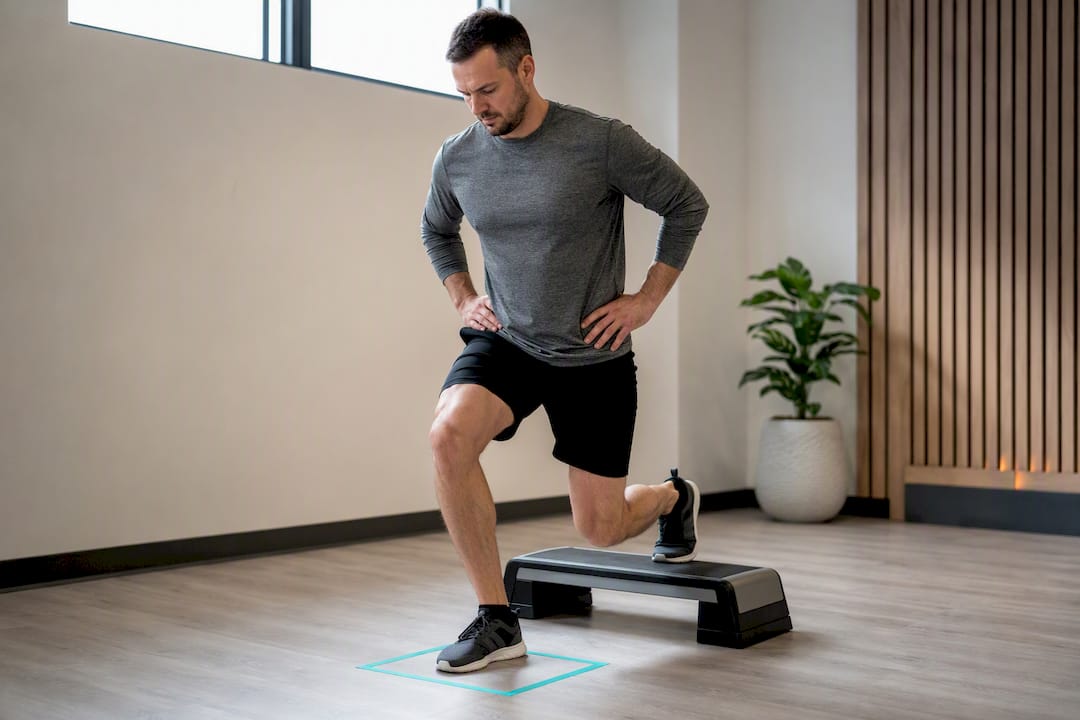
Functional screens layered onto these numbers, things like single-leg squats or step-downs, tend to reveal the modifiable constraint behind the data: a weak hip, a stiff ankle, poor single-leg control. That's usually more useful clinically than the raw metric itself.
How do clinicians turn gait data into a treatment plan?
Data on its own is a weak prescription. A clinician's job is to treat the numbers as a hypothesis, not a label, then find the modifiable constraint driving them and test whether changing it helps.
Say your ground contact time is longer on one side and your hip control screen was poor on the same leg. The working theory becomes: weak hip control is letting your stance phase drift, so strengthen the hip and retest. Common interventions include cadence cueing (nudging step rate up gradually, often in small increments), targeted strength work aimed at the constraint identified in screening, and orthotic prescription where pressure data actually supports it, not as a default add-on.
Good practice means changing one variable at a time, in a controlled dose, then retesting under the exact same conditions, same speed, same shoes, same route, to see whether the change did what it was meant to. That's the only honest way to know if it worked.
A high-quality report should document the conditions it was captured under: speed, shoes, incline, whether you were fresh or fatigued. Skip that and the numbers become meaningless the moment circumstances change, since gait variables shift with the task itself.
When should you get gait analysis, and when should you see a clinician first?
Gait analysis earns its keep when you've got persistent pain that isn't settling, an injury that keeps recurring in slightly different forms, an asymmetry you can't explain, or you're chasing a specific performance target and want to know if your form is costing you.
It's not the first move for everything, though. Acute, severe pain, anything neurological like numbness or weakness down a leg, or systemic symptoms such as unexplained swelling or fever, need a clinician's eyes before any camera does. Gait analysis is a measurement tool, useful, but not a substitute for medical triage when something looks properly wrong.
If your issue is mild and recent, a simple video review or a spell of targeted strength work, like the routines in this runner's strength plan, might genuinely be enough before you book anything more involved.
Clinical perspective: how Hamilton Pain and Sports Injury Clinic runs a gait analysis
Hamilton Pain and Sports Injury Clinic builds its running assessments around the same logic outlined above: history first, then functional screening, then motion capture or video during running trials, then targeted exercise prescription based on what's found. It's not a bolt-on service, it's the whole point of the visit.
The clinic's own case work backs this up. A Trendelenburg gait correction shows how identifying the right modifiable constraint, in that case hip control, and pairing it with a specific exercise programme, produced a measurable change in the walk itself. That's the model: measure, hypothesise, intervene, retest, not measure and hope.
How to prepare for a gait analysis and what it costs
Turning up prepared makes the whole session more useful, and it's genuinely not much to organise.
- Bring your usual running shoes (the ones you actually train in, not your newest pair)
- Bring a training log if you keep one, plus any prior scans or physio notes
- Wear fitted, non-baggy clothing so markers and cameras can pick up your joints properly
- Warm up as you would before a normal training run, don't turn up cold
Pro Tip: If you own more than one pair of running shoes, bring them all. Loading patterns can shift noticeably between a max-cushioned trainer and a racing flat, and that comparison is often more revealing than one pair alone.
Cost varies depending on the equipment used, the clinician's experience, and the detail of the report and follow-up plan. Prices can range significantly, with full 3D motion capture assessments typically costing more than video-based clinical assessments.
Clinician's perspective: what realistic progress looks like
Meaningful change in running form rarely shows up in a week. Cadence tweaks and strength work typically need several weeks of consistent, monitored dosing before a retest shows a real shift, not a fluke. The plan only works if you actually follow it and turn up for the retest.
— Mark
Book a gait analysis with Hamilton Pain and Sports Injury Clinic
If you've read this far, you've probably clocked that a five-minute treadmill clip won't tell you why your knee keeps flaring up on longer runs, and that's exactly the gap Hamilton Pain and Sports Injury Clinic is built to close. Sportsinjurydublin runs its gait assessments the clinical way: history, functional screening, motion capture during actual running trials, and a written plan tied to the specific constraint your data points to, not a generic shoe suggestion.
Expect follow-up built into the process from the start, with a retest against your original conditions to check whether the plan is actually working, not just plausible on paper. If persistent pain or a recurring niggle is what brought you here, the sports rehabilitation programme is the natural next step after assessment, giving you a structured route back to full training rather than a one-off report and a shrug. Book an assessment and get a plan you can actually measure against.
Sources
- Setting standards for medically based running analysis
- What is clinical gait analysis? — Vicon
- Gait analysis: How and why runners should do one — Runner's World (UK)
- Running gait analysis: What it shows and when it helps — Nextgait