

Use a progressive run/walk protocol combined with twice-weekly strength work and clear soreness rules to rebuild running tolerance safely. Aim for 30 minutes of continuous, easy running as your practical milestone, not your starting point. Before you begin, confirm you can walk 15 minutes pain-free and manage a single-leg hop without wobbling or compensating.
TL;DR:
- Progression should be based on tissue tolerance and pain-free performance, with at least two to three repetitions at each step before advancing.
- Halt or regress if soreness persists into the next day, worsens during activity, or lasts beyond 72 hours, especially if accompanied by swelling or difficulty walking.
- Achieve at least 15 minutes of pain-free walking, manage stairs comfortably, and perform a single-leg hop without compensation before starting running.
- Cross-training and strength exercises targeting hips, calves, and core are essential to support tissue resilience and prevent re-injury.
- Only add hills, speed, or longer runs after four weeks of consistent 30-minute runs with no soreness, progressing gradually one variable at a time.
Table of Contents
- What should you do today to start your return to running plan?
- The 9-step run/walk progression that actually works
- When should you hold, regress or stop your run?
- Are you actually ready to start running again?
- Do you need to strength train while returning to running?
- When can you add hills, speed and longer runs?
- What does a sample 8-week comeback plan look like?
- How does individualised assessment change your recovery odds?
- What's the honest truth about return-to-run timelines?
- Get a plan built around your actual injury, not a generic template
- Sources
What should you do today to start your return to running plan?
You don't need a spreadsheet or a physio appointment to make a sensible start today. Here's what actually moves the needle in week one.
Keep everything short and conversational. If you can't chat through a sentence while running, you're going too hard.
- Start with brief run/walk intervals rather than jumping straight back into continuous miles.
- Run every other day at first. Your tendons and bones need the rest days more than your lungs do.
- Slot in two short strength sessions a week, even 20 minutes counts.
- Skip hills and speed work entirely until continuous easy running feels boringly stable.
- If pain shows up, your gait changes, or something just feels "off," stop and follow the regression rules below rather than pushing through.
That last point trips people up more than anything else. Runners are stubborn (good on us, mostly), but stubbornness is exactly what turns a manageable niggle into another six weeks off. The whole point of a structured return-to-sport approach is that it removes the guesswork, you follow the rule, not your mood that day.
One more thing worth knowing early: your entire body detrains during a layoff, not just the injured part. Aerobic capacity drops, muscles lose coordination, and tendons lose tolerance for repeated loading. That's why experts frame the comeback as whole-body reconditioning, not just "waiting for the injury to heal and then running again."
The 9-step run/walk progression that actually works
This is the meat of your return to running plan, and it's borrowed from a genuinely well-tested format rather than something dreamed up on a whim. The structure moves you from short running bursts to a full 30-minute continuous run, and each step builds tolerance without asking your tissue to do something it isn't ready for yet.
The nine steps look roughly like this, adapted from the widely used run/walk progression:
- Several two-minute running intervals interspersed with walking
- Longer running intervals gradually increasing in length, separated by walking
- Continued progression in run intervals with walking breaks
- Increasing run duration with walking breaks
- Further longer running intervals with walking breaks
- Extended running intervals with shorter walking breaks
- Moderate duration continuous running
- Extended duration continuous running
- A full 30-minute continuous running session
Every session should be bookended properly. Start with 5 to 10 minutes of brisk walking and dynamic mobility, think leg swings, walking lunges, ankle circles, to get blood into the tissue before you ask it to run. Finish with 5 minutes of easy walking to bring your heart rate down, followed by light static stretching or foam rolling on the calves, quads, and hips. It's not glamorous, but it's the bit almost everyone skips, and it's often the bit that matters most.
Pace guidance is simple: keep it conversational. You should be running at an effort where you could hold a chat, not gasping through gritted teeth. If you're checking your watch every thirty seconds to see if you've hit some arbitrary pace, you've missed the point of this phase entirely. Speed comes later, right now you're teaching tissue to tolerate load again.
On progression rules, clinical protocols are consistent on a few points worth taking seriously. Run no more than every other day in the early steps, this isn't laziness, it's recovery time your bone and tendon genuinely need. Several protocols also recommend repeating each phase two to three times before advancing, and never moving to the next step until you're pain-free at the current one. That's a harder rule to follow than it sounds, because by step 4 or 5 you'll feel great and want to skip ahead. Don't. The step number isn't the goal, tolerance without pain is.
If you're coming off a shorter break with tissue that isn't especially irritable, you might move through steps faster or even skip the earliest ones. But longer layoffs and more irritable tissue call for sticking closely to the run/walk structure, resist the urge to fast-track just because you used to run 10Ks without thinking about it.
When should you hold, regress or stop your run?
Soreness is not a red flag by default, it's information. The trick is knowing which kind of soreness is telling you to carry on and which kind is telling you to back off.
There are broadly three categories worth watching for. Soreness that appears during warm-up and fades once you're moving is usually fine, that's normal stiffness waking up. Soreness that shows up during the run and persists through to the next day is your cue to hold at the current step rather than advance. Soreness that gets worse through the session and is still there, or worse, 24 to 72 hours later means you need to drop back a step, or several, and reassess.
- Stay at your current step if soreness appears only after the session and settles within a few hours.
- Drop back one step if soreness persists into the next day but is mild and improving.
- Take 2 to 3 full rest days and reassess if soreness worsens through the session or lingers beyond 72 hours.
- Seek professional review if none of the above resolves things within a week, or if you're seeing any red flags below.
Certain symptoms shouldn't wait for the "reassess in a few days" approach at all. Limping (even mild), swelling that doesn't settle overnight, pain that wakes you at night, or symptoms that get steadily worse over several consecutive days all warrant a clinician's eyes on it sooner rather than later. These aren't "push through it" signals, they're "stop and get this checked" signals.
Pro Tip: Keep a one-line training log, even just a note on your phone: step number, how it felt during, how it felt the next morning. Patterns become obvious after a week that are invisible after a single run.
Clinical return-to-run guidance backs this next-day trend test specifically because it takes emotion out of the decision. You're not asking "do I feel like running today," you're checking a simple rule against what your body told you yesterday.
Are you actually ready to start running again?
Before step 1 of any plan, it's worth running through a short readiness check. This matters more than people expect, because "the pain has mostly gone" and "my tissue can tolerate running load" are two very different things.
- Walk 15 minutes pain-free, at a normal brisk pace, with no compensating limp or altered gait.
- Go up and down a full flight of stairs without pain, this loads the joint and tendon in a way flat walking doesn't.
- Perform a single-leg hop without compensation, land cleanly on the injured side without your knee caving in or your balance collapsing sideways.
Clinicians often use these as practical proxies for tolerating the repeated loading running demands, sometimes described as being able to handle 200 to 250 foot contacts without pain. If you can't manage the single-leg hop cleanly, running is going to load that same weakness thousands of times over, not ideal.
Certain situations need formal medical clearance before you go anywhere near a run/walk plan: a diagnosed bone injury (stress fracture territory), swelling that hasn't settled despite rest, or any neurological signs like numbness, tingling, or weakness down the leg. These aren't do-it-yourself situations.
The duration and irritability of your injury should also shape how cautiously you approach the plan. A niggle from a two-week lay-off behaves very differently to a tendon issue that's flared on and off for six months. The longer and more irritable the history, the more conservative your early progression should be, think smaller step increases and longer holds at each stage, not a race through the nine steps.
Do you need to strength train while returning to running?
Yes, and skipping this is probably the single most common mistake in DIY comeback plans. Running asks your tissue to absorb forces several times bodyweight with every stride. Walking simply doesn't demand that, so if your only preparation is walking and a bit of run/walk work, you're asking tendons and muscles to handle a job they haven't been trained for.
Pairing progressive running with concurrent resistance training is now standard clinical advice, not an optional extra. Two sessions a week is the practical minimum, focused on glutes, hips, calves, and core.
A few exercises earn their place in almost every return-to-run programme:
- Loaded single-leg Romanian deadlift, start bodyweight, add dumbbells as control improves.
- Split squats, progress from bodyweight to goblet-holds to rear-foot-elevated versions.
- Progressive calf raises, moving from double-leg to single-leg, then adding load or slowing the eccentric phase.
- Side-lying hip abduction or banded lateral walks, cheap insurance against the hip weakness that shows up in a lot of running injuries.
Eccentric calf strength in particular deserves attention if your issue involved the Achilles or lower leg, clinicians consistently flag it as a priority area when prescribing loaded resistance work for returning runners.
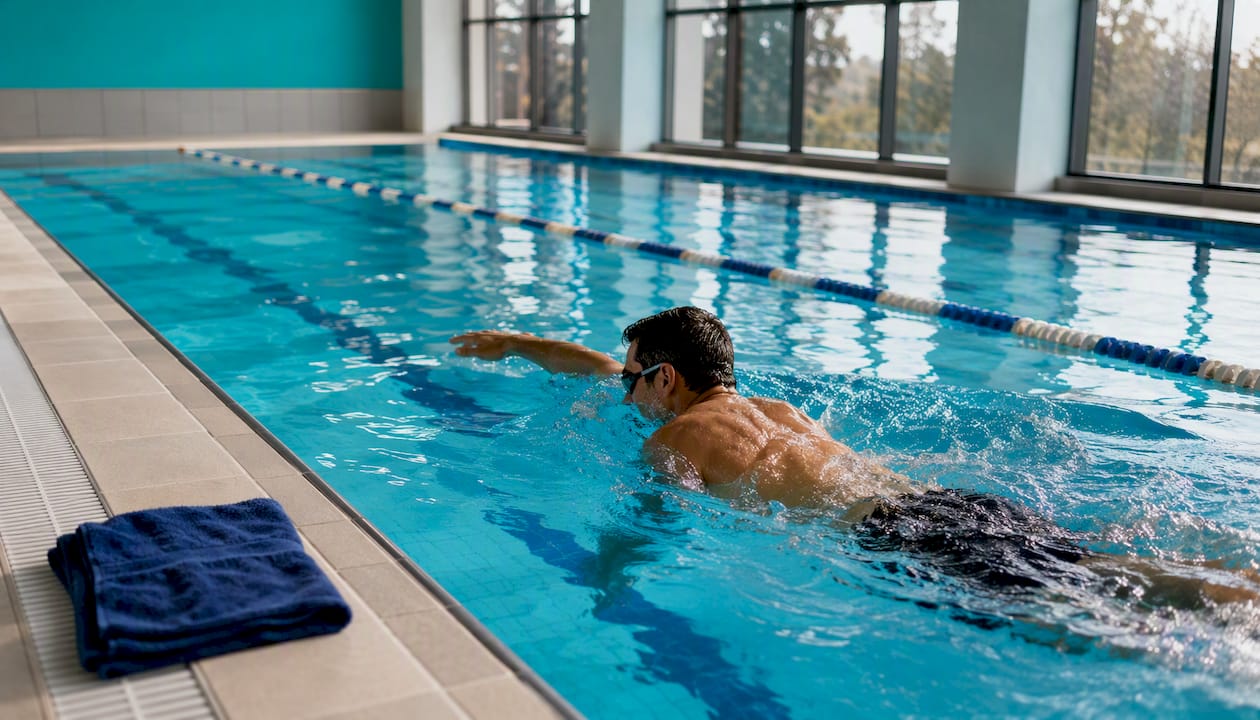
Cross-training fills the aerobic gap without adding impact stress. Cycling, swimming, or the elliptical on your non-running days keep your engine ticking over while your legs recover between run sessions. If you can only squeeze in two runs a week early on, a couple of cross-training sessions stop your fitness sliding backwards in the meantime. For structured examples of load progression, a strength-focused injury prevention guide is worth a browse.
Pro Tip: Do your strength sessions on easy or rest days, not immediately before a run. Tired glutes change your running mechanics, which rather defeats the purpose.
When can you add hills, speed and longer runs?
There's an order to this, and jumping it is how comebacks go sideways. The sequence to follow is frequency, then duration, then intensity, in that order, never intensity first.
Once you're comfortably running every other day (frequency sorted) and can hold 30 minutes continuously without soreness creeping in (duration sorted), only then does it make sense to think about hills, strides, or pace work.
A sensible benchmark before adding intensity: you should be managing comfortable 30-minute continuous runs for around two weeks straight, with no worsening soreness trend across that period. That's not an arbitrary hurdle, it's giving your tissue time to adapt to the new baseline before you load it further.
- Introduce hills gradually, one or two short, gentle inclines within an otherwise flat easy run, not a hill repeat session out of nowhere.
- Add strides (short, relaxed accelerations of 15 to 20 seconds) once a week before jumping into structured speed work.
- Monitor the next-day response exactly as you did during the run/walk phase, that trend test doesn't stop mattering once you've hit 30 minutes.
- Increase only one variable at a time, don't add a hill and a longer distance and faster pace in the same week.
Runners who've been sidelined tend to get impatient right around this stage, ironically often the point where re-injury risk creeps back up, because confidence outpaces tissue capacity. Keep the same discipline that got you through the run/walk phase.
What does a sample 8-week comeback plan look like?
This is a template to adapt, not a rigid script. Shift the timeline earlier or later depending on where you're starting and how your tissue responds.
- Weeks 1 to 2: steps 1 to 3 of the run/walk progression, every other day, plus two strength sessions.
- Weeks 3 to 4: steps 4 to 6, still every other day, strength sessions continuing unchanged.
- Weeks 5 to 6: steps 7 to 8 (20 to 25 minutes continuous), maybe stretching to four running days if tolerance is good.
- Weeks 7 to 8: step 9 (30 minutes continuous) held for at least two weeks before any hills or strides.
Every session follows the same shape: 5 to 10 minutes of mobility and brisk walking to warm up, the interval or continuous run itself, then an easy walking cool-down and a few minutes of stretching or foam rolling.
If you're starting from a higher fitness baseline or a shorter layoff, you can compress this timeline. If your tissue is irritable or this is a repeat injury, stretch it out, repeat steps, and lean more heavily on the soreness rules than the calendar.
How does individualised assessment change your recovery odds?
Generic plans work for a lot of people right up until they don't, usually because one detail about your specific injury, your gait, your training history, doesn't fit the template. At Sportsinjurydublin, assessment starts with understanding what's actually driving your symptoms, not just applying a standard protocol regardless of the person in front of us.
A first appointment typically covers a movement and strength assessment, a look at your training history and injury pattern, and a tailored plan built around your actual step readiness rather than a generic week count. That might mean progressing faster through early steps if your tissue is calm, or building in more conservative holds if there's a pattern of recurring flare-ups. Individualised planning consistently produces steadier outcomes than a one-size-fits-all handout, because the plan adjusts to you instead of the other way round.
If your injury has been recurring, or you're not confident reading your own soreness signals yet, that's precisely the gap a supervised assessment closes.
What's the honest truth about return-to-run timelines?
Recovery timelines genuinely vary, and comparing yours to someone else's Strava history helps nobody. Consistency beats speed every time. The mistakes I see most are rushing steps, ignoring a gait change because "it's not that bad," and treating strength work as optional. It isn't.
— Mark
Get a plan built around your actual injury, not a generic template
Reading a run/walk table online is a fine starting point, but it can't feel what your calf is doing on day three or spot the gait change you've stopped noticing. Sportsinjurydublin builds your comeback around your actual injury history, your current step readiness, and how your tissue is genuinely responding, not a generic week-by-week download.
A first appointment includes a full movement and strength assessment, a look at your training history, and a specific plan for where you are right now, not where a generic template assumes you should be. If you're dealing with a recurring flare-up, uncertain whether your symptoms warrant a pause, or just want someone to sanity-check your progression, that's exactly what Sportsinjurydublin's rehabilitation programme is built for. And if you're unsure whether what you're feeling is normal training soreness or something that needs a proper look, this guide on when to see a sports therapist will help you decide. Book an assessment and get a plan that actually fits your injury, not the other way round.
Sources
- Return to Run Program (Allina Health protocol)
- Basic return-to-running guideline (Wexner Medical / sports medicine)