
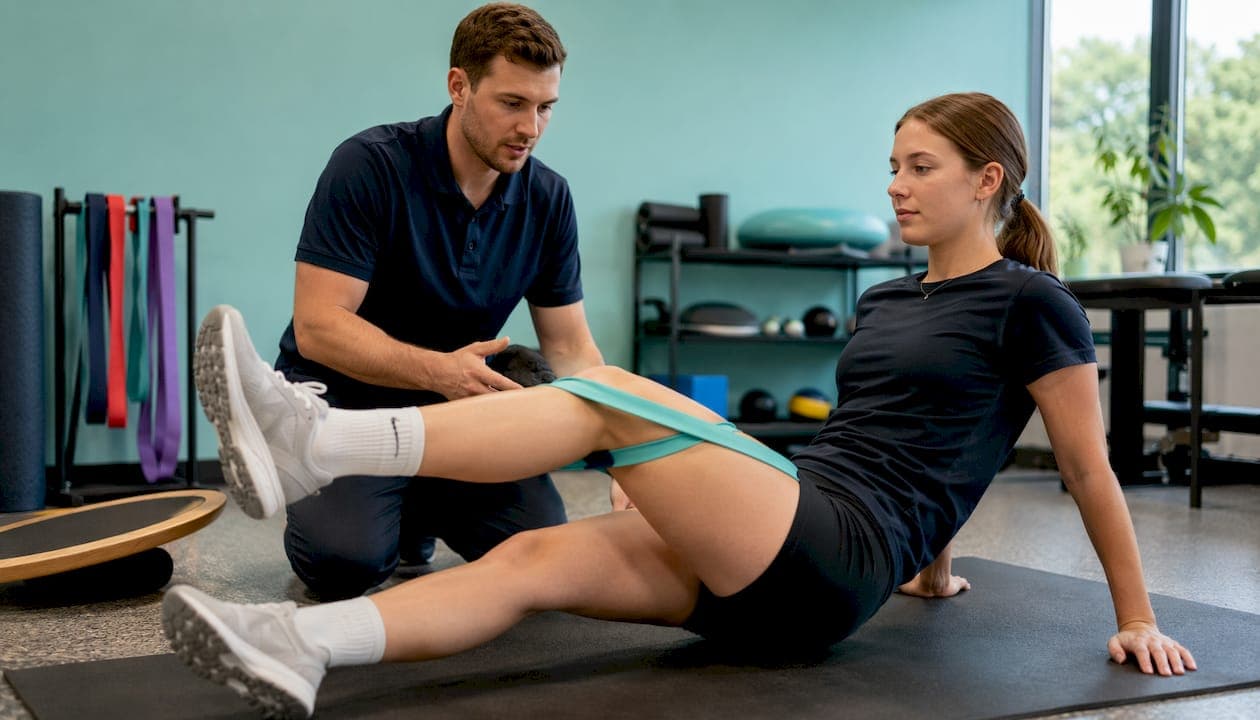
To stop the same sports injury coming back, the single highest-value action is this: complete your full rehabilitation programme and restore genuine tissue capacity before returning to training — not just wait until the pain goes away.
Sound simple? It is, in theory. In practice, most people feel better after a week or two, lace up their trainers, and wonder why they're limping again by Thursday. Sound familiar? (Yeah, we've all been there.)
Here are five things you can start doing right now to break that cycle:
- Pause the aggravating activity. Not forever — just long enough to stop adding load to already-stressed tissue.
- Book a clinician assessment. A physiotherapist or sports medicine doctor can identify what's actually driving the recurrence, not just where it hurts.
- Begin progressive strength work. Target the specific muscles and movement patterns that failed you, under guidance.
- Set a measured return plan. Agree objective milestones with your clinician before you go back to full training.
- Protect your recovery days. Two proper rest days per week aren't laziness — they're when your tissue actually adapts.
If you're experiencing sharp night pain, progressive swelling, loss of function, or any neurological symptoms (tingling, numbness, weakness), skip the self-management phase and get assessed urgently.
Table of Contents
- Why do sports injuries keep recurring?
- The core framework to prevent recurring sports injuries
- What does a rehab programme that truly prevents recurrence look like?
- How to change your training safely to avoid re-injury
- Targeted strength and neuromuscular training that cuts recurrence risk
- Movement screening and technique fixes you can do in training
- Equipment, footwear and training environment adjustments
- Red flags and when to seek professional help
- What the evidence says about recurrence and progressive loading
- Ready-to-use routines: warm-ups, prehab and a weekly plan
- Key takeaways
- The part most guides get wrong about recurrence
- How Sportsinjurydublin can help you get back and stay back
- Selected sources and further reading
Why do sports injuries keep recurring?
Here's the honest answer: recurrence is almost never bad luck. It's a capacity-to-load mismatch — your tissue simply isn't ready for what you're asking it to do.
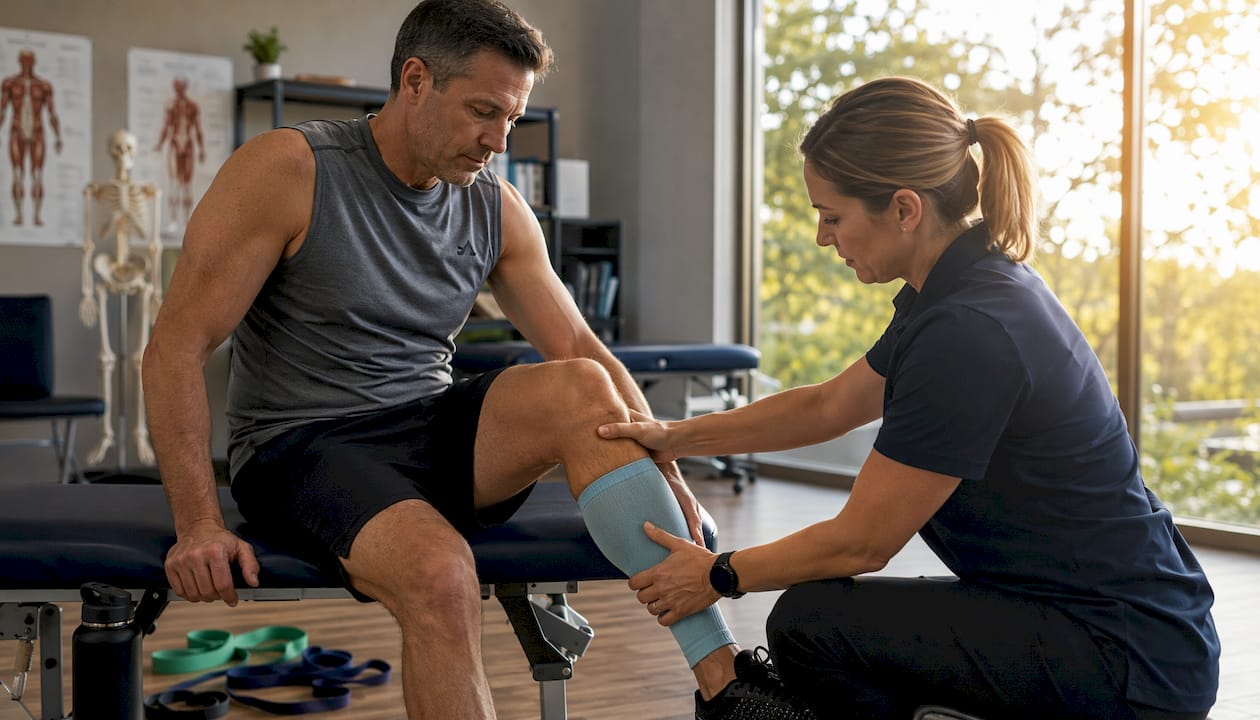
Research published on PubMed found that approximately 15.6% of subsequent injuries are directly related to an earlier index injury. That's a significant proportion of re-injuries that are, in a real sense, predictable and preventable.
The main drivers tend to cluster around five patterns:
Incomplete rehabilitation. Pain disappears well before tissue has fully healed and regained strength. Athletes return to sport at 70–80% capacity and wonder why the same spot flares up. Clinical commentary suggests re-injury rates in some runner cohorts are as high as 70% when root causes go unaddressed.
Rapid load spikes. Jumping from three runs a week to six, or returning from two weeks off and training like you never left — these spikes expose tissue to stress it hasn't been conditioned for.
Biomechanical compensation. Limp for a week and your body rewires its movement patterns. Those compensations often outlast the original injury and create new stress points upstream or downstream.
Chronic fatigue and poor sleep. Tissue repair happens during rest. Consistently short-changing sleep or stacking hard sessions without recovery days keeps the body in a state where it can't adapt fast enough.
Training and technique errors. Poor running mechanics, faulty lifting form, or sport-specific movement habits that overload one structure repeatedly — these are often the original cause and, left uncorrected, guarantee a return visit.
The overuse injury literature from PMC puts it well: excessive loading, insufficient recovery, and underpreparedness all increase injury risk by exposing athletes to relatively large spikes in load. It's not the sport that's the problem — it's the mismatch.
The core framework to prevent recurring sports injuries
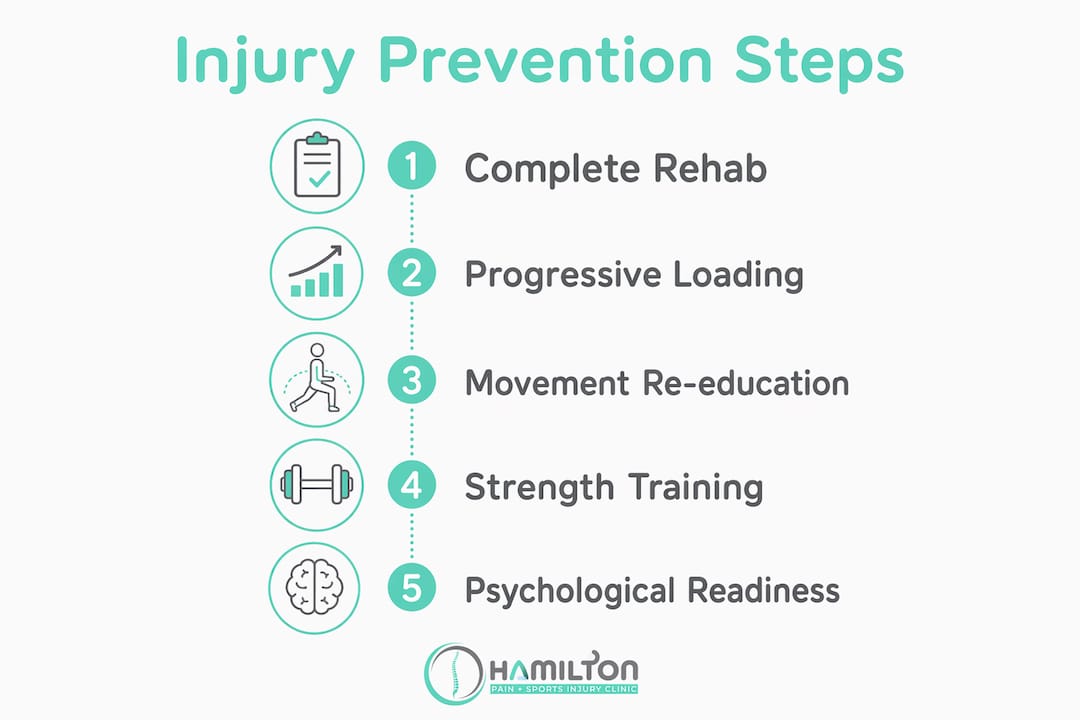
Think of it as a five-step sequence, not a checklist you tick once: rehabilitate → rebuild capacity → control load → test function → maintain.
Miss any step, or rush through it, and you're essentially building on a cracked foundation.
- Complete progressive rehabilitation. Work through every phase — acute management, tissue loading, strength rebuilding — before declaring yourself fit. Symptom resolution is not the finish line.
- Restore sport-specific load tolerance. Your tissue needs to handle the actual demands of your sport: the cutting, the sprinting, the overhead press, the landing. Generic rehab that stops at pain-free walking isn't enough.
- Schedule rest and recovery. Two rest days per week, adequate sleep, and planned deload weeks aren't optional extras. They're when adaptation happens.
- Correct movement patterns. Identify and address the mechanical drivers — hip weakness, ankle stiffness, poor scapular control — that created the problem in the first place.
- Maintain strength long-term. Rehab ends; strength work doesn't. Two to three sessions per week of targeted strength training, ongoing, is what keeps recurrence at bay.
Pro Tip: Here's how to spot false recovery — the sneaky one that catches people out. Ask yourself: "Is my pain gone, or is my capacity restored?" Pain can disappear while tissue is still only 60% of its pre-injury strength. Before returning to full training, test yourself with a single-leg calf raise to fatigue, a single-leg squat, or a sport-specific movement under load. If you can't match your uninjured side, you're not ready — regardless of how good you feel.
What does a rehab programme that truly prevents recurrence look like?
A proper rehab programme isn't just a sheet of exercises from a clinic printer. It's a staged process with objective markers at each gate. Personalised sports therapy consistently outperforms generic protocols because it accounts for your specific deficits, sport demands, and history.
The core components are:
Assessment and diagnosis. Not just "where does it hurt" but why — imaging where indicated, movement screening, load history, and previous interventions.
Graded loading. For tendons and muscles, progressive loading is the treatment, not just the recovery vehicle. Evidence supports progressive tendon loading over prolonged immobilisation for overuse conditions.
Movement re-education. Correct the compensatory patterns that developed during the injury period.
Strength and power rebuilding. Progress from foundational strength to sport-specific power and plyometrics.
Psychological readiness. Fear of re-injury is real and measurable. A good clinician will address it explicitly, not assume confidence returns automatically.
Return-to-sport criteria: what "ready" actually looks like
Objective markers matter here. Feeling fine is not a criterion. Clinical practice stresses load tolerance testing and sport-specific functional tests as the real gatekeepers.
Look for: symmetry between limbs on strength and power tests (typically within 10–15% of the uninjured side), pain-free performance under sport-specific load, and psychological confidence scores above a validated threshold (the ACL-RSI scale is commonly used for knee injuries, for example).
Typical rehabilitation phases and timelines
| Injury type | Phase 1: Acute (weeks) | Phase 2: Loading and strength (weeks) | Phase 3: Sport-specific (weeks) | Notes |
|---|---|---|---|---|
| Ankle sprain (Grade I–II) | 1–2 | 3–6 | 4–8 | Balance and proprioception critical |
| Muscle strain (Grade I–II) | 1–2 | 3–5 | 3–6 | Eccentric loading from week 3 |
| Achilles tendinopathy | 2–4 | 8–12 | 6–12 | Alfredson protocol (3×15 reps, twice daily) |
| Hamstring strain | 1–2 | 4–8 | 4–8 | Nordic curls from mid-phase |
| Rotator cuff strain | 2–4 | 6–10 | 6–10 | Scapular control before shoulder loading |
Timelines are approximate and vary significantly by individual, severity, and sport. Always confirm phases and progression with your clinician.
Questions to ask at your first assessment
- Do I need imaging, and will it change the management plan?
- What is the progressive loading plan, week by week?
- What are the measurable goals before I return to full training?
- How will we know when I'm ready — what tests will you use?
How to change your training safely to avoid re-injury
Load management is the unglamorous hero of injury prevention. The goal is simple: match your training stimulus to what your tissue can currently handle, then increase demand gradually as capacity grows.
The commonly cited 10% rule — increasing weekly volume or intensity by no more than around 10% at a time — is a useful rule of thumb, not a rigid law. What matters is the principle: no sudden spikes.
Here's how to apply it practically:
- Plan microcycles. Structure your week so hard sessions are followed by easy or rest days — never stack two high-intensity days back to back during a return phase.
- Include deload weeks. Every third or fourth week, drop volume by 30–40% to let tissue consolidate the adaptation.
- Monitor next-day response. If you're significantly sorer or stiffer the morning after a session than you were after the previous equivalent session, that's a signal to back off.
- Log training and symptoms. A simple spreadsheet or training app noting session type, duration, RPE (rate of perceived exertion), and any symptoms is worth its weight in gold.
- Pair hard days with easy days. This applies to both volume and intensity — don't spike both at once.
Example return-to-run progression (weeks 1–6)
| Week | Sessions | Format | Notes |
|---|---|---|---|
| 1 | 3 | Walk 20 min | Pain-free baseline |
| 2 | 3 | Walk 15 min / jog 5 min | Monitor next-day response |
| 3 | 3 | Walk 10 min / jog 10 min | Increase only if week 2 symptom-free |
| 4 | 3 | Jog 20 min continuous | Deload if any flare |
| 5 | 3 | Jog | Add one tempo interval |
| 6 | 3 | Jog 30 min + 2×5 min tempo | Review with clinician |
Pro Tip: To measure session RPE, ask yourself immediately after training: "On a scale of 1–10, how hard was that overall?" Multiply that number by the session duration in minutes to get your session load score. Track this weekly. If your total weekly load jumps by more than about 10% from the previous week, that's your warning sign — regardless of how good you felt during the session.
Targeted strength and neuromuscular training that cuts recurrence risk
Strength work reduces recurrence because it improves force absorption, distributes load across more structures, and maintains motor control when you're tired — which is exactly when most injuries happen. Strength training for injury prevention is one of the most evidence-supported tools available to active people.

Neuromuscular training adds another layer: it trains the nervous system to react quickly and coordinate movement under unpredictable conditions — the kind of conditions that cause ankle rolls, knee collapses, and shoulder impingements.
Exercise map by region
| Region | Target muscles | Key exercises | Progression markers |
|---|---|---|---|
| Hip/core (for knee pain) | Glutes, hip abductors, deep core | Clamshells, single-leg deadlift, Copenhagen plank | Single-leg squat without knee cave |
| Calf/ankle (for Achilles) | Gastrocnemius, soleus, peroneals | Calf raises (bilateral → single-leg), heel drops, banded eversion | 3×15 single-leg calf raises pain-free |
| Hamstring | Biceps femoris, semimembranosus | Nordic curl, Romanian deadlift, glute-ham raise | Limb symmetry index >10–15% difference |
| Rotator cuff/scapular (shoulder) | Infraspinatus, serratus anterior, lower trapezius | External rotation, face pulls, wall slides | Full overhead range pain-free under load |
| Quadriceps/knee | Vastus medialis, quadriceps group | Terminal knee extension, step-downs, leg press | Single-leg press equal to bodyweight |
8–12 week phased programming template
Phase 1 (weeks 1–4): Foundational strength. Two sessions per week. Focus on bilateral movements, controlled tempo (3 seconds down, 1 up), and building the habit. Sets of 3×12–15 at moderate load.
Phase 2 (weeks 5–8): Capacity building. Three sessions per week. Introduce unilateral loading, increase intensity to 3×8–10 at higher load, and add isometric holds for tendon health.
Phase 3 (weeks 9–12): Power and sport-specific. Three sessions per week. Add plyometrics (box jumps, bounding, medicine ball throws), reduce reps (3×5–6 at near-maximal load), and integrate sport drills. This is where you earn your return-to-sport clearance.
Integrate strength sessions on non-sport days where possible, or at least several hours apart from high-intensity sport sessions. Two to three sessions per week is the sweet spot for most active adults — enough stimulus to drive adaptation without accumulating excessive fatigue.
Movement screening and technique fixes you can do in training
Many recurrences are driven by what clinicians call regional interdependence — a problem at one joint that's actually caused by a deficit somewhere else entirely. Knee pain from weak hips. Achilles overload from stiff ankles. Shoulder impingement from poor thoracic mobility. Treat the system, not just the sore bit.
Common mechanical drivers by region:
- Hip weakness → knee pain and IT band issues. The knee collapses inward under load because the hip can't hold it out.
- Ankle stiffness → Achilles and calf overload. Restricted dorsiflexion forces the heel to rise early, dumping load onto the Achilles.
- Poor thoracic mobility → shoulder and neck problems. The shoulder compensates for a stiff mid-back by impinging on the rotator cuff.
- Weak deep core → lower back and hip flexor strain. The spine loses stability under load and adjacent structures pick up the slack.
Self-checks you can run in the gym or on the track
Single-leg squat. Stand on one leg and lower slowly to 45 degrees. Watch for knee cave (inward collapse), trunk lean, or hip drop. Any of these signals hip or core weakness.
Controlled lunge. Step forward and lower the back knee to just above the floor. The front knee should track over the second toe. Wobble, collapse, or pain indicates control deficits.
Overhead reach. Stand with your back to a wall and raise both arms overhead. Can you reach the wall without your lower back arching away from it? If not, thoracic or shoulder mobility is limiting you.
Pro Tip: Log technique breakdown under fatigue — not just at the start of a session. Film yourself doing a single-leg squat at the beginning and again at the end of a run or circuit. If your form deteriorates significantly by the end, that's the window where re-injury risk spikes. Address the fatigue threshold, not just the movement pattern.
Equipment, footwear and training environment adjustments
Equipment and environment are genuinely overlooked contributors to recurrence — and they're often the easiest things to fix. As the NIAMS guidance on sports injuries notes, wearing shoes without adequate support and running or jumping on hard surfaces are recognised risk factors for sports injuries.
Footwear. Running shoes have a lifespan of roughly 300–500 miles. Beyond that, the midsole cushioning degrades even if the upper looks fine. If you've been running in the same pair for over a year, that's worth investigating. For field sports, check that studs or blades match the surface — wrong stud type on firm ground creates rotational stress on the knee and ankle.
Surface choice. Rotating between surfaces (grass, trail, track, treadmill) distributes load differently and reduces the repetitive stress that drives overuse injuries. If you've been doing all your running on concrete, shifting some sessions to grass can make a meaningful difference.
Protective equipment. Braces and supports have a role in the early return phase, but they're not a long-term substitute for strength and proprioception. Use them as a bridge, not a crutch.
Quick action checklist:
- Inspect your training shoes and check mileage or wear pattern on the sole
- Rotate between at least two surfaces per week during return phases
- Check court or field conditions before sessions (wet, uneven, or hard surfaces increase risk)
- Review whether any footwear inserts are still appropriate for your current biomechanics
A note on orthotics and specialist equipment: Custom orthotics can be genuinely useful for specific biomechanical presentations — but they work best as part of a broader plan that includes strength and movement correction, not as a standalone fix. If you've been prescribed orthotics previously and are still getting recurring injuries, it's worth revisiting whether the underlying movement drivers have been addressed. Discuss this with a physiotherapist or sports medicine clinician before investing in new kit.
Red flags and when to seek professional help
Most recurring sports injuries can be managed conservatively with the right plan. But some presentations need urgent professional review — and knowing the difference matters.
Seek urgent assessment if you have:
- Sharp pain at rest or at night that isn't explained by recent training
- Progressive swelling that isn't settling within 48–72 hours
- Significant loss of function (can't weight-bear, can't lift the arm above shoulder height)
- Neurological symptoms: tingling, numbness, or unexplained weakness in a limb
- A "pop" or "snap" at the time of injury followed by rapid swelling
Who to see and what they offer:
- GP. First port of call for ruling out non-musculoskeletal causes, referring for imaging, and accessing NHS physiotherapy. Waiting times vary significantly by region.
- Physiotherapist. The primary clinician for most sports injuries — assessment, diagnosis, progressive rehab, and return-to-sport planning. Private access is typically faster than NHS for active adults who need to return quickly.
- Sports medicine clinician. Useful for complex or persistent cases, imaging interpretation, injection therapies, and coordinating multi-disciplinary care.
The general flow looks like this: self-manage a mild flare for 5–7 days → if not improving, see a physiotherapist → if persistent or complex, request a sports medicine referral for imaging or specialist input.
What to bring to your appointment:
- A training log covering the 4–6 weeks before the injury or flare
- Any previous imaging (X-ray, MRI, ultrasound)
- A list of interventions you've already tried and their effect
- Your sport, training volume, and goals — the clinician needs to know what "return to sport" means for you specifically
Lifestyle factors including sleep and nutrition are also worth discussing at assessment — they're often underreported but genuinely influence recovery speed.
What the evidence says about recurrence and progressive loading
The research on sports injury recurrence is pretty clear, even if it's not always cheerful reading.
One PubMed-indexed review found that approximately 15.6% of subsequent injuries are directly related to an earlier index injury — meaning a meaningful share of new injuries aren't new at all. They're the same problem, incompletely resolved.
The PMC overuse injury review reports a 27% recurrence rate for Achilles tendinopathy managed conservatively, and notes that shorter rehabilitation periods at first presentation are a likely contributor. The implication is uncomfortable but clear: rushing back creates a second, often worse, problem.
On progressive loading, the acute:chronic workload ratio concept (comparing recent training load to the longer-term average) has become a standard framework in sports science. The practical takeaway is that sudden spikes in load — not high load per se — are the primary driver of overuse injury. Guidance from physical therapy practice consistently recommends modest, incremental increases (the ~10% weekly rule as a starting point) to keep the ratio stable.
Mayo Clinic guidance reinforces that embedding injury prevention into training design — not treating it as a separate add-on — is what actually moves the needle on long-term injury rates. Dynamic warm-ups, strength sessions, and preseason conditioning aren't extras; they're the programme.
The honest caveat: most of this evidence comes from specific populations (professional footballers, military recruits, runners) and individual variation is substantial. Use the evidence as a framework, not a guarantee, and adjust based on your clinician's assessment of your specific situation.
Ready-to-use routines: warm-ups, prehab and a weekly plan
A purposeful warm-up does two things: it prepares tissue for the load it's about to face, and it reinforces movement patterns that reduce injury risk. Injury prevention habits built into every session — not just occasionally — are what compound into genuine protection over time.
Dynamic warm-up templates (5–10 minutes)
For runners:
- Leg swings (forward/back and lateral): 10 each leg
- Hip circles: 10 each direction
- Walking lunges with rotation: 10 each leg
- High knees: 20 metres
- Glute bridges: 2×10
- A-skips: 20 metres
For field athletes (football, rugby, GAA):
- Lateral shuffles: 2×10 metres each direction
- Carioca: 2×10 metres
- Inchworm walk-outs: 8 reps
- Banded clamshells: 2×12
- Jump and stick (single-leg landing): 6 each leg
For lifters:
- Cat-cow: 10 reps
- Thoracic rotations: 10 each side
- Banded pull-aparts: 2×15
- Goblet squat with pause: 2×8 (light)
- Single-leg Romanian deadlift (bodyweight): 8 each leg
Prehab circuit (10–15 minutes, 3×week)
Mapped to the most common recurring problems:
- Calf/Achilles: Single-leg calf raise, slow tempo (3 seconds down) — 3×15
- Hamstring: Nordic curl or lying leg curl — 3×8
- Hip/knee: Copenhagen plank — 3×20 seconds each side
- Shoulder: Face pulls with band — 3×15; wall slides — 2×10
- Core/lower back: Dead bug — 3×8 each side; side plank — 3×30 seconds
8-week weekly plan integrating rehab and progressive training
| Week | Mon | Tue | Wed | Thu | Fri | Sat | Sun |
|---|---|---|---|---|---|---|---|
| 1–2 | Prehab + walk/easy jog | Rest | Prehab + strength (Phase 1) | Rest | Easy sport/walk | Prehab + strength | Rest |
| 3–4 | Prehab + jog 20 min | Rest | Strength (Phase 1) | Easy jog 15 min | Rest | Prehab + strength | Rest |
| 5–6 | Jog + prehab | Strength (Phase 2) | Rest | Sport drill session | Rest | Strength (Phase 2) | Rest |
| 7–8 | Sport session (60%) | Strength (Phase 3) | Rest | Sport session | Prehab | Strength (Phase 3) | Rest |
Deload in week 4 by dropping all session volumes by 30%. Reassess with your clinician at the end of week 8 before progressing to full training.
Key takeaways
Preventing recurring sports injuries comes down to one non-negotiable principle: restore genuine tissue capacity through progressive rehabilitation before returning to full load — not just wait for pain to disappear.
| Point | Details |
|---|---|
| Complete full rehab | Symptom resolution is not recovery; restore tissue capacity with objective functional tests before returning to sport. |
| Manage load progressively | Increase weekly volume or intensity by roughly 10% at a time; monitor next-day response and include deload weeks every 3–4 weeks. |
| Build and maintain strength | Two to three targeted strength sessions per week, long-term, are the most reliable protection against recurrence. |
| Screen and correct movement | Address regional drivers (hip weakness, ankle stiffness, poor thoracic mobility) not just the painful site. |
| Know your red flags | Sharp night pain, progressive swelling, neurological symptoms, or loss of function warrant urgent professional assessment. |
| Sportsinjurydublin | Offers clinician-led, individualised assessment, graded rehab, and return-to-sport planning for active people who want a structured, measurable path back to training. |
The part most guides get wrong about recurrence
Here's a perspective that tends to get glossed over in standard injury advice: the biggest obstacle to preventing recurrence isn't knowledge — it's the gap between knowing what to do and actually doing it when you feel fine.
Most active people who re-injure themselves aren't ignorant of the principles. They know they should do their rehab exercises. They know they shouldn't spike their mileage. They know rest days matter. But when the pain disappears, the urgency disappears with it. And that's the window where recurrence becomes almost inevitable.
What I find genuinely useful in clinical thinking is the reframing of "feeling better" as a starting point, not a finishing line. The tissue has reduced its inflammatory response — great. Now the real work begins: rebuilding the strength, control, and load tolerance that were lost during the injury and the period of reduced activity. That process takes weeks to months, not days.
There's also an underappreciated psychological dimension. Fear of re-injury can be just as disabling as the physical deficit — it changes movement patterns, reduces training confidence, and sometimes pushes athletes in the opposite direction, back to training too soon because the anxiety of being inactive feels worse than the risk. A good clinician addresses both sides.
The UK clinical guidance on breaking recurrence cycles is clear: system assessment, progressive loading, and movement correction are the core responses. Not rest alone. Not pain management alone. The full sequence.
If you take one thing from this: treat the return to training as a performance goal with measurable criteria, not a feeling-based decision. That shift in framing changes everything.
How Sportsinjurydublin can help you get back and stay back
Sportsinjurydublin (Hamilton Pain and Sports Injury Clinic) offers something that generic rehab sheets simply can't: a clinician-led, individualised approach that treats you as a whole person, not just a painful body part. For active people who are tired of the same injury derailing the same training block, that specificity makes a real difference.
The clinic's services directly support every stage of recurrence prevention: thorough initial assessment to identify the actual drivers of your injury, graded rehabilitation that progresses your load week by week, targeted strength programming, and objective return-to-sport testing so you know — with measurable confidence — when you're genuinely ready.
Whether you're a runner dealing with a persistent Achilles, a footballer with a hamstring that keeps going, or someone who just wants to train consistently without the constant setbacks, the approach is the same: personalised, progressive, and built around your goals and activity level.
Ready to stop guessing and start with a proper plan? Book your sports rehabilitation assessment at Sportsinjurydublin and get a structured, measurable path back to the training you love.
Selected sources and further reading
The evidence and guidance in this article draws on the following sources. If you're discussing your rehab plan with a clinician, these are worth bringing to the conversation.
-
Overuse injuries in sport: a comprehensive overview (PMC) — Used for the mechanisms of overuse injury, the 27% Achilles tendinopathy recurrence rate, and the role of load spikes in injury aetiology.
-
Subsequent injury rates linked to index injuries (PubMed) — The source for the 15.6% subsequent injury figure cited in the overview and evidence summary.
-
Sports injuries: types, symptoms and risk factors (NIAMS) — Used for the classification of acute and chronic injuries and the recognised risk factors including footwear and surface choice.
-
Mayo Clinic: sports injury prevention strategies — Supports the warm-up recommendations and the principle of embedding prevention into training design.
-
Overuse injury prevention: how physiotherapy helps athletes (Ivy Rehab) — Used for progressive loading guidance, the 10% rule, and objective return-to-sport criteria.
-
Why recurrent injuries happen and how to break the cycle (The Injury and Performance Clinic) — UK clinical perspective on system assessment and movement correction as core responses to recurrence.
-
How to fix recurring injuries: a guide for active adults (Valhalla Performance) — Practice-based commentary on re-injury rates in runners and the importance of addressing root causes.
This article is general information for educational purposes and does not constitute medical or clinical advice. For your specific situation, confirm any management plan with a qualified physiotherapist, sports medicine clinician, or your GP.