
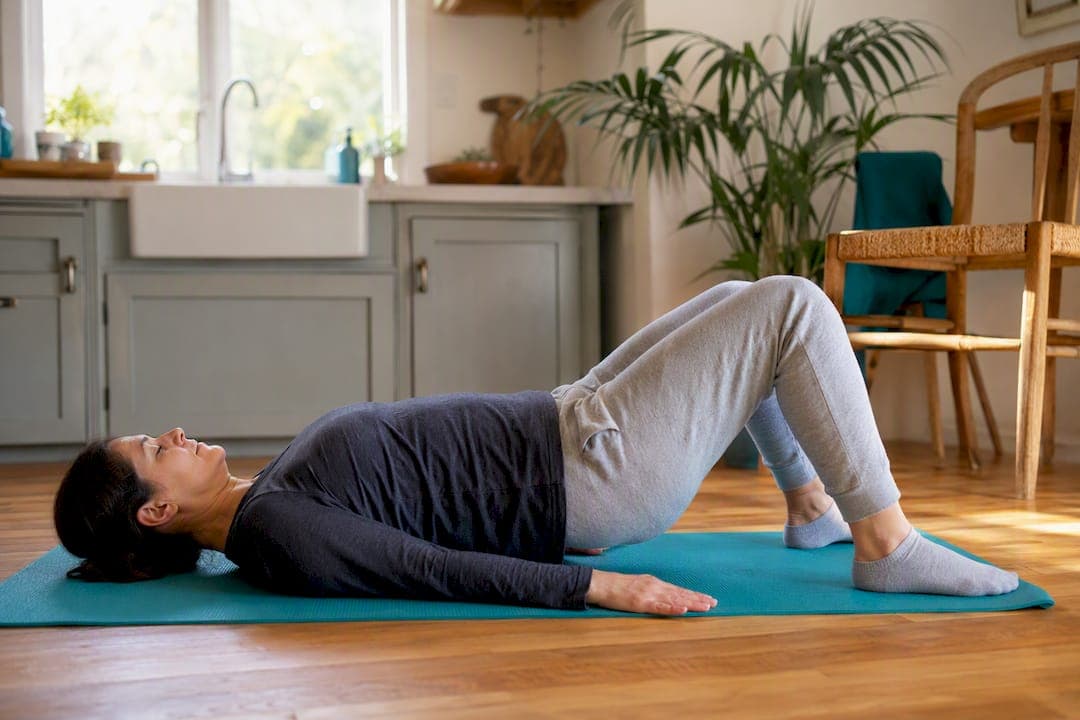
Pelvic tilts, glute bridges, knee-to-chest stretches, the figure-4 stretch, standing hamstring stretches, and sciatic nerve glides are the six moves physiotherapists reach for first. Do them gently, daily, in a short routine. Stop immediately if you get new leg weakness, numbness around your saddle area, or any change in bladder or bowel control, and get checked out. The full step-by-step routine is below.
TL;DR:
- Sciatica exercises should be introduced gradually, starting with gentle movements like pelvic tilts and knee-to-chest stretches, progressing only if symptoms remain mild.
- Pain during exercises should stay below a 4 on a 10-point scale, and symptoms like weakness, numbness, or bladder changes require prompt medical evaluation.
- External activities such as walking, swimming, or cycling support recovery, provided they do not worsen symptoms, along with ergonomic adjustments at work and sleep.
- Movements like heavy forward bends, uncontrolled twisting, and heavy lifting should be avoided to prevent aggravating nerve irritation.
- Combining home exercise routines with professional assessment and manual therapy maximizes recovery chances and shortens the time to relief.
Table of Contents
- Sciatica exercises for pain relief: the core routine
- Why exercise helps sciatica
- How do you know when sciatica exercises have gone too far?
- Building a 10 to 20 minute sciatica exercise routine
- Sciatica exercises and movements to avoid
- Complementary activities that support sciatica recovery
- Modifying sciatica exercises for limited mobility
- When hands-on care helps alongside home exercises
- A clinician's honest take on exercising through sciatica
- Ready for a tailored sciatica recovery plan?
- Sources
Sciatica exercises for pain relief: the core routine
Right, let's get into the actual moves. I'm going to walk you through six exercises that show up again and again in physiotherapist-led programmes, including the ones NHS demonstrates in its own exercise videos. Do them in this order, they flow nicely from gentle warm-up to proper stretch.
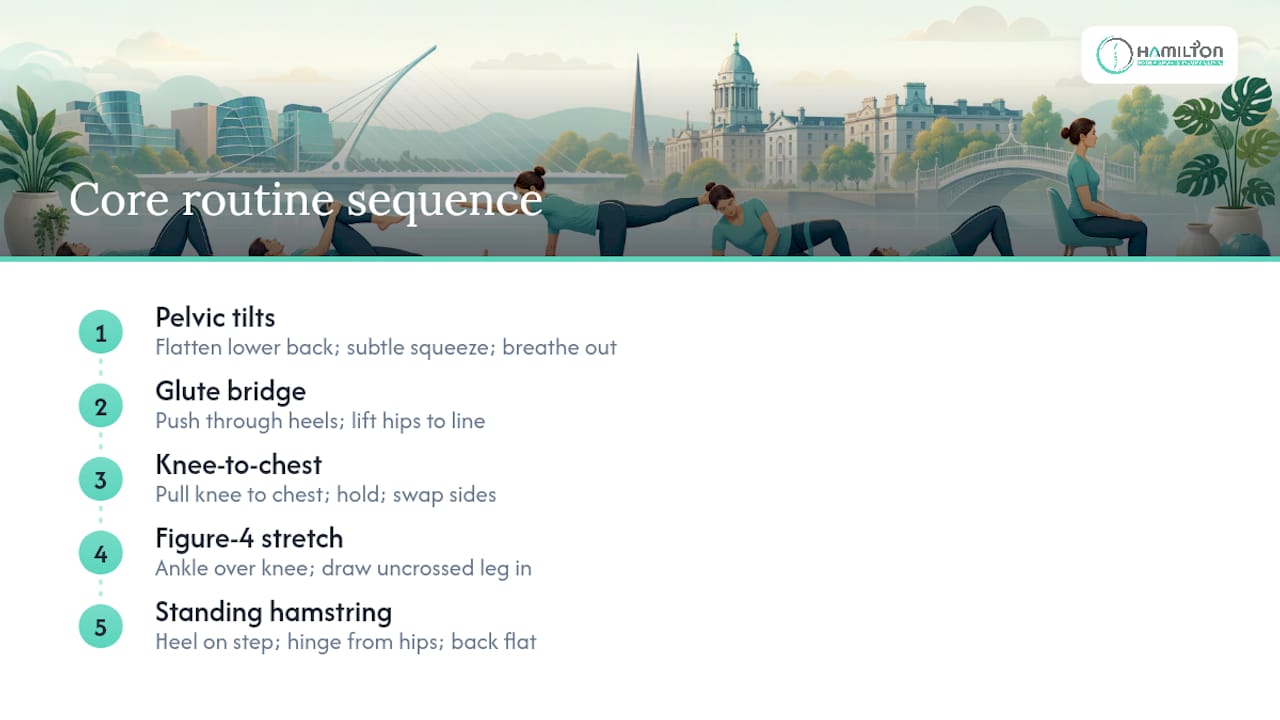
1. Pelvic tilts. Lie on your back, knees bent, feet flat on the floor. Flatten your lower back into the floor by gently tightening your tummy, then release. Breathe out as you tighten, breathe in as you release. Do several repetitions. It should feel like a subtle squeeze, nothing dramatic. If it pinches or shoots down your leg, you're overdoing the tilt, ease off the range. Progression: hold each tilt for 5 seconds. Regression: do it seated in a chair instead.

2. Glute bridge. Same starting position as the pelvic tilt. Push through your heels and lift your hips until your body forms a straight line from knees to shoulders. Breathe out on the lift, in as you lower. Hold a few seconds at the top, repeat several times. You should feel your glutes and hamstrings working, not your lower back. Stop if you feel a pinch at the base of your spine. Progression: single-leg bridge. Regression: smaller range, just lift a couple of inches.
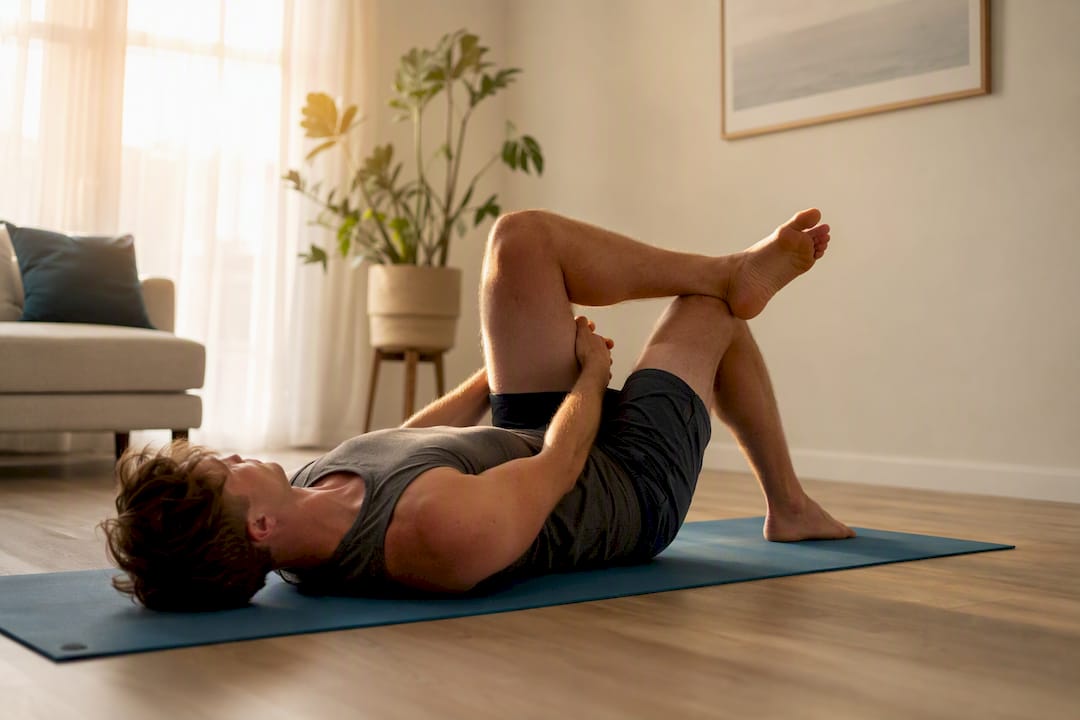
3. Lying knee-to-chest. Flat on your back, pull one knee gently towards your chest with both hands behind the thigh, keeping the other leg either bent or flat. Hold the stretch for a short while, breathing normally throughout, then swap sides and repeat a few times on each leg. This one should feel like a satisfying stretch through your lower back and glute, never a pull down the leg. Progression: pull both knees in together. Regression: use a towel looped around the thigh if you can't reach comfortably.
4. Figure-4 (lying gluteal stretch). Lying on your back, cross one ankle over the opposite knee, then draw the uncrossed leg towards your chest, holding behind the thigh. You'll feel this deep in the glute of the crossed leg. Hold the stretch for a short while, a few times per side, breathing steadily. If you feel it running down the back of your leg rather than staying in the glute, back off the pull. Progression: add gentle overpressure with your hand. Regression: do it seated, ankle crossed over knee, leaning forward from the hips.
5. Standing hamstring stretch. Place your heel on a low step or stair, knee straight but not locked, then hinge forward from your hips, keeping your back flat, until you feel a stretch behind the thigh. Hold the stretch for a short while, a few times per leg. Breathe out as you hinge forward. Sharp pain behind the knee or down the calf means the stretch is too aggressive, dial it back. Progression: point your toes towards you to increase the stretch. Regression: sit on a chair with one leg straight out and lean forward slightly instead.
6. Nerve glide (sciatic floss). Sit tall, straighten one knee while gently pointing your toes up, then flex your ankle down as you tilt your head slightly forward, and repeat the reverse. Move slowly with multiple repetitions, breathing continuously rather than holding your breath. This should feel like tension, not pain, and definitely not a sharp electric sensation. Shephard Health's nerve flossing guide covers the technique nicely if you want a visual reference alongside NHS's own exercise videos.
Pro Tip: Breathe out on the effort, in on the release, for every single one of these. Holding your breath tightens your core and lower back unnecessarily, which can actually increase the pressure irritating the nerve in the first place.
A short video demonstration alongside a printed step sheet works best here, since sciatica stretches are far easier to copy than to read about.
Why exercise helps sciatica
Movement helps for a few concrete reasons, not just because "staying active is good for you" (though it is, obviously). Gentle exercise increases blood flow to the lower back and hip region, which supports tissue healing around the irritated nerve root. It also helps restore normal movement patterns, since most people with sciatica unconsciously start avoiding certain positions, which then stiffens everything further and makes things worse, not better.
There's a strengthening piece too. Weak glutes and a weak core mean your lower back picks up the slack during everyday movement, and that extra load often feeds straight into sciatic irritation. Building strength in the hips and trunk takes pressure off the structures actually causing your pain.
- Movement and graded activity are generally recommended over prolonged bed rest, which research indicates doesn't speed recovery and can slow it.
- Gentle, regular stretching reduces muscular tension that can compress or irritate the sciatic nerve, according to Harvard Health.
- Exercise and physiotherapy are considered first-line conservative management for many people with sciatica, rather than something you try only after other treatments fail.
The evidence in brief: clinical reviews consistently place exercise and physiotherapy ahead of prolonged rest or immediate imaging for most sciatica cases, though the exact mechanism causing your symptoms (a disc bulge, piriformis tightness, spinal stenosis) still matters for how quickly and how far you should progress.
None of this means exercise fixes every cause of sciatica. Some underlying issues, like a significant disc herniation pressing on a nerve root, need a different level of care, and no home routine replaces urgent review when something's genuinely wrong.
How do you know when sciatica exercises have gone too far?
There's a real difference between "good" stretch discomfort and "bad" nerve pain, and learning to tell them apart is the single most useful skill in this whole process. Good discomfort is mild, feels like a pull or a stretch, stays localised to the muscle you're targeting, and eases off within a rep or two. Bad pain is sharp, shooting, radiates further down the leg the more you do it, or lingers and worsens afterwards.
Watch for these red flags, and treat them as a reason to stop exercising and phone a clinician rather than push through:
- Progressive weakness in your leg or foot, especially difficulty lifting your foot when walking.
- New numbness around your groin, buttocks, or inner thighs (the "saddle" area).
- Any change in bladder or bowel control.
- Fever combined with back pain, which points to something other than mechanical sciatica.
If exercise consistently makes your pain worse rather than better over several sessions, or if you notice any of the symptoms above, that's your cue to stop the routine and get assessed properly rather than experiment further on your own.
Pace yourself using a simple 0 to 10 pain scale. Anything up to about a 3 or 4 during a stretch is generally acceptable, provided it settles quickly afterwards. NHS's own guidance is blunt about this: stop the exercise if it increases your pain, and seek advice if symptoms worsen rather than persisting through a bad flare.
Building a 10 to 20 minute sciatica exercise routine
You don't need an hour a day. You need consistency, and a plan that adapts to how you're feeling that particular day. Here's how I'd structure it.
The flare routine (bad days). Keep this to gentle mobility only, no strengthening.
- Pelvic tilts, 10 reps.
- Knee-to-chest, 20 second hold, 2 reps each side.
- Figure-4 stretch, seated version, 20 second hold, 2 reps each side.
- Nerve glide, slow and controlled, 5 reps.
The progression routine (steadier days), add over weeks 2 to 4.
- Pelvic tilts, 15 reps.
- Glute bridge, 10 reps with a 3 second hold.
- Knee-to-chest, 30 second hold, 3 reps each side.
- Figure-4 stretch, lying version, 30 second hold, 3 reps each side.
- Standing hamstring stretch, 30 second hold, 3 reps each leg.
- Nerve glide, 10 reps.
Run through your chosen routine daily for mobility work, and layer in dedicated strengthening two to three times a week once the flare routine feels easy. A separate gentle strength training guide is worth reading if you want to push the glute bridge and similar moves further once you're past the acute stage.
Progress by increasing one variable at a time, never all of them together. Add a rep or two before you add a hold second, and add a hold second before you add resistance or range. A sensible weekly pattern over four to eight weeks looks like: week one, flare routine only; weeks two to three, progression routine every other day; weeks four onwards, progression routine daily with strength work three times weekly, adding aerobic activity as tolerated.
Pro Tip: If a particular exercise flares things up two sessions running, drop it back to its regression for a week rather than abandoning it entirely. Most sciatica exercises just need dialling down, not cutting out.
Sciatica exercises and movements to avoid
Some movements reliably wind sciatica up, and knowing them saves you a lot of unnecessary setbacks.
- Heavy forward bends, especially with rounded spine and straight legs, load the disc and nerve root awkwardly.
- Uncontrolled twisting, like reaching across your body to grab something behind you, combines rotation and flexion, a nasty combination for an irritated nerve.
- Double leg raises put a lot of strain through the lower back before the core is ready for it.
- Heavy loaded lifts without bracing, think shifting furniture or lifting a full suitcase from the floor with straight legs.
Adapt daily tasks instead of avoiding them altogether. Hip-hinge rather than round your back when picking things up, keep the load close to your body, and lift with one leg stepping slightly forward for balance. Use a stool or raised surface so you're lifting from waist height rather than the floor whenever you can. In the gym, swap barbell deadlifts for supported single-leg work until you're pain-free, and skip any exercise that reproduces leg symptoms, full stop, no exceptions for "just this once."
Complementary activities that support sciatica recovery
Exercise alone isn't the whole picture. What you do for the other 23 hours of the day matters just as much, arguably more.
Low-impact aerobic work builds the cardiovascular fitness that supports tissue healing without hammering an already irritated area:
- Walking, 15 to 30 minutes daily, is usually the safest starting point and rarely aggravates sciatica.
- Pool-based exercise or swimming takes weight off the spine entirely, useful if walking still feels too much.
- Stationary cycling, upright rather than aggressively hunched forward, three to five times weekly once tolerated.
- Elliptical machines offer a middle ground between walking and cycling for those ready to progress.
Ergonomics deserve just as much attention as the exercises themselves. Sitting for long stretches, particularly with poor posture, is one of the biggest daily aggravators. Set your chair so your hips sit slightly higher than your knees, and get up every 30 to 45 minutes. In the car, a small lumbar roll behind your lower back reduces nerve tension on longer drives. At night, side-sleeping with a pillow between your knees, or back-sleeping with a pillow under your knees, tends to keep the spine in a more neutral position than sleeping face down. A broader look at lifestyle's role in injury recovery covers this territory if you want more detail on the habits side of things.
Modifying sciatica exercises for limited mobility
Not everyone starts from the same place, and that's completely fine. Chair-based versions exist for nearly every move above.
- Seated pelvic tilts: sit tall, rock your pelvis forward and back gently, same breathing pattern as the lying version.
- Seated figure-4: cross one ankle over the opposite knee, lean forward from the hips.
- Seated marching replaces the glute bridge for those who can't get to the floor easily, lifting one knee at a time while seated.
- Wall-supported hamstring stretch: use a wall or sturdy chair back for balance instead of a step.
- Towel-assisted knee-to-chest: loop a towel around the thigh if reaching your hands behind it isn't comfortable.
Dose progression the same way regardless of starting point. Increase repetitions first, then range of movement, then add resistance (a light resistance band works well for bridges and seated leg extensions). Once the basic routine feels genuinely easy and pain-free for a week or two, start layering in single-leg balance work, standing on one leg near a wall for support, since hip and ankle stability both feed directly into how well your lower back tolerates daily load.
Pro Tip: A folded towel under one hip during the glute bridge helps if one side feels noticeably weaker or more painful than the other, it evens out the load without you having to think about it too hard.
When hands-on care helps alongside home exercises
Home exercises get most people a good way towards feeling better, but there's a ceiling to what self-directed stretching can achieve, particularly when the underlying cause of your sciatica hasn't actually been identified. That's where an individual assessment earns its place.
Hamilton Pain and Sports Injury Clinic builds a tailored exercise programme around what's specifically driving your symptoms, rather than a generic sheet of stretches, which matters because piriformis-related sciatica and disc-related sciatica often respond to quite different emphasis in a routine.
Services that sit naturally alongside a home programme include:
- Manual therapy to address the specific soft tissue or joint restriction feeding your symptoms.
- Dry needling for persistent muscular tension that stretching alone hasn't resolved.
- Personalised strength and return-to-sport planning for anyone wanting to get back to running, gym training, or a specific sport without recurrence.
Worth knowing: many clients report meaningful improvement after their very first session, since a proper assessment often identifies the specific movement fault or muscle imbalance that months of generic stretching had missed entirely.
Bring a rough timeline of when symptoms started, anything that seems to trigger or ease them, and a list of what you've already tried. Progress typically gets measured through movement testing and symptom tracking session to session, not just "does it feel better today."
A clinician's honest take on exercising through sciatica
Here's what I think most guides get slightly wrong: they treat exercise as either the whole solution or an afterthought before "proper treatment." Neither's accurate. An active, guided approach in clinic works precisely because someone's watching how you actually move, not just handing you a sheet of six stretches and hoping for the best. Two people with "sciatica" can have completely different drivers, and the exercise emphasis should shift accordingly.
Realistically, many people see solid improvement within a few weeks of consistent home exercise. But if you're three or four weeks in with no change, or symptoms keep flaring despite doing everything "right," that's not failure, it's information. It means the routine needs adjusting by someone who can actually assess what's going on, which usually shortens the whole recovery timeline rather than extending it.
— Mark
Ready for a tailored sciatica recovery plan?
If you've worked through the flare routine above and you're still stuck, or you simply want certainty about what's actually causing your symptoms before committing weeks to a self-guided programme, that's exactly the gap Sportsinjurydublin closes. Rather than generic handouts, you get an assessment built around your specific movement pattern, followed by a plan that adapts as you improve.

The Sports Rehabilitation Programme suits most sciatica presentations well, combining manual therapy with a progressive exercise plan tailored to whatever's actually driving your symptoms. For those wanting a single hands-on session before committing to a full programme, recovery sessions offer a lower-commitment starting point, and appointments are typically available within a few days rather than weeks. Book an assessment and find out what's really behind your sciatica, rather than guessing your way through another month of stretches.
Sources
- Exercises for sciatica problems
- NCBI clinical summary
- Sciatica: Gentle stretches to help relieve pain and improve mobility - Harvard Health
This article is general information, not a substitute for advice from a qualified doctor. Consult a qualified healthcare professional about your own circumstances before acting on anything here.