

Yes, exercise genuinely reduces pain for many people — and the evidence behind that claim is solid. The NHS and NICE both recommend physical activity as a core part of managing chronic pain, and organisations like Versus Arthritis have long championed movement as medicine. A major overview of Cochrane reviews found that exercise can reduce pain severity and improve physical function across multiple conditions, with most adverse events being nothing more than temporary soreness.
Here's the honest TL;DR before we get into the detail:
- Short-term relief can happen after a single session. A phenomenon called exercise-induced hypoalgesia means your pain threshold can rise within minutes of moderate activity — your body releases endogenous opioids and your nervous system temporarily dials down pain signals.
- Lasting improvement typically takes weeks to months. Programmes lasting several weeks at light-to-moderate intensity are where most people notice meaningful, durable change. Neurological changes in the brain that parallel pain reduction tend to require at least 12 weeks of consistent effort.
- Soreness is normal; red flags are not. Mild muscle ache after starting is a normal adaptation. Sudden worsening pain, neurological symptoms (numbness, weakness, bladder changes), or severe functional loss need a clinician's review before you continue.
Table of Contents
- How does exercise actually reduce pain?
- What does the research actually say?
- Which types of exercise help most?
- How do you start exercising safely when you're in pain?
- When should you see a professional in the UK?
- How a personalised exercise prescription actually gets built
- Key takeaways
- The reality of getting people moving again
- How Sportsinjurydublin can help you get started
- Useful sources and further reading
How does exercise actually reduce pain?
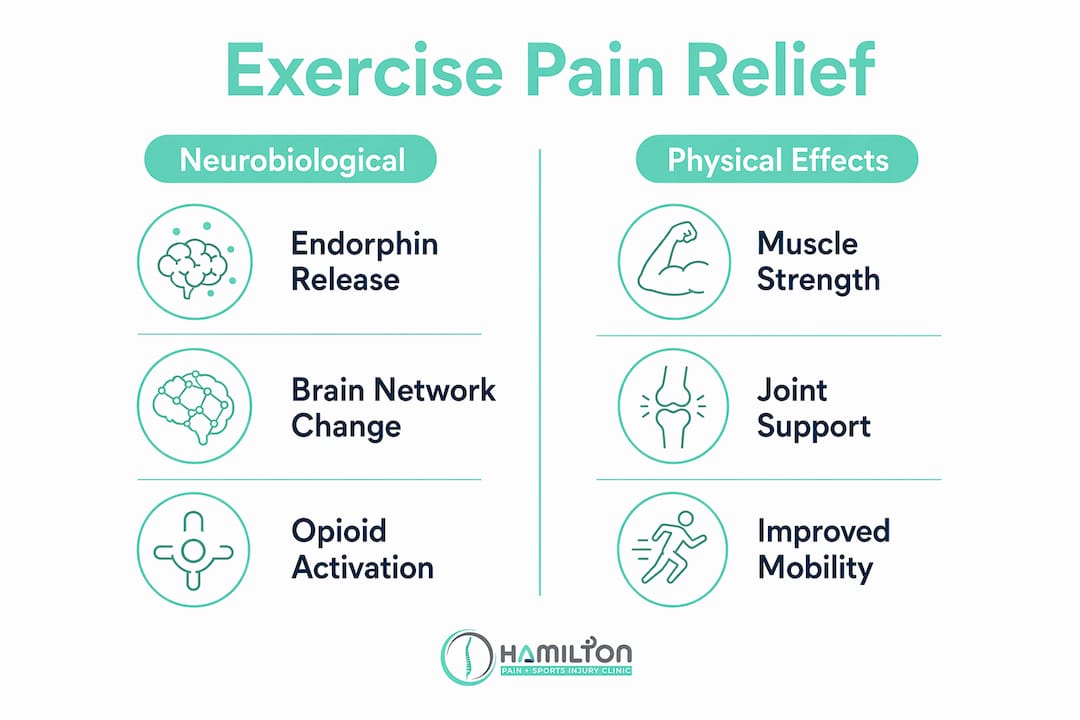
The role of exercise in pain reduction isn't just about getting fitter or losing weight (though both help). It's fundamentally neurobiological — and once you understand that, the whole thing starts to make a lot more sense.
The immediate effect: your body's own painkillers
A single bout of exercise triggers the release of endogenous opioids — your body's homemade version of morphine, essentially. These bind to the same receptors that pharmaceutical opioids target, producing a transient anti-nociceptive effect (fancy way of saying: pain signals get quieter). Research confirms that acute exercise increases endogenous opioid production, and repeated exercise can produce longer-lasting anti-nociceptive effects over time. Endorphins are part of this picture too, alongside serotonin and dopamine, which is why a good walk can genuinely lift your mood and ease discomfort simultaneously.
What happens in the brain over time
This is where it gets really interesting. Exercise interventions of 12 weeks or longer have been associated with measurable changes in brain network function — specifically in the cortico-limbic pathway, the default mode network, and the dorsolateral prefrontal cortex (DLPFC). These are regions involved in how we process, anticipate, and emotionally respond to pain. When they change, pain perception changes with them. It's not that the pain signal disappears; it's that the brain becomes better at modulating it.
The peripheral side of things
Away from the brain, exercise also works on the body's tissues directly. Stronger muscles reduce the load on joints. Improved circulation delivers oxygen and nutrients to recovering tissue. Reduced body weight (often a side effect of sustained activity) takes pressure off the hips, knees, and spine. Harvard Health notes that regular activity combats deconditioning, reduces systemic inflammation, and improves sleep — all of which feed directly into how much pain you experience day to day.
Pro Tip: Discomfort and temporary muscle soreness during or after exercise are usually safe and expected. The signals that need attention are different: sudden sharp pain, neurological changes (pins and needles, weakness, loss of bladder control), or pain that is significantly worse the next day and doesn't settle. If in doubt, check with a physio before pushing on.
What does the research actually say?
The honest answer: exercise generally improves function, and its effects on pain severity are real but small-to-moderate and vary quite a bit between individuals and conditions. That's not a reason to dismiss it — it's a reason to set realistic expectations.
Here's a condition-by-condition snapshot:
- Low back pain: Strong evidence that exercise improves function and reduces pain compared to no treatment. Effects are modest but consistent across multiple reviews. Supervised programmes tend to outperform advice-only approaches.
- Osteoarthritis (hip and knee): Good evidence for aerobic and resistance exercise reducing pain and improving physical function. Versus Arthritis highlights this as one of the most well-supported areas of exercise research.
- Fibromyalgia: Aerobic exercise in particular shows consistent benefit for pain and fatigue. Adherence is the main challenge; low-intensity starting points matter here.
- Chronic neck pain: Moderate evidence for specific strengthening and multicomponent programmes; evidence is less consistent than for back pain or OA.
The Cochrane overview is worth quoting directly here:
One important caveat: many trials in this space are small, short, and use different exercise protocols, which makes direct comparison tricky. What the evidence does consistently show is that supervised or structured programmes achieve better adherence and outcomes than simply telling someone to "be more active." Advice alone rarely changes behaviour reliably.
Which types of exercise help most?
Not all movement is equal when it comes to physical activity for pain relief — and the research is pretty clear on what works and what's less useful on its own.
| Exercise type | Evidence for pain reduction | Best for | Starter example |
|---|---|---|---|
| Aerobic (cardio) | Strong | Back pain, OA, fibromyalgia | 10–15 min brisk walk |
| Resistance (strength) | Strong | OA, back pain, general MSK | Bodyweight squats, resistance band rows |
| Multicomponent | Strongest overall | Chronic MSK pain broadly | Combination of above |
| Tai chi / yoga | Moderate | OA, fibromyalgia, balance | Guided class or video |
| Stretching alone | Weaker for pain | Flexibility, mobility | Morning mobility routine |
Both aerobic and resistance training produce hypoalgesic effects, whereas stretching and proprioceptive exercises alone show weaker results for pain outcomes in trials. Multicomponent programmes — combining aerobic work, strengthening, and some flexibility — tend to perform best overall.
Dose and intensity: what the evidence suggests
Evidence-based programmes for chronic musculoskeletal pain typically use light-to-moderate intensity, around 60–120 minutes per week, over 7–15 weeks. For aerobic work, that roughly corresponds to around 50–60% of your maximum heart rate — effort where you can still hold a conversation, as the NHS describes moderate intensity. Resistance work should be at a load that's challenging but tolerable; you shouldn't be gritting your teeth through every rep.
Practical starting points
Walking plan (starter): 10 minutes at a comfortable pace, five days a week. Progression: add five minutes every two weeks until you reach 30 minutes per session.

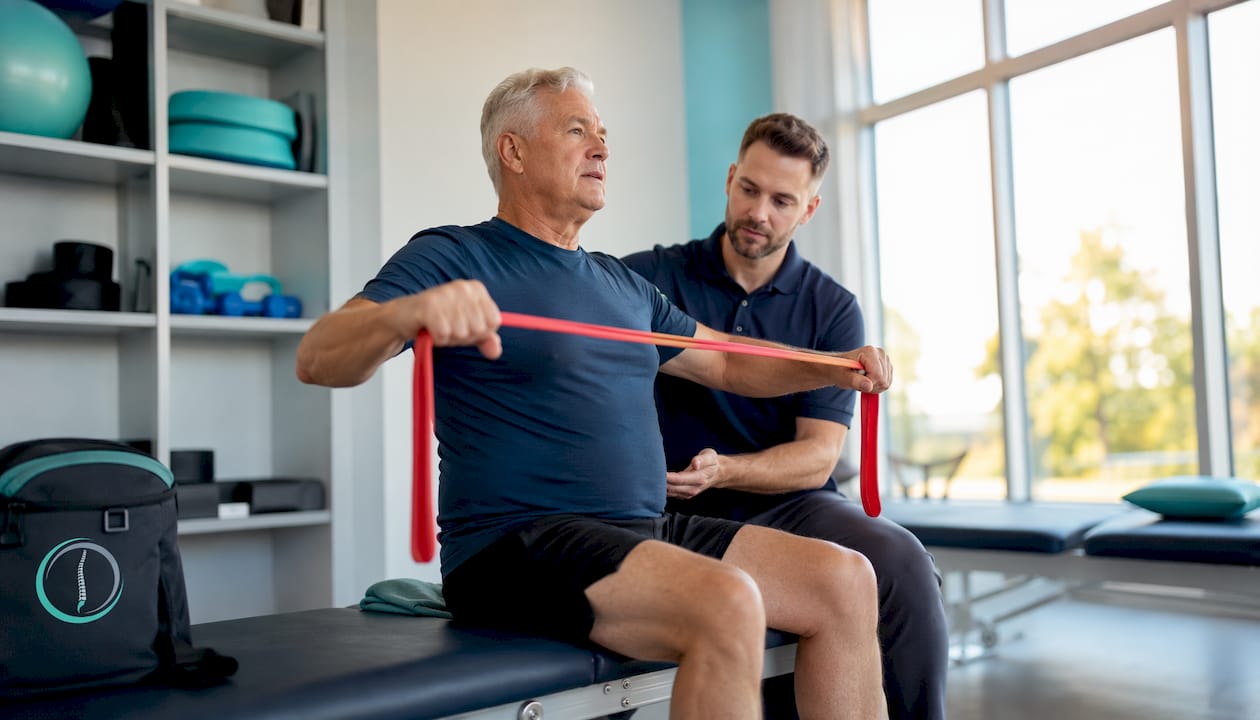
Home strength circuit (starter): Sit-to-stand from a chair (10 reps), wall press-ups (10 reps), resistance band rows if you have a band (10 reps). Rest 60 seconds between exercises. Progression: add a second set after two weeks.
Mobility routine (starter): Gentle hip circles, shoulder rolls, and a seated spinal rotation — five minutes morning and evening. This won't reduce pain on its own, but it supports the other work and keeps joints moving.
Equipment needed: genuinely nothing to start. A resistance band (around £5–10 from most sports shops) opens up more options, and light dumbbells help later. If mobility is significantly limited, a chair-based version of most exercises works just as well.
Pro Tip: For gentle strength training tailored to chronic pain, the key is starting well below what you think you can do. You can always add more next week. You can't un-do a flare-up that set you back three weeks.
How do you start exercising safely when you're in pain?
Start gently, prioritise consistency over intensity, and treat the first few weeks as information-gathering rather than performance. That's the whole principle, really — but here's how it looks in practice.
Your first four weeks: a simple checklist
- Week 1: Choose one activity (walking is ideal). Aim for 10 minutes, three times. Note your pain level before and after on a 0–10 scale.
- Week 2: If pain after sessions settles within 24 hours, add a fourth session or extend by five minutes.
- Week 3: Introduce one simple strength exercise (sit-to-stand works for almost everyone). Two sets of eight reps.
- Week 4: Review. Are you managing sessions without significant flare-ups? If yes, progress. If no, hold the current level for another week before adding load.
Pacing and progression table
| Phase | Duration | Session goal | Intensity guide |
|---|---|---|---|
| Start | Weeks 1–2 | 10–15 min, 3x/week | Comfortable; pain ≤2/10 |
| Build | Weeks 3–4 | around 10–30 min, 3–5x/week | Moderate; pain ≤5/10 |
| Consolidate | Weeks 7–12 | 25–30 min, 4–5x/week | Moderate; manageable soreness |
| Progress | Weeks 12–15 | Increase load or duration | Review with clinician |
Red flags that need a clinician's review
Stop and seek advice if you experience any of the following:
- Neurological changes: new numbness, tingling, or weakness in limbs
- Bladder or bowel changes alongside back or neck pain
- Pain that is significantly worse the following day and does not settle
- Chest pain, dizziness, or shortness of breath during activity
- Unexplained weight loss alongside pain
These aren't reasons to avoid exercise forever — they're reasons to get a proper assessment first so your programme can be built safely around what's actually going on.
Pro Tip: Use the VAS (Visual Analogue Scale) as your guide. Low levels of pain during exercise are generally safe to continue. Moderate pain may be acceptable if it settles quickly. Higher pain signals the need to reduce load rather than push through. This threshold approach is widely used in musculoskeletal rehabilitation and gives you a practical, consistent way to monitor yourself.
For a detailed recovery framework if you do experience a flare, the chronic pain flare-up recovery guide is worth bookmarking.
When should you see a professional in the UK?
Self-managing with a sensible walking and strengthening plan is absolutely reasonable for many people. But there are situations where professional input makes a real difference — and the UK has decent pathways to access it.
UK care options at a glance
GP: Your first port of call for new or worsening pain, red flags, or if you want a referral to NHS physiotherapy or a pain management clinic. GPs can also refer to community exercise on referral schemes in some areas.
NHS physiotherapy: Available via GP referral or, in many areas, self-referral (check your local NHS trust). A physio will assess your movement, identify contributing factors, and build a graded exercise plan. Wait times vary considerably by region.
NHS pain management clinics: For persistent pain that hasn't responded to standard treatment. These typically offer a multidisciplinary approach including psychology, physiotherapy, and medication review.
Private physiotherapy or sports therapy: Faster access, longer appointments, and more continuity of care. Worth considering if NHS wait times are long or if your condition is complex.
What to bring to your appointment
- A pain diary: dates, activities, pain scores (0–10), and what makes it better or worse
- A list of any medications you're taking
- Your goals: what do you want to be able to do that you can't do now?
- Any previous imaging or letters from other clinicians
Pro Tip: Ask your clinician specifically: "What type of pain do I have — nociceptive, neuropathic, or central sensitisation?" The answer shapes everything about which exercises will help and how quickly you should progress. If they can't answer that, it might be worth seeking a second opinion.
How a personalised exercise prescription actually gets built
Here's what a proper clinical assessment looks like in practice — because there's a meaningful difference between a generic exercise handout and a plan built around your specific situation.
The assessment process
A thorough initial assessment covers: full pain history (onset, behaviour, aggravating and easing factors), functional movement testing, and a working hypothesis about the pain mechanism. Is this primarily nociceptive (tissue-driven), neuropathic (nerve-related), or does it involve central sensitisation (where the nervous system itself has become sensitised)? That distinction drives the entire prescription.
Goal-setting follows: not vague goals like "feel better," but specific functional targets — returning to a five-kilometre run, carrying shopping without hip pain, sleeping through the night.
An example pathway (de-identified)
Presenting complaint: Persistent low back pain for eight months, worsening with prolonged sitting and morning stiffness. Previous advice to rest had led to significant deconditioning.
Assessment findings: Reduced lumbar mobility, weak hip extensors and deep stabilisers, pain behaviour consistent with nociceptive and early central sensitisation components.
Chosen approach (weeks 0–12):
- Weeks 0–3: Walking programme (10–15 minutes daily), gentle hip hinge pattern, education on pain neuroscience
- Weeks 4–8: Progressive resistance work (deadlift pattern with light load, single-leg balance), aerobic sessions extended to 25 minutes
- Weeks 9–12: Full multicomponent programme, functional movement targets reviewed, return to recreational activity planned
This kind of individualised care approach consistently outperforms generic protocols — and the evidence backs that up.
Questions worth asking at your clinic visit
- What is my pain mechanism hypothesis?
- What outcome measures will we use to track progress?
- What should I do if I have a flare-up between sessions?
- When should I expect to notice improvement?
Pro Tip: Most people expect to feel better within two to three weeks. Realistic timelines are more like six to twelve weeks for meaningful functional change, and up to fifteen weeks for durable pain reduction. Knowing this upfront prevents people from giving up at week four when they're actually right on track.
Key takeaways
Exercise is one of the most evidence-backed tools for reducing chronic pain and improving function, but it works best when it's appropriately dosed, individually prescribed, and consistently applied over at least 7–15 weeks.
| Point | Details |
|---|---|
| Exercise reduces pain neurobiologically | Endogenous opioids, brain network changes, and reduced inflammation all contribute to pain relief. |
| Lasting change takes 12+ weeks | Neuroplastic brain changes linked to pain reduction require consistent exercise over at least 12 weeks. |
| Multicomponent programmes work best | Combining aerobic, resistance, and flexibility work outperforms any single modality for chronic MSK pain. |
| Use VAS thresholds to pace safely | Pain ≤2/10 is safe; ≤5/10 is acceptable if it settles within 24 hours; above 5/10 means reduce load. |
| Sportsinjurydublin offers tailored plans | Hamilton Pain and Sports Injury Clinic builds individualised exercise prescriptions for chronic pain and sports injuries. |
Next steps: Start a two-week walking plan (10 minutes, three times a week), note your pain scores before and after each session, and book a clinical assessment if you have red flags or haven't improved after four weeks of consistent effort.
The reality of getting people moving again
Look, the hardest part of all this isn't the physiology — it's the moment someone in pain is told "you need to exercise more" and they think, are you serious right now? That response makes complete sense. Pain makes movement feel dangerous. Avoidance feels protective. And for a long time, rest was what everyone recommended.
What I've seen, working with people across a range of pain presentations, is that the turning point usually isn't a dramatic breakthrough. It's the third or fourth week of a graded programme when someone realises their morning stiffness is a bit less, or they walked to the shops without thinking about their hip. Small wins compound. Consistency matters far more than intensity, especially early on. The people who do best aren't the ones who push hardest — they're the ones who show up regularly and trust the process even when progress feels slow.
If you're in pain and the idea of exercise feels daunting, that's completely normal. Start smaller than you think you need to. And if you're not sure where to start, that's exactly what a clinical assessment is for.
How Sportsinjurydublin can help you get started
If you've read this far and you're thinking "right, but I need someone to actually tell me what to do for my situation" — that's precisely what Hamilton Pain and Sports Injury Clinic is built for.

Rather than handing you a generic exercise sheet, the clinic builds a prescription around your specific pain presentation, activity level, and goals. A first appointment includes a full assessment of your pain mechanism, functional movement testing, and a clear plan with measurable targets. From there, you can access sports rehabilitation sessions, supervised personal training for structured progression, or recovery sessions as part of a broader programme. Everything is individualised — no two plans look the same, because no two people's pain does either.
To book an assessment or enquire about availability, visit sportsinjurydublin.ie.
Useful sources and further reading
These are the resources worth bookmarking — share them with your clinician when discussing your plan.
- NHS: Benefits of exercise — Clear, public-facing guidance on physical activity intensity and health benefits; good starting point for UK readers.
- Versus Arthritis — Condition-specific exercise guidance for osteoarthritis, back pain, and related conditions; practical and evidence-based.
- Cochrane overview: exercise for chronic pain (PMC) — The most comprehensive overview of exercise trials across multiple chronic pain conditions; worth reading the abstract at minimum.
- Brain function and exercise in chronic pain (PMC) — Systematic review on neurological changes from exercise programmes of 12 weeks or more; useful if you want to understand the neuroscience.
- Physical exercise in chronic musculoskeletal pain (PMC) — Narrative review covering dose, modality, and intensity recommendations; the source for the 7–15 week programme guidance and VAS thresholds.
- Harvard Health: exercise for chronic pain — Patient-friendly explanation of mechanisms and safe activity choices; good to share with someone just starting out.
- Joint mobility after 30 (Novonatur) — Practical mobility advice relevant to anyone managing joint stiffness alongside a pain programme.
Bring the Cochrane overview and the musculoskeletal pain narrative review to your next appointment — most physios and GPs will recognise them and it makes for a much more productive conversation about your options.