
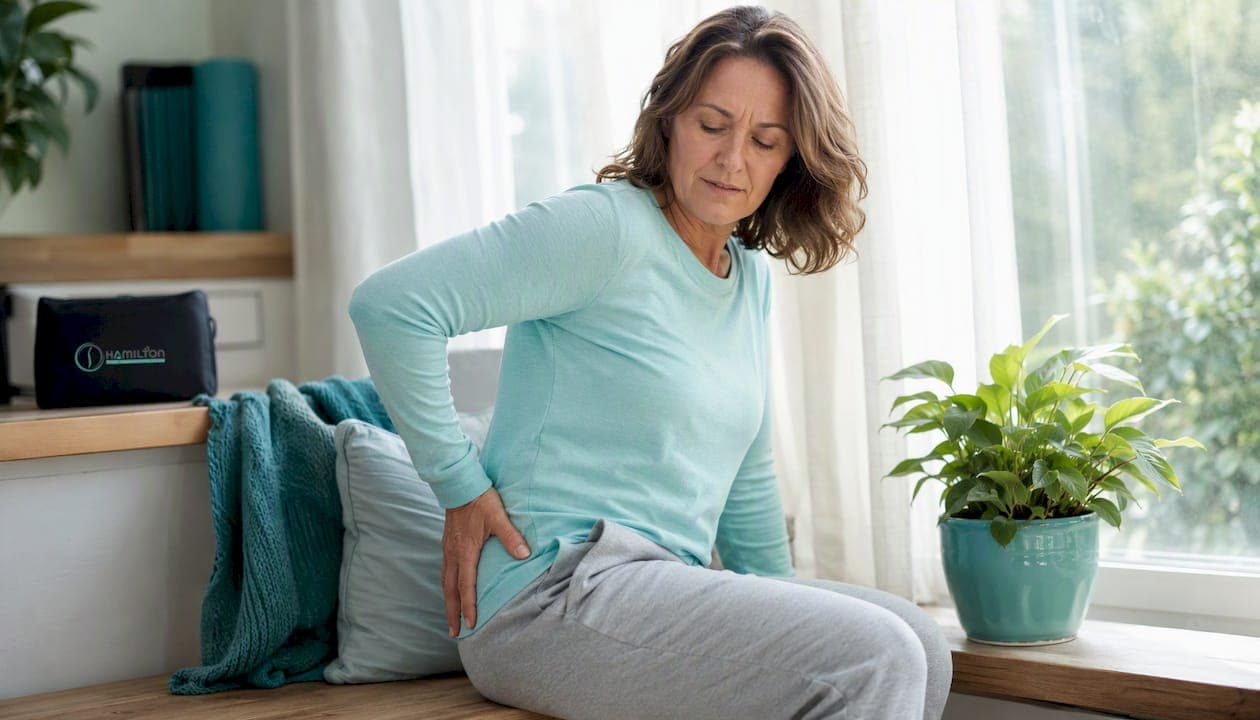
Hip pain limits daily activity because pain, reduced range of motion, and muscle weakness change how you load and move your hip joint — making ordinary tasks like walking, climbing stairs, dressing, and getting into a car genuinely difficult, not just uncomfortable. The NHS guidance on hip pain and the Academy of Orthopaedic Physical Therapy's 2025 clinical practice guideline both confirm that functional limitation, not just pain intensity, is the defining problem for most adults. And the good news? Targeted rehabilitation addresses all three mechanisms at once.
Here is the short version of what that means for you day-to-day:
- Walking becomes shorter and slower because each step loads the joint and triggers pain or a limp.
- Stairs demand hip flexion and single-leg loading that a stiff or weak hip struggles to produce.
- Dressing (putting on socks, shoes, trousers) requires deep hip flexion that arthritic or impinged joints resist.
- Getting in and out of a car combines rotation and flexion in a way that catches people off guard.
- Fall risk rises because altered gait and reduced hip strength reduce balance and reaction time.
Table of Contents
- What causes hip pain in adults?
- How hip pain reduces your ability to do everyday tasks
- Where does hip pain actually hurt?
- What happens at a hip pain assessment?
- What treatments actually restore function?
- Practical tips for daily tasks when your hip hurts
- When should you actually see someone?
- How specialist care at Sportsinjurydublin restores hip function
- Key takeaways
- The thing most people get wrong about hip pain
- Hip pain holding you back? Here is what Sportsinjurydublin can do
- Useful sources and further reading
What causes hip pain in adults?
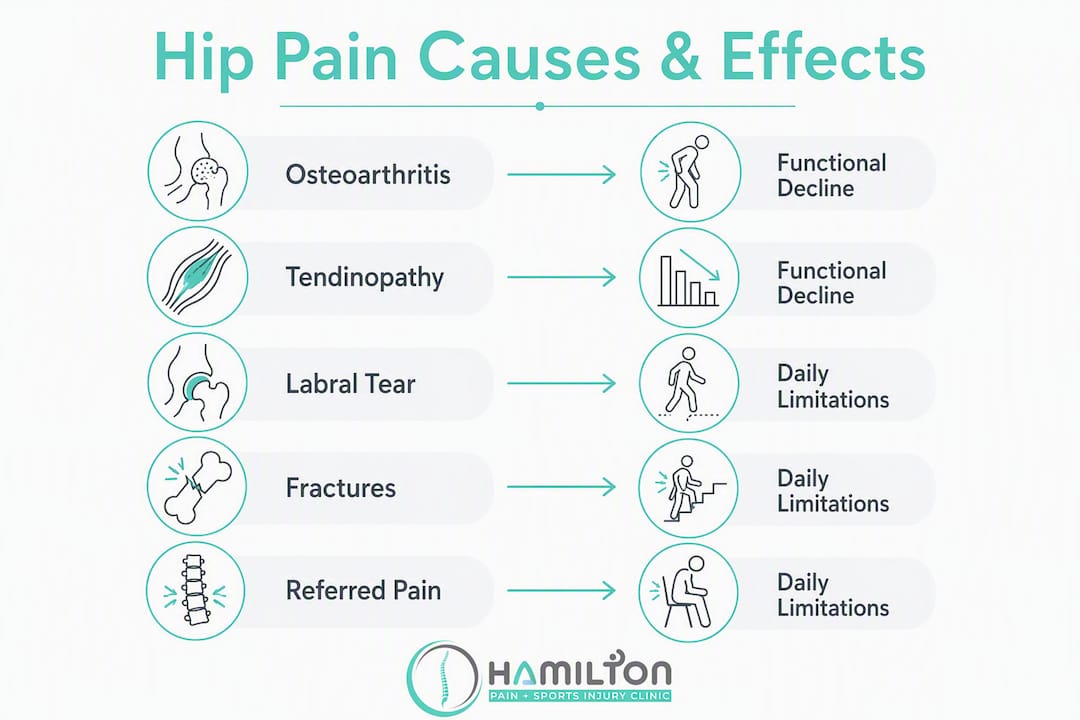
There is no single answer here (sorry), but there are a handful of conditions that account for the vast majority of cases — and each one tends to affect daily tasks in a slightly different way. Knowing which pattern fits yours helps you understand what treatment is actually targeting.
Osteoarthritis
The most common cause in adults over 45. Cartilage inside the joint wears down, the joint space narrows, and the hip becomes stiff, especially first thing in the morning or after sitting. Many adults with hip arthritis report difficulty with walking, stairs, and getting into a car. Risk factors include age, obesity, prior joint injury, and female sex.
Trochanteric bursitis and abductor tendinopathy
Pain on the outer hip, often worse lying on that side at night or walking uphill. The bursa (a small fluid sac) or the gluteal tendons become irritated, usually from repetitive loading or a sudden increase in activity. Single-leg stance and side-lying become particularly uncomfortable.
Labral tear and femoroacetabular impingement (FAI)
A labral tear involves the cartilage ring around the hip socket; FAI is a structural mismatch between the ball and socket that causes pinching. Both tend to produce a sharp catch in the groin with deep flexion or rotation — think squatting, tying shoelaces, or pivoting. More common in younger, active adults.
Stress fractures and fragility fractures
Stress fractures occur in athletes from repetitive loading; fragility fractures (often of the femoral neck) occur in older adults with osteoporosis, sometimes with minimal trauma. Both cause severe pain with weight-bearing and require urgent assessment. A Yale School of Medicine review highlights femoral neck stress fractures and subchondral insufficiency fractures as causes that can progress to joint replacement if missed.
Referred pain from the lumbar spine
The hip and lower back share nerve supply, so lumbar disc problems or facet joint irritation can produce pain felt deep in the buttock or even the groin. The giveaway is that hip range of motion is often preserved, but back movements reproduce the pain. This matters because treating the hip alone will not fix a lumbar source.
Risk factors that accelerate functional decline
| Risk factor | Why it matters for function |
|---|---|
| Age over 45 | Reduced muscle mass and bone density amplify pain-related weakness |
| Obesity | Increases joint load with every step, accelerating cartilage wear |
| Prior hip or knee injury | Alters biomechanics and predisposes to compensatory patterns |
| Coexisting low back pain | Compounds movement restriction and increases fall risk |
| Sedentary lifestyle | Reduces hip stabiliser strength before pain even begins |
How hip pain reduces your ability to do everyday tasks
This is where things get interesting (and a bit frustrating, honestly). Hip pain does not just hurt — it sets off a chain of mechanical and behavioural changes that gradually erode your independence. Let us walk through each link in that chain.
Direct mechanical effects
The hip joint is a ball-and-socket that handles roughly three times your body weight with each walking step. When pain or inflammation is present, the joint's range of motion shrinks, the surrounding muscles switch off (a process called arthrogenic muscle inhibition), and your tolerance for load drops. The hip abductors — the muscles on the outer hip — are particularly vulnerable. When they weaken, you lose the ability to stabilise your pelvis during single-leg stance, which is basically every step you take.
Altered gait and compensatory loading
Two gait patterns show up repeatedly in clinic. An antalgic gait is where you shorten your stance time on the painful side to reduce load. A Trendelenburg gait is where the pelvis drops on the opposite side because the abductors cannot hold it level. Both patterns shift load onto the lower back, the opposite knee, and the ankle. So the hip problem becomes a back problem and a knee problem if left unaddressed long enough. This is also why posture and compensatory movement patterns matter so much in hip rehab.
Fear, avoidance, and deconditioning
Here is the bit that does not get enough attention. Pain influences perceived function more than objective capability in many patients. People stop doing things that hurt — which makes complete sense in the short term — but prolonged avoidance leads to deconditioning, further weakness, and a growing fear of movement. The result is a cycle where the hip gets weaker, tasks feel harder, confidence drops, and activity reduces further.
Falls risk is not just a concern for frail older adults. Research published in Arthritis Research & Therapy found that each additional hip osteoarthritis impairment criterion was associated with an increased fall risk and higher odds of multiple falls over 12 months among community-dwelling older adults with chronic low back pain.
How function breaks down: a summary
| Mechanism | Daily task most affected |
|---|---|
| Reduced range of motion | Dressing, car entry/exit, deep chair sitting |
| Painful load-bearing | Walking distance, stair climbing |
| Hip abductor weakness | Single-leg balance, step-ups, uneven ground |
| Antalgic/Trendelenburg gait | All walking, especially prolonged or uphill |
| Fear and avoidance | Social activities, exercise, housework |
| Increased fall risk | Stairs, uneven surfaces, getting up at night |
Where does hip pain actually hurt?
Pain location is one of the most useful clues a clinician has — and one you can use yourself to start making sense of what is going on.
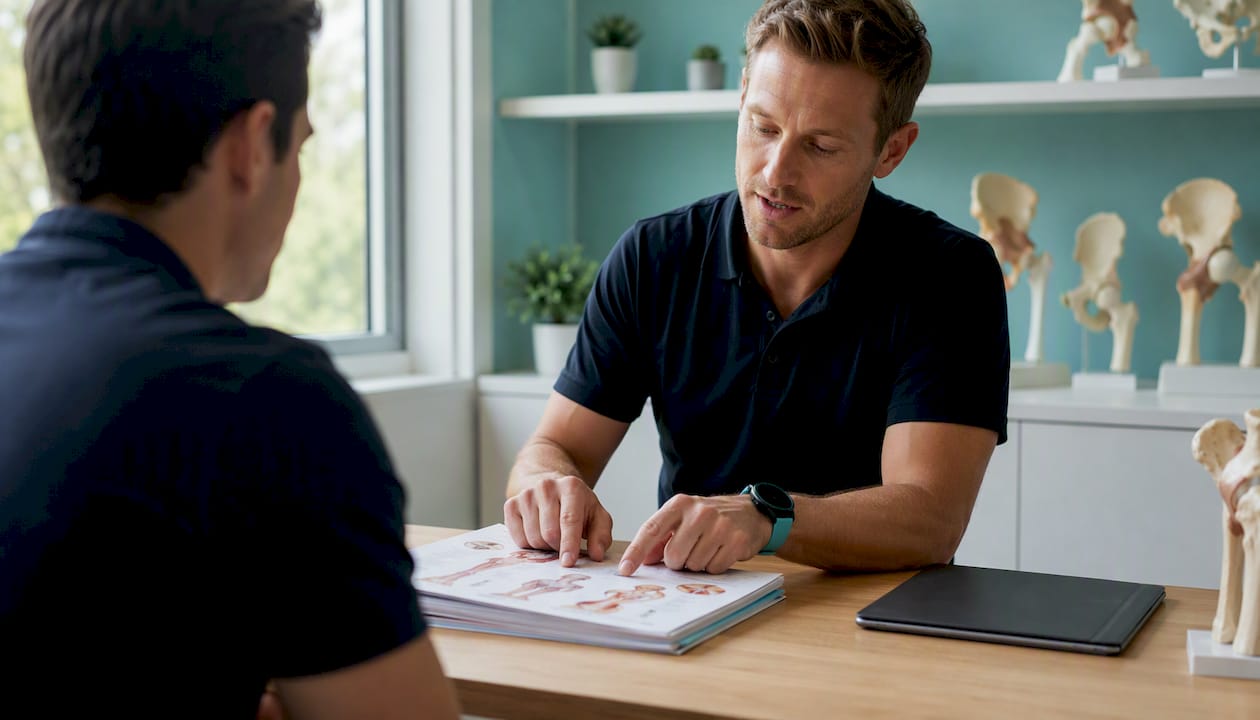
Anterior (groin) pain points toward the hip joint itself. Osteoarthritis, labral tears, and FAI all tend to produce pain in the groin or deep in the front of the hip. This is the location most associated with difficulty walking, climbing stairs, and anything involving deep hip flexion. If you feel a pinching sensation in the crease of your hip when you sit down or tie your shoes, that is a classic anterior pattern.
Lateral (outer) hip pain suggests trochanteric bursitis or gluteal tendinopathy. It is often worse lying on that side, walking on hard surfaces, or standing on one leg. People with this pattern frequently describe an ache that runs down the outside of the thigh.
Posterior (buttock) pain is trickier because it can come from the hip itself, the sacroiliac joint, or the lumbar spine. Piriformis syndrome also lives here. The key question a clinician will ask: does moving your hip reproduce it, or does bending your back reproduce it?
Thigh pain (front or back) is usually referred pain. The hip joint can refer into the front of the thigh; lumbar nerve root irritation can refer down the back of the thigh and into the calf. If your pain travels, that is important information to share.
A simple way to describe your pain to a clinician: point to the exact spot with one finger, describe whether it is a deep ache, a sharp catch, or a burning sensation, note what makes it worse (flexion, rotation, weight-bearing, lying on it), and rate it at rest versus activity. That four-part description saves a lot of time in assessment.
What happens at a hip pain assessment?
Whether you see your GP, a physiotherapist, or a specialist, the assessment follows a fairly predictable path. Knowing what to expect makes the whole thing less daunting.
Clinical history comes first. The clinician will ask which tasks you can no longer do or do with difficulty, how long the pain has been present, whether it came on gradually or after a specific incident, and what makes it better or worse. They will also ask about your general health, medications, and any previous hip or back problems.
Physical examination includes:
- Passive and active range of motion testing (how far the hip moves in each direction)
- Provocative tests such as FABER (Flexion, ABduction, External Rotation) and FADIR (Flexion, ADduction, Internal Rotation) to stress specific structures
- Gait observation and single-leg stance tests to assess abductor function and balance
- Functional performance measures: the Timed Up and Go (TUG) test, 30-second chair stand, and stair climb test are all recommended in the JOSPT-linked 2025 clinical practice guideline as validated outcome measures for hip osteoarthritis
Imaging is not always needed at first presentation. X-ray is useful for confirming osteoarthritis or fracture. MRI is indicated when soft-tissue pathology (labral tear, tendon tear, avascular necrosis) is suspected. Imaging after trauma is urgent.
Red flags that need immediate attention:
- Inability to weight-bear after a fall or trauma (possible fracture)
- Fever with severe hip pain (possible septic arthritis or infection)
- Sudden severe pain in an older adult with osteoporosis (fragility fracture)
- New neurological symptoms in the leg (weakness, numbness, loss of bladder/bowel control)
- Unexplained weight loss alongside hip pain (possible systemic or malignant cause)
If any of these apply, go to A&E or call 999. Do not wait for a routine appointment.
What treatments actually restore function?
The 2025 clinical practice guideline from the Academy of Orthopaedic Physical Therapy is pretty clear on this: individualised therapeutic exercise, manual therapy, and progressive loading are the cornerstone of hip osteoarthritis management. Not rest. Not waiting. Active rehabilitation.
Conservative first-line care
- Manual therapy: — joint mobilisation and soft-tissue techniques, typically 1–3 sessions per week over 6–12 weeks, combined with exercise to maintain gains.
- Movement therapies such as hydrotherapy and Pilates-based rehab can complement land-based exercise, particularly in the early stages when load tolerance is low.
Adjuncts that help
Paracetamol and topical NSAIDs (such as diclofenac gel) are commonly used for symptom control. Research published in the Annals of the Rheumatic Diseases found that three quarters of new primary-care hip pain patients had already used analgesics and half had used topical creams before their first appointment — which tells you something about how much pain people are managing at home. A walking stick, used correctly in the opposite hand, reduces joint load and can restore walking confidence while strength builds. Corticosteroid injections offer short-term pain relief when inflammation is significant, creating a window for rehabilitation to take hold. Shockwave therapy is a useful option for persistent trochanteric bursitis and tendinopathy.
Timelines: what to realistically expect
Most people with hip osteoarthritis or tendinopathy see meaningful improvement in pain and function within 6–12 weeks of structured rehabilitation. That is not a cure, but it is enough to get back to walking further, managing stairs, and sleeping better. More complex pathology (labral tears, FAI, fractures) has longer timelines and may require specialist input or surgery.
Surgery (total hip replacement or arthroscopic procedures) is considered when persistent functional limitation remains despite best conservative care, and when imaging confirms structural pathology that explains the mechanical limitation. It is a last resort, not a first step.
Pro Tip: Activity modification does not mean doing less. It means moving smarter. Swap high-impact loading (running on hard surfaces, heavy squats) for lower-impact alternatives (cycling, swimming, walking on softer ground) while you build hip strength. Targeted loading of the hip stabilisers corrects gait patterns and prevents further deconditioning — the goal is always to keep you moving.
Practical tips for daily tasks when your hip hurts
Small adjustments to how you do everyday things can make a real difference while you are working through rehabilitation. None of these are permanent workarounds — they are bridges to keep you functional and confident.
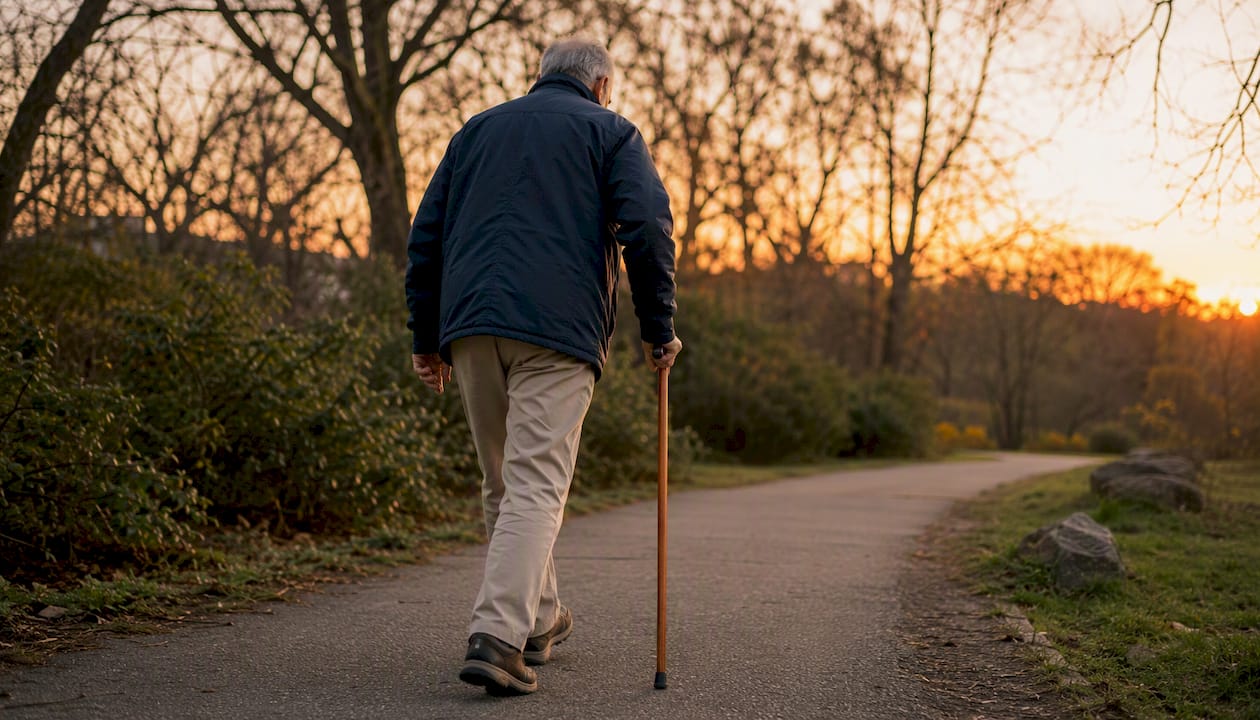
Walking: use a cane or walking stick in the hand opposite your painful hip to reduce joint load. Aim for a steady rhythm rather than rushing. Shorter, more frequent walks beat one long painful one.
Stairs: lead with your stronger leg going up ("up with the good"), and lead with the painful leg going down ("down with the bad"). Use the handrail. This is not cheating — it is smart load management.
Dressing: sit on a firm chair or the edge of the bed rather than standing on one leg. A long-handled shoehorn and a sock aid (available from most pharmacies) remove the need for deep hip flexion when putting on footwear.
Getting in and out of a car: back up to the seat, sit down first, then swing both legs in together. Reverse to exit. Raising the seat with a cushion reduces the depth of hip flexion required.
Sleeping: if lateral hip pain is the issue, avoid lying directly on the painful side. A pillow between your knees in a side-lying position reduces hip adduction and takes pressure off the outer hip structures. Lying on your back with a pillow under your knees is often the most comfortable option for joint pain.
Progressive loading habits: small doses of hip strengthening woven into daily routines work better than sporadic gym sessions. Clamshells, glute bridges, and standing hip abductions can be done in your living room in five minutes. The mobility and athletic longevity guide from HTK Training offers a useful framework for building these habits progressively.
Pro Tip: Avoid the boom-and-bust trap. It goes like this: you have a good day, do loads, pay for it the next three days. Instead, set a comfortable daily activity baseline and add 10% per week. Boring? Yes. Effective? Absolutely.
When should you actually see someone?
Good question, and one that a lot of people sit on for too long (pun intended).
Go to A&E immediately if:
- You cannot put any weight on your leg after a fall or injury
- You have a fever alongside severe hip pain (possible infection)
- You have sudden, severe hip pain and you have osteoporosis or take steroids
- You develop new weakness, numbness, or loss of bladder or bowel control
See your GP within a few days if:
- Pain is getting rapidly worse despite rest and over-the-counter pain relief
- You are increasingly relying on a walking aid or daily analgesics
- Walking and stairs are becoming progressively harder over weeks
Book a specialist physiotherapy assessment within 1–4 weeks if:
- Hip pain is limiting everyday tasks despite self-management
- You want a proper diagnosis and a structured rehabilitation plan
- You are not sure whether your pain is hip, back, or something else
The NHS hip pain guidance recommends seeing a GP if hip pain does not improve with rest, ice, and over-the-counter pain relief within a few weeks. That is a sensible baseline, but if daily tasks are already significantly affected, earlier specialist input tends to produce better outcomes.
This article is general information, not medical advice. Always confirm your specific situation with a qualified clinician or your GP.
How specialist care at Sportsinjurydublin restores hip function
At Sportsinjurydublin, the approach to hip pain starts with a thorough individualised assessment — not a generic protocol. The clinician maps exactly which tasks are limited, identifies the underlying mechanical drivers (whether that is joint stiffness, abductor weakness, altered gait, or a combination), and builds a plan around your specific activity goals.
The rehabilitation pathway typically includes:
- Manual therapy — (joint mobilisation, soft-tissue work, dry needling or dry cupping where indicated) to reduce pain and restore range of motion
Typical outcomes include improved walking tolerance, reduced pain on stairs and dressing, better single-leg balance, and fewer falls. Most people with hip osteoarthritis or tendinopathy see meaningful progress within 6–12 weeks of consistent rehabilitation. The individualised care approach matters here because the same diagnosis presents very differently in a 35-year-old runner and a 68-year-old retired teacher.
Key takeaways
Hip pain limits daily activity through three overlapping mechanisms: pain, reduced range of motion, and muscle weakness — all of which respond well to targeted, individualised rehabilitation started early.
| Point | Details |
|---|---|
| Three core mechanisms | Pain, reduced range of motion, and hip abductor weakness combine to restrict walking, stairs, and dressing. |
| Falls risk is real | Each additional hip OA impairment criterion raises fall risk by 23%, making early rehab a safety issue, not just a comfort one. |
| Conservative care works | Structured exercise and manual therapy over 6–12 weeks produces meaningful functional improvement for most adults. |
| Red flags need urgent care | Inability to weight-bear after trauma, fever with hip pain, or new neurological symptoms require immediate assessment. |
| Sportsinjurydublin | Offers individualised hip assessment, manual therapy, and progressive rehab to restore walking, stairs, and daily independence. |
The thing most people get wrong about hip pain
Most people treat hip pain as a pain problem. It is actually a movement problem that happens to hurt.
The distinction matters because it changes what you do about it. If pain is the problem, the logical response is to rest, take painkillers, and wait. And that works, briefly. But the underlying weakness, stiffness, and altered gait do not resolve with rest. They get worse. By the time someone books an appointment, they have often been managing with analgesics and avoidance for months, and the deconditioning has compounded the original problem significantly.
The other thing that gets underestimated is the psychological side. Fear of movement is not weakness or hypochondria. It is a completely rational response to a joint that has been hurting for weeks. But that fear drives avoidance, avoidance drives deconditioning, and deconditioning drives more pain. Breaking that cycle requires graded exposure to movement, not just symptom management.
What actually works is addressing all three layers simultaneously: reduce pain enough to allow movement, restore range of motion and strength through progressive loading, and rebuild confidence through task-specific practice. That is not complicated in principle. But it does require a plan that is built around your specific limitations and goals, not a generic exercise sheet.
The adults who recover best are not the ones who rest the most. They are the ones who move smarter, earlier, with guidance.
Hip pain holding you back? Here is what Sportsinjurydublin can do
If walking further, managing stairs without wincing, or simply getting dressed without a battle sounds like a reasonable goal — that is exactly what sports rehabilitation at Sportsinjurydublin is built around. The clinic offers hands-on assessment, manual therapy, dry needling, progressive strengthening, and shockwave and laser therapy for persistent tendon and soft-tissue pain — all tailored to what your hip actually needs, not a one-size-fits-all protocol.

Both in-person and online consultations are available, so you can get a proper assessment and a structured plan without waiting for a long NHS referral queue. The initial assessment covers your movement, your pain triggers, and your daily-life goals — and you leave with a clear picture of what is going on and what to do about it.
Book your assessment at sportsinjurydublin.ie/hip-pain and start moving without the wince.
Useful sources and further reading
These are the primary sources and clinical guidelines used to inform this article. Worth bookmarking if you want to go deeper.
- Hip Pain and Mobility Deficits — Hip Osteoarthritis: Revision 2025 (Academy of Orthopaedic Physical Therapy clinical practice guideline) — the most current evidence-based guideline for assessment and treatment of hip OA, including manual therapy protocols and functional outcome measures.
- JOSPT: Hip Pain and Mobility Deficits — Hip Osteoarthritis: Revision 2025 (ICF-linked) — the peer-reviewed journal version of the guideline, with validated physical performance tests (TUG, 6MWT, 30-second chair stand) and gait/balance training recommendations.
- NHS: Hip pain in adults — clear, accessible guidance on causes, self-management, and when to seek care; the standard reference for UK adults.
- Arthritis Research & Therapy: Hip OA and fall risk in older adults — peer-reviewed study linking hip OA impairment criteria to a 23% increase in fall risk per criterion; relevant for understanding the safety implications of untreated hip pain.
- Annals of the Rheumatic Diseases: Health impact of hip pain in primary care — cohort study showing early and widespread use of analgesics and walking aids in new hip pain patients; useful context for realistic timelines and functional burden.
- Yale School of Medicine: Beyond arthritis — three causes of hip pain that can lead to joint replacement — accessible review of osteonecrosis, femoral neck stress fractures, and subchondral insufficiency fractures; important for understanding non-arthritic causes.
- NHS Borders Physiotherapy: Hip pain patient information — practical NHS physiotherapy guidance on hip pain management and self-care strategies.